 I, the copyright holder of this work, hereby release it into the public domain. This applies worldwide. In case this is not legally possible, I grant anyone the right to use this work for any purpose, without any conditions, unless such conditions are required by law.

Saturday, March 20, 2010
PDP #193: Concrete River
Los Angeles is centered where it is partially because of the Los Angeles River, the city's original source of fresh water. Owing to local geography it had a tendency to meander and flood at unpredictable degrees, and so in an initiative that should come as no surprise in a place like southern California, the river was paved over and almost entirely transformed into a concrete-lined flood control channel. To me, it's just another reminder that we've been managing our environment at one scale or another for a long time - better in some ways than in others.
 I, the copyright holder of this work, hereby release it into the public domain. This applies worldwide. In case this is not legally possible, I grant anyone the right to use this work for any purpose, without any conditions, unless such conditions are required by law.
I, the copyright holder of this work, hereby release it into the public domain. This applies worldwide. In case this is not legally possible, I grant anyone the right to use this work for any purpose, without any conditions, unless such conditions are required by law.


Friday, March 19, 2010
Tunnels, Taxes, and the Law
If you've been reading this weblog for a bit you've probably realized that I am a transit booster - hell, a transit nerd, like it says in the sidebar. Whenever we had free play time in kindergarten, I would always run for the train set. So, in that spirit, I'm glad to see that transit seems to have become the major issue so far in the Toronto municipal election, whether it's Rocco Rossi's apparent vendetta against bike lanes and light rail lines, Sarah Thomson's subway boosting, or my own desire to build a transit-friendly city wherein a car is a luxury, but not a necessity.
Two days ago, Thomson unveiled her subway expansion plan, the first major platform plank I've seen from her campaign. Calling it "our key to a strong and dynamic future," Thomson proposes a burst of subway construction the likes of which this city hasn't seen since the 1960s, incorporating a full subway beneath Eglinton Avenue and a Downtown Relief Line. It's certainly a bold vision, and my main complaints with it are the Queen alignment of the DRL, and the termination of the DRL at the Bloor-Danforth line - if we're building an Eglinton line in her world, the DRL should serve both.
The thing about bold visions is that they can't be realized for pocket change. This program of construction would cost billions of dollars that the city of Toronto quite frankly doesn't have. Thomson has two proposals with which to blunt this. The first, partnering with a private corporation in order to build the line, isn't that revolutionary but is something I'm a bit leery about myself, after the London Underground's stab at a public-private partnership ended with UK taxpayers being left on the hook for nearly £2 billion after the private partner went bust.
Her second proposal is to levy tolls on the Gardiner Expressway and Don Valley Parkway, "a reasonable fee" that would be charged during peak hours on weekdays. These tolls would be wholly devoted to the subway expansion plan, and would be strictly temporary - but, then again, so was the income tax back in 1917. It's the sort of idea that other candidates haven't been talking about, and it seems to have significantly raised Thomson's profile in the last couple of days.
There's only one problem. We can't do it.
As I've mentioned before, the fundamental organizing framework of Toronto is the City of Toronto Act, 2006, passed by the Ontario legislature. This firmly establishes what the government of Toronto can do, as well as what it cannot do. One particularly important component of that, in my mind, is Section 267, Subsection 2, which establishes the taxes that the City of Toronto is not authorized to impose. There's one very critical one at the end of it.
13. A tax on the use of a highway (as defined in subsection 1 (1) of the Highway Traffic Act) by a person in respect of equipment placed under, on or over the highway for the purpose of supplying a service to the public. 2006, c. 11, Sched. A, s. 267 (2).
All right, so let's see what the Highway Traffic Act defines a highway. Legal definitions frequently don't dovetail with vernacular usages. It's a brief definition, but important:
“highway” includes a common and public highway, street, avenue, parkway, driveway, square, place, bridge, viaduct or trestle, any part of which is intended for or used by the general public for the passage of vehicles and includes the area between the lateral property lines thereof; (“voie publique”)
So, according to the laws of the province of Ontario, everything from East Liberty Street to the 401 counts as a "highway." The Gardiner Expressway and Don Valley Parkway most definitely fall into this category, and the City of Toronto Act is particularly clear on the establishment of municipal tolls - we can't do it. Unless Sarah Thomson has discovered a fourth spatial dimension and plans to use tesseracts to charge peak-hour drivers, this plank is already smoking on the campfire.
I'd love to see new subways in Toronto. To promise new subways through methods that are legally impracticable, though, does no one favors.
UPDATE 11:28 AM 03/17: I recognize that we could conceivably go to the province and get the Act amended. The problem I have is that this issue appears nowhere in Thomson's subway plan, and that ignoring this legal reality is, in my opinion, rather disingenuous.
UPDATE 11:02 AM 03/21: I am wrong. The City of Toronto Act is a far more tangled skein than I had first thought. As pointed out by one of the nameless commenters below, Section 116 presents a roadmap for working with the province to authorize road tolls, and Subsection 2 actually states that this takes precedence over what's said otherwise in the Act. I suppose a note tying Section 267 to Section 116 would have been too easy to insert while the thing was being drafted.
Two days ago, Thomson unveiled her subway expansion plan, the first major platform plank I've seen from her campaign. Calling it "our key to a strong and dynamic future," Thomson proposes a burst of subway construction the likes of which this city hasn't seen since the 1960s, incorporating a full subway beneath Eglinton Avenue and a Downtown Relief Line. It's certainly a bold vision, and my main complaints with it are the Queen alignment of the DRL, and the termination of the DRL at the Bloor-Danforth line - if we're building an Eglinton line in her world, the DRL should serve both.

The thing about bold visions is that they can't be realized for pocket change. This program of construction would cost billions of dollars that the city of Toronto quite frankly doesn't have. Thomson has two proposals with which to blunt this. The first, partnering with a private corporation in order to build the line, isn't that revolutionary but is something I'm a bit leery about myself, after the London Underground's stab at a public-private partnership ended with UK taxpayers being left on the hook for nearly £2 billion after the private partner went bust.
Her second proposal is to levy tolls on the Gardiner Expressway and Don Valley Parkway, "a reasonable fee" that would be charged during peak hours on weekdays. These tolls would be wholly devoted to the subway expansion plan, and would be strictly temporary - but, then again, so was the income tax back in 1917. It's the sort of idea that other candidates haven't been talking about, and it seems to have significantly raised Thomson's profile in the last couple of days.
There's only one problem. We can't do it.
As I've mentioned before, the fundamental organizing framework of Toronto is the City of Toronto Act, 2006, passed by the Ontario legislature. This firmly establishes what the government of Toronto can do, as well as what it cannot do. One particularly important component of that, in my mind, is Section 267, Subsection 2, which establishes the taxes that the City of Toronto is not authorized to impose. There's one very critical one at the end of it.
13. A tax on the use of a highway (as defined in subsection 1 (1) of the Highway Traffic Act) by a person in respect of equipment placed under, on or over the highway for the purpose of supplying a service to the public. 2006, c. 11, Sched. A, s. 267 (2).
All right, so let's see what the Highway Traffic Act defines a highway. Legal definitions frequently don't dovetail with vernacular usages. It's a brief definition, but important:
“highway” includes a common and public highway, street, avenue, parkway, driveway, square, place, bridge, viaduct or trestle, any part of which is intended for or used by the general public for the passage of vehicles and includes the area between the lateral property lines thereof; (“voie publique”)
So, according to the laws of the province of Ontario, everything from East Liberty Street to the 401 counts as a "highway." The Gardiner Expressway and Don Valley Parkway most definitely fall into this category, and the City of Toronto Act is particularly clear on the establishment of municipal tolls - we can't do it. Unless Sarah Thomson has discovered a fourth spatial dimension and plans to use tesseracts to charge peak-hour drivers, this plank is already smoking on the campfire.
I'd love to see new subways in Toronto. To promise new subways through methods that are legally impracticable, though, does no one favors.
UPDATE 11:28 AM 03/17: I recognize that we could conceivably go to the province and get the Act amended. The problem I have is that this issue appears nowhere in Thomson's subway plan, and that ignoring this legal reality is, in my opinion, rather disingenuous.
UPDATE 11:02 AM 03/21: I am wrong. The City of Toronto Act is a far more tangled skein than I had first thought. As pointed out by one of the nameless commenters below, Section 116 presents a roadmap for working with the province to authorize road tolls, and Subsection 2 actually states that this takes precedence over what's said otherwise in the Act. I suppose a note tying Section 267 to Section 116 would have been too easy to insert while the thing was being drafted.
Thursday, March 18, 2010
PDP #192: Spadina Like You've Never Seen It
The camera interprets and the camera lies, just like any other observer. Taking into account the functional differences between a human eye and a mechanical lens, it's no surprise that it's more obvious when the camera takes liberties with the world. I saw that sort of thing just after I took this picture, looking south out of a moving streetcar's window down Spadina Avenue. The day was bright and the sky was blue - but we'd just emerged from the shadows of buildings. Evidently the camera couldn't adjust in time. Maybe the flash of a detonating nuclear warhead would look like this - for a split second, and then everyone and everything in a position to see it so would be vaporized.
It's not the kind of picture I could have set out to take. That's one of the things, in my mind, that makes it awesome.
 I, the copyright holder of this work, hereby release it into the public domain. This applies worldwide. In case this is not legally possible, I grant anyone the right to use this work for any purpose, without any conditions, unless such conditions are required by law.
It's not the kind of picture I could have set out to take. That's one of the things, in my mind, that makes it awesome.
 I, the copyright holder of this work, hereby release it into the public domain. This applies worldwide. In case this is not legally possible, I grant anyone the right to use this work for any purpose, without any conditions, unless such conditions are required by law.
Wednesday, March 17, 2010
A Province Within A City
There's no such thing as a perfect democracy. Inevitably, instabilities will creep into the structure because humans are not robots, and are not capable of maintaining a totally smooth, entirely equitable path. This is the case in Ontario, particularly with regard to the province's relationship with the city of Toronto, home to a fair chunk of its population. Some urban boosters, myself among them, have felt that the province doesn't give the city a fair shake, and that it should secede from Ontario and become Canada's eleventh province. Yesterday, the issue was put into starker focus and propelled into a small media spotlight when Member of Provincial Parliament Bill Murdoch spoke favorably of Torontonian secession, framing it as a vehicle for Ontario to pay more attention to rural issues without megalopolitan distractions.
It's good that this is being talked about. It hasn't been in the news, really, for ten years, when ex-Mayor Mel Lastman and second-place mayoral candidate Tooker Gomberg mused about it, when the wounds from the forced amalgamation of Metropolitan Toronto were even more raw than they are today. For the record, I personally support the idea of a Province of Toronto - containing at least the inner 905 as well, for the reasons Randy McDonald elaborated on yesterday - as a way to equalize the situation that currently exists between Ontario and Toronto - but it's not something that should be, or could be, done lightly.
 You have to admit, though, it would make the snazziest parliament in the country.
Creating a Province of Toronto would be, by its very nature, a seismic shift in Canadian politics. It's been more than a hundred years since a province was created out of whole cloth in such a fashion, and it's not the sort of thing that would happen easily. The path to provincehood is fraught with obstacles - it would require the amendment of the Constitution, and considering what we had to do to get the provinces to sign the Constitution, amending it would complicate things even more - and would, in Queen's Park, brush up against the one common feature of every government on Earth: an unwillingness to relinquish authority it already possesses.
Still, something has got to give. Budgetary woes represent Toronto's biggest long-term problem at the moment, and ultimately the reason we have those woes is the government of Ontario. Beyond the issues of Queen's Park taking more tax money out of Toronto than it invests in it, beyond the concerns of city services that were once provincially-supported but are now no longer thanks to Mike the Knife, it's a simple issue of capability.
The province's City of Toronto Act, 2006 provides the legal framework under which the City of Toronto runs. While the Preamble states that "the Assembly recognizes that the City of Toronto... is an economic engine of Ontario," the Act itself scarcely allows the city the capability to maintain that engine. The list of taxes that Toronto is not permitted to levy is long, and while some - like income tax - are understandable, from much of the rest of the list I get the impression that the province is holding on to power for power's sake.
Toronto is not allowed to impose sales taxes outside of four very specific circumstances, whereas many cities or counties in the United States levy their own local sales taxes. In Los Angeles County, it's a half-cent sales tax that is financing Measure R, the Los Angeles County Metropolitan Transportation Authority's long-term, consistent revenue stream. Nor can it establish hotel taxes, road tolls, or gas taxes. One reason the billboard tax increase recently has been in the news is because those billboards are one of the few things Toronto is allowed to tax.
As a result, the city has to rely on property tax revenue in order to run. This isn't a formula that can be continued forever, particularly considering the wealth of provincial responsibilities that were unceremoniously downloaded to the cities during the Harris years. Nor can Toronto run a deficit, unlike the federal or provincial governments - so while it's Ottawa and Queen's Park that talk big about fiscal responsibility while digging themselves into deeper and deeper holes, it's Toronto and other cities that are forced to balance that responsibility with the responsibilities that have been dumped on them.
A Province of Toronto would change that, at least for Toronto. It would give the city the capacity to move at its own pace, to forge its own destiny. I think it's a valid last-ditch maneuver. In the meantime, we owe it more to ourselves and to each other to try to remedy the imbalance that currently exists - to bring a greater equitability to relationships between the province and the municipalities, to give cities and towns across Ontario the capacity to stand tall.
It's good that this is being talked about. It hasn't been in the news, really, for ten years, when ex-Mayor Mel Lastman and second-place mayoral candidate Tooker Gomberg mused about it, when the wounds from the forced amalgamation of Metropolitan Toronto were even more raw than they are today. For the record, I personally support the idea of a Province of Toronto - containing at least the inner 905 as well, for the reasons Randy McDonald elaborated on yesterday - as a way to equalize the situation that currently exists between Ontario and Toronto - but it's not something that should be, or could be, done lightly.
 You have to admit, though, it would make the snazziest parliament in the country.
Creating a Province of Toronto would be, by its very nature, a seismic shift in Canadian politics. It's been more than a hundred years since a province was created out of whole cloth in such a fashion, and it's not the sort of thing that would happen easily. The path to provincehood is fraught with obstacles - it would require the amendment of the Constitution, and considering what we had to do to get the provinces to sign the Constitution, amending it would complicate things even more - and would, in Queen's Park, brush up against the one common feature of every government on Earth: an unwillingness to relinquish authority it already possesses.
Still, something has got to give. Budgetary woes represent Toronto's biggest long-term problem at the moment, and ultimately the reason we have those woes is the government of Ontario. Beyond the issues of Queen's Park taking more tax money out of Toronto than it invests in it, beyond the concerns of city services that were once provincially-supported but are now no longer thanks to Mike the Knife, it's a simple issue of capability.
The province's City of Toronto Act, 2006 provides the legal framework under which the City of Toronto runs. While the Preamble states that "the Assembly recognizes that the City of Toronto... is an economic engine of Ontario," the Act itself scarcely allows the city the capability to maintain that engine. The list of taxes that Toronto is not permitted to levy is long, and while some - like income tax - are understandable, from much of the rest of the list I get the impression that the province is holding on to power for power's sake.
Toronto is not allowed to impose sales taxes outside of four very specific circumstances, whereas many cities or counties in the United States levy their own local sales taxes. In Los Angeles County, it's a half-cent sales tax that is financing Measure R, the Los Angeles County Metropolitan Transportation Authority's long-term, consistent revenue stream. Nor can it establish hotel taxes, road tolls, or gas taxes. One reason the billboard tax increase recently has been in the news is because those billboards are one of the few things Toronto is allowed to tax.
As a result, the city has to rely on property tax revenue in order to run. This isn't a formula that can be continued forever, particularly considering the wealth of provincial responsibilities that were unceremoniously downloaded to the cities during the Harris years. Nor can Toronto run a deficit, unlike the federal or provincial governments - so while it's Ottawa and Queen's Park that talk big about fiscal responsibility while digging themselves into deeper and deeper holes, it's Toronto and other cities that are forced to balance that responsibility with the responsibilities that have been dumped on them.
A Province of Toronto would change that, at least for Toronto. It would give the city the capacity to move at its own pace, to forge its own destiny. I think it's a valid last-ditch maneuver. In the meantime, we owe it more to ourselves and to each other to try to remedy the imbalance that currently exists - to bring a greater equitability to relationships between the province and the municipalities, to give cities and towns across Ontario the capacity to stand tall.
Tuesday, March 16, 2010
PDP #191: St. Clair West, 2008
I always get a bit of a thrill when I leaf back through my photo archives - around seventeen thousand pieces in thirty-six gigabytes, going back to 2003, so it takes a hell of a lot of leafing sometimes - and find a photograph that, for some reason or another, can no longer be taken. It's a reminder that the world around us, however stable it may seem at a look, is nevertheless in flux. Take this photo of St. Clair Avenue West, which I took in the beginning of August 2008. The completion of right-of-way construction there was still more than a year away. It would not be possible to take this photograph anymore, and I feel as if that makes it important.
Granted, 2008 doesn't exactly feel like history. Nevertheless, it's every bit as inaccessible to us as 1908, or 2008 BCE. It's not as if we can hop back there for a larf if we feel like it - we have to build the time machine first, you know.
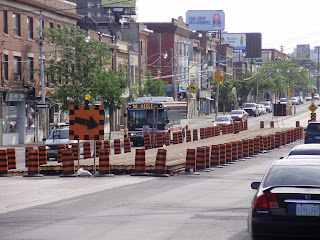 I, the copyright holder of this work, hereby release it into the public domain. This applies worldwide. In case this is not legally possible, I grant anyone the right to use this work for any purpose, without any conditions, unless such conditions are required by law.
Granted, 2008 doesn't exactly feel like history. Nevertheless, it's every bit as inaccessible to us as 1908, or 2008 BCE. It's not as if we can hop back there for a larf if we feel like it - we have to build the time machine first, you know.
 I, the copyright holder of this work, hereby release it into the public domain. This applies worldwide. In case this is not legally possible, I grant anyone the right to use this work for any purpose, without any conditions, unless such conditions are required by law.
Monday, March 15, 2010
Engineering Instability
The concept of climate change is not a new thing. The scientific community has been speculating about it for decades and the idea of global warming - generally expressed in terms of sea level rise, since that's the most easily deduced effect - has been going strong for at least twenty years. I remember encountering it in my youth, in school and in popular entertainment that assumed Earth of the future would have a severely, obviously compromised environment.
To listen to the people who are railing about it today, though, you'd think climate change is something a bunch of bored scientists created one morning out of whole cloth. Not only is that idea ridiculous, it's dangerous - unless you're denying that carbon dioxide is a warming agent, which is an entirely different level of willful blindness - and I, personally, am tired of people and corporations that made bank from the time of free-wheeling, uncaring hubris we call "the twentieth century" working to secure that gravy train even as they destabilize the future.
Fortunately, I don't think this will be happening forever. There are two plausible reasons I can think of to explain why climate change skepticism has the strength it does today - because the actions that we would need to take to mitigate our impact on the environment would "negatively" impact current vested interests, in that they would stand to make less money than they do now, and because our effects are not yet patently obvious. There's going to be a tipping point in the public consciousness eventually - the only question is whether or not it'll come before or after the environmental tipping point. Personally, I think photos from orbit of an Arctic without ice may well be what catalyzes that, and at the rate things have been going I expect those pictures to be taken within the next ten years.
Things will change. Attitudes will shift, on both sides.
 This chimney is not, so far as I know, emitting sulfur dioxide. But one day ones like it might be.
You may have heard of geoengineering, either on this weblog or elsewhere. To put it bluntly, geoengineering is terraforming Earth - that is, humanity taking an active role in the management of the planetary biosphere. At this point I feel it's necessary, part of our maturation as a species; we're at a stage where we're going to affect the environment no matter what we do, so we might as well invest in our future by keeping it as stable as we can. That having been said, though, geoengineering is not perfect. Throwing new variables into an already complex situation can easily produce chaos.
But when the alternative is watching those billions of tons of methane sequestered in Arctic permafrost be vented into the atmosphere, I'll take the chance of chaos. The most likely method of early geoengineering, because it's comparatively cheap, will probably be stratospheric injection of sulfur dioxide to create a cooling effect - the same sulfur dioxide, incidentally, which helps create acid rain.
Whoops. So there's a ready-made reason for people to oppose that flavor of geoengineering, and perhaps by extension all geoengineering - considering the degree to which environmental groups have, in my opinion, harmed the environmental cause by standing so squarely against nuclear power, I find that a pretty likely outcome. But that doesn't account for everyone. What about the sort of people who are, right now, strenuously objecting to the very concept of climate change, dismissing it as a hoax to line Al Gore's pockets? They're not all going to change their minds.
What I think is possible is that more and more people will come over to the notion that climate change is happening - but where today they deny it, tomorrow they will argue that climate change is a good thing. It's already begun, in fits and starts, and I've heard dubious claims that it would lengthen growing seasons in northern latitudes - somehow, though, I doubt it would magically make that northern soil sufficiently fertile for large-scale agriculture. I can even see governments taking up this notion, and actively working against geoengineering projects - from putting up diplomatic roadblocks in the United Nations or wherever, to actual sabotage of geoengineering installations, because, you know, climate change is somehow in the national interest.
Though it would greatly upset me, it would not surprise me - particularly given its track record in the last ten years - to see the government of Canada leading this charge. It might have been funny when Mordecai Richler joked about it in the 1990s, about selling Prince Edward Island to the Japanese just before it was submerged beneath rising sea levels and building seaside resorts in Inuvik.
Now, though, things are serious, and I'm disturbed at the great number of people who seem to think that everything is just a-OK.
To listen to the people who are railing about it today, though, you'd think climate change is something a bunch of bored scientists created one morning out of whole cloth. Not only is that idea ridiculous, it's dangerous - unless you're denying that carbon dioxide is a warming agent, which is an entirely different level of willful blindness - and I, personally, am tired of people and corporations that made bank from the time of free-wheeling, uncaring hubris we call "the twentieth century" working to secure that gravy train even as they destabilize the future.
Fortunately, I don't think this will be happening forever. There are two plausible reasons I can think of to explain why climate change skepticism has the strength it does today - because the actions that we would need to take to mitigate our impact on the environment would "negatively" impact current vested interests, in that they would stand to make less money than they do now, and because our effects are not yet patently obvious. There's going to be a tipping point in the public consciousness eventually - the only question is whether or not it'll come before or after the environmental tipping point. Personally, I think photos from orbit of an Arctic without ice may well be what catalyzes that, and at the rate things have been going I expect those pictures to be taken within the next ten years.
Things will change. Attitudes will shift, on both sides.
 This chimney is not, so far as I know, emitting sulfur dioxide. But one day ones like it might be.
You may have heard of geoengineering, either on this weblog or elsewhere. To put it bluntly, geoengineering is terraforming Earth - that is, humanity taking an active role in the management of the planetary biosphere. At this point I feel it's necessary, part of our maturation as a species; we're at a stage where we're going to affect the environment no matter what we do, so we might as well invest in our future by keeping it as stable as we can. That having been said, though, geoengineering is not perfect. Throwing new variables into an already complex situation can easily produce chaos.
But when the alternative is watching those billions of tons of methane sequestered in Arctic permafrost be vented into the atmosphere, I'll take the chance of chaos. The most likely method of early geoengineering, because it's comparatively cheap, will probably be stratospheric injection of sulfur dioxide to create a cooling effect - the same sulfur dioxide, incidentally, which helps create acid rain.
Whoops. So there's a ready-made reason for people to oppose that flavor of geoengineering, and perhaps by extension all geoengineering - considering the degree to which environmental groups have, in my opinion, harmed the environmental cause by standing so squarely against nuclear power, I find that a pretty likely outcome. But that doesn't account for everyone. What about the sort of people who are, right now, strenuously objecting to the very concept of climate change, dismissing it as a hoax to line Al Gore's pockets? They're not all going to change their minds.
What I think is possible is that more and more people will come over to the notion that climate change is happening - but where today they deny it, tomorrow they will argue that climate change is a good thing. It's already begun, in fits and starts, and I've heard dubious claims that it would lengthen growing seasons in northern latitudes - somehow, though, I doubt it would magically make that northern soil sufficiently fertile for large-scale agriculture. I can even see governments taking up this notion, and actively working against geoengineering projects - from putting up diplomatic roadblocks in the United Nations or wherever, to actual sabotage of geoengineering installations, because, you know, climate change is somehow in the national interest.
Though it would greatly upset me, it would not surprise me - particularly given its track record in the last ten years - to see the government of Canada leading this charge. It might have been funny when Mordecai Richler joked about it in the 1990s, about selling Prince Edward Island to the Japanese just before it was submerged beneath rising sea levels and building seaside resorts in Inuvik.
Now, though, things are serious, and I'm disturbed at the great number of people who seem to think that everything is just a-OK.
Sunday, March 14, 2010
PDP #190: First, Go East
I've mentioned before that while I was in Los Angeles, I found the streetscape there at best indifferent to pedestrians - at least, the parts of it I have personal experience with. The only place where this wasn't the case was Hollywood Boulevard, and considering that it's Hollywood Boulevard and thus one of the city's major tourist draws, it sort of stands apart from the rest - and even then, it's pretty much only the bit between Vine and La Brea. Elsewhere, I tended to get a rather "suburban" vibe from the cityscape, optimized for the car and not used so much by people on their own two legs.
One such place was East 1st Street, where I took this photo. The new Gold Line Extension runs along the street, and it's a stone's throw from downtown Los Angeles - and yet I encountered maybe two pedestrians between Little Tokyo/Arts District and Pico/Aliso. It's probably because I'm contrasting it to Toronto, where pretty much any neighborhood within easy sight of the downtown core is pedestrian-friendly and thrumming with people, that it seems so sparse.
 I, the copyright holder of this work, hereby release it into the public domain. This applies worldwide. In case this is not legally possible, I grant anyone the right to use this work for any purpose, without any conditions, unless such conditions are required by law.
One such place was East 1st Street, where I took this photo. The new Gold Line Extension runs along the street, and it's a stone's throw from downtown Los Angeles - and yet I encountered maybe two pedestrians between Little Tokyo/Arts District and Pico/Aliso. It's probably because I'm contrasting it to Toronto, where pretty much any neighborhood within easy sight of the downtown core is pedestrian-friendly and thrumming with people, that it seems so sparse.
 I, the copyright holder of this work, hereby release it into the public domain. This applies worldwide. In case this is not legally possible, I grant anyone the right to use this work for any purpose, without any conditions, unless such conditions are required by law.
Saturday, March 13, 2010
For All Nails #301
Before I was a science fiction writer, I was a follower of alternate history - a subgenre of speculative fiction placed in settings where the actual flow of history took a different course than it did in our textbooks. Sliders, the worldhoppingest of Nineties Adventure Shows, introduced me to the concept, and the Internet exposed me to a world of it - sites such as Kedamono's Alternate History Travel Guides and many others that have since been lost, but the core of it was the Usenet newsgroup soc.history.what-if. Timelines such as President Chester A. Arthur's For All Time, a supremely dystopian unfolding of the Cold War, took my interest, and projects like For All Nails sealed it.
For All Nails is a collaborative extension of the richly detailed alternate history set out by Robert Sobel in 1973's For Want of a Nail, where a British victory at the Battle of Saratoga in 1777 led to the end of the American Revolution and a vastly altered North America, one dominated by the British-influenced Confederation of North America and its great rival, the United States of Mexico. Sobel's summation of the history left off in the early 1970s. In late 2001, Noel Maurer started the project where Sobel left off, and intended to take it to the 21st century. It eventually attracted more than a dozen contributors, including Randy McDonald of A Bit More Detail, and by the time I stumbled into the project in 2003, more than two hundred and fifty posts had been made.
Shortly thereafter, it seems, the project lost steam barely having made it to the 1980s. I wrote a few posts focusing on Quebec - in this alternate history, a semi-independent associate of the Confederation of North America - and left one unfinished. I began work on it on October 5, 2004, but it lay fallow until late September 2009, when I returned to it and completed it. The most recent post, FAN #300, was made on July 26, 2005.
Five years is a long time. I'm not sure what kind of a reaction it would get on soc.history.what-if. Still, I can't abide something going unseen - so, for better or for worse, it'll at least be live here.
For All Nails #301: An Independent Quebec Within a United CNA
"The greatest failure of the Bastien government was that, in seeking to please everyone, it succeeded in pleasing no one. While Sir Geoffrey Gold, eager to salvage something out of the CNA's Executive Revision debacle[1], was quick to approve Quebec's petition for its own Viceroy, there were many in Quebec who were unsatisfied with the arrangement. In requesting and welcoming Sir Albert Hardy as Viceroy, Bastien reminded Quebec of ties to Britain that many would prefer to have forgotten."
- From _It Began With A Whisper: A History of the Quebec Crisis_ by Michael Deschamps. Dorchester: Upcountry Press, 1997.
*****
Dorchester House
Quebec City, Associated Confederation of Quebec
16 June 1977
One could be forgiven for thinking that the residence of the Honourable Sir Albert Hardy, Viceroy of Quebec, had seen better days. Sir Albert himself certainly thought so. The place had been built while Queen Victoria was in power, and aside from a rather hasty renovation that had characterized the first fortnight of his occupancy in Dorchester House, he didn't imagine it had been well kept up since then. In one of his more contemplative moods, he'd realized that it was eminently logical. After all, from what better place could he watch over the slum of a continent than a dilapidated mansion?
A year of living in his "temporary lodgings" had hardened his spirits. His official residence, the Palais du Québec - he had preferred "Viceregal Palace," but had been overruled - was little more than a wooden frame in undeveloped parkland. The most hopeful estimates didn't anticipate it would be ready for another five years, at least. The contractors called it a regrettable necessity in light of the Viceroy's august office. The Viceroy himself called it shiftlessness. With a hundred years of internal sovereignty behind them, and North America at their doorstep, Sir Albert wondered how they could have fallen so far.
Of course, that wasn't to say that recent events had proved the Johnnies down south to be much better. The people of Quebec knew where their true loyalties ought to lie, even if North America had forgotten.
A hard rap at the door put paid to those thoughts. Sir Albert put down the memorandum he'd tried to read five times and of which he'd retained not one line and signalled his watchman to let the scandalmonger in. Luther Macpherson, a stout, competent Scot who'd proven his grit on blood-soaked French fields, entered with a notebook-clutching, fire-eyed young lady in a knee-length skirt and knitted blouse in all the colors of Quebec's damnable flag. All that London had done for them, and not even a hint of the Union Jack that had made it all possible.
"Your Excellency," she said, offering an obviously-practiced curtsey. "It's a privilege to meet you. I'm Eve Devlin, of the Frontenac[2] _Intrepid_."
"Madame," Sir Albert said as he rose from his chair. He clasped her hand for a moment and found it nearly as hot as coal fresh from the furnace. "I hope you'll understand that this interview must be brief by necessity. Would that you were the only demand on my time."
"Brevity is my job, Excellency," Devlin said. Young and shapely, she was, the sort of woman for whom those scandalous Mexican costumes were made, and most likely a calculated maneuver by her editor. He'd hardly be the first man to have a few wrong words slip out. "May I be seated?"
Sir Albert motioned to a rickety, uneven chair, the only other one in the room. Few visitors had the inclination to prolong meetings after a few moments balancing on it. With luck, she'd ask the sort of questions that would allow him to trot the same old answers out for a ride around the stables.
Did he see further friction between London and Burgoyne? No, he said, Britain has always been ready for North America to choose its own path. Will he be active in pursuing greater cooperation between Quebec and Britain? Of course, he said, and he'd taken a primary role in the continued cooperative development of hydroelectric stations at Gallivan Falls.[3] Devlin asked sharp questions, and he thought it a shame they'd only appear in some upcountry rag of a newspaper.
"What's your opinion on Quebec's decision to retain its ties to the United Kingdom separately from the CNA?"
"I'd call it a recognition of historical connexions, and one that remains most welcome in London," Sir Albert said. "My presence as Viceroy of Quebec is a recognition of the role the United Kingdom played in ensuring Quebec's continuity as a distinct culture on this continent. Without British aid, you would have been helpless against Fanchon and his heirs, and hopeless to maintain its unique identity without being subsumed into the greater whole of North America."
"You might have some people disagree with you on that, Excellency," Devlin said. "I don't believe there's a nation on this Earth as stubborn as the Quebecois. Nevertheless, I--"
"I'm sorry, madame, but I'll have to stop you there," Sir Albert said, raising one hand. "I've given you twenty minutes now, and I think I've been more than generous. I'm certain you've collected enough material today for an entire series of articles. For myself, as I said, important matters of state do not wait, not even in the company of beautiful women."
Devlin blushed. "I'm thankful for your time, Excellency. It was a privilege and an honour."
Sir Albert thanked her and let Macpherson lead her out. He returned to the memoranda, and the files, and the requests for services and signatures that piled his desk, and kept his back to the wall. He couldn't help but think she'd find some way to pound his words into a knife.
*********
From the Frontenac _Intrepid_, Page A1
20 June 1977
QUEBEC "HELPLESS AND HOPELESS" WITHOUT BRITAIN: VICEROY
*********
[1] See FAN #253.
[2] OTL Toronto, Ontario. Given the differing patterns of settlement in eastern Canada due to the lack of United Empire Loyalists, among other changes, Frontenac is a far smaller and lower-profile city than Toronto was even in 1977, when the Anglophone exodus from Montreal had only just begun.
[3] OTL Churchill Falls, Labrador. They weren't discovered until after the POD in any event, and had a succession of names before being renamed after Winston in 1965. Here they're named after Ezra Gallivan, who is still fondly looked upon in Quebec for his role in the 1889 plebiscite. Owing to Quebec's access to Niagara Falls and multiple dammable Ontario rivers in the FaNTL, as well as more limited historic industrialization, there was less motivation to tap the falls' potential as early as in OTL.
For All Nails is a collaborative extension of the richly detailed alternate history set out by Robert Sobel in 1973's For Want of a Nail, where a British victory at the Battle of Saratoga in 1777 led to the end of the American Revolution and a vastly altered North America, one dominated by the British-influenced Confederation of North America and its great rival, the United States of Mexico. Sobel's summation of the history left off in the early 1970s. In late 2001, Noel Maurer started the project where Sobel left off, and intended to take it to the 21st century. It eventually attracted more than a dozen contributors, including Randy McDonald of A Bit More Detail, and by the time I stumbled into the project in 2003, more than two hundred and fifty posts had been made.
Shortly thereafter, it seems, the project lost steam barely having made it to the 1980s. I wrote a few posts focusing on Quebec - in this alternate history, a semi-independent associate of the Confederation of North America - and left one unfinished. I began work on it on October 5, 2004, but it lay fallow until late September 2009, when I returned to it and completed it. The most recent post, FAN #300, was made on July 26, 2005.
Five years is a long time. I'm not sure what kind of a reaction it would get on soc.history.what-if. Still, I can't abide something going unseen - so, for better or for worse, it'll at least be live here.
#
For All Nails #301: An Independent Quebec Within a United CNA
"The greatest failure of the Bastien government was that, in seeking to please everyone, it succeeded in pleasing no one. While Sir Geoffrey Gold, eager to salvage something out of the CNA's Executive Revision debacle[1], was quick to approve Quebec's petition for its own Viceroy, there were many in Quebec who were unsatisfied with the arrangement. In requesting and welcoming Sir Albert Hardy as Viceroy, Bastien reminded Quebec of ties to Britain that many would prefer to have forgotten."
- From _It Began With A Whisper: A History of the Quebec Crisis_ by Michael Deschamps. Dorchester: Upcountry Press, 1997.
*****
Dorchester House
Quebec City, Associated Confederation of Quebec
16 June 1977
One could be forgiven for thinking that the residence of the Honourable Sir Albert Hardy, Viceroy of Quebec, had seen better days. Sir Albert himself certainly thought so. The place had been built while Queen Victoria was in power, and aside from a rather hasty renovation that had characterized the first fortnight of his occupancy in Dorchester House, he didn't imagine it had been well kept up since then. In one of his more contemplative moods, he'd realized that it was eminently logical. After all, from what better place could he watch over the slum of a continent than a dilapidated mansion?
A year of living in his "temporary lodgings" had hardened his spirits. His official residence, the Palais du Québec - he had preferred "Viceregal Palace," but had been overruled - was little more than a wooden frame in undeveloped parkland. The most hopeful estimates didn't anticipate it would be ready for another five years, at least. The contractors called it a regrettable necessity in light of the Viceroy's august office. The Viceroy himself called it shiftlessness. With a hundred years of internal sovereignty behind them, and North America at their doorstep, Sir Albert wondered how they could have fallen so far.
Of course, that wasn't to say that recent events had proved the Johnnies down south to be much better. The people of Quebec knew where their true loyalties ought to lie, even if North America had forgotten.
A hard rap at the door put paid to those thoughts. Sir Albert put down the memorandum he'd tried to read five times and of which he'd retained not one line and signalled his watchman to let the scandalmonger in. Luther Macpherson, a stout, competent Scot who'd proven his grit on blood-soaked French fields, entered with a notebook-clutching, fire-eyed young lady in a knee-length skirt and knitted blouse in all the colors of Quebec's damnable flag. All that London had done for them, and not even a hint of the Union Jack that had made it all possible.
"Your Excellency," she said, offering an obviously-practiced curtsey. "It's a privilege to meet you. I'm Eve Devlin, of the Frontenac[2] _Intrepid_."
"Madame," Sir Albert said as he rose from his chair. He clasped her hand for a moment and found it nearly as hot as coal fresh from the furnace. "I hope you'll understand that this interview must be brief by necessity. Would that you were the only demand on my time."
"Brevity is my job, Excellency," Devlin said. Young and shapely, she was, the sort of woman for whom those scandalous Mexican costumes were made, and most likely a calculated maneuver by her editor. He'd hardly be the first man to have a few wrong words slip out. "May I be seated?"
Sir Albert motioned to a rickety, uneven chair, the only other one in the room. Few visitors had the inclination to prolong meetings after a few moments balancing on it. With luck, she'd ask the sort of questions that would allow him to trot the same old answers out for a ride around the stables.
Did he see further friction between London and Burgoyne? No, he said, Britain has always been ready for North America to choose its own path. Will he be active in pursuing greater cooperation between Quebec and Britain? Of course, he said, and he'd taken a primary role in the continued cooperative development of hydroelectric stations at Gallivan Falls.[3] Devlin asked sharp questions, and he thought it a shame they'd only appear in some upcountry rag of a newspaper.
"What's your opinion on Quebec's decision to retain its ties to the United Kingdom separately from the CNA?"
"I'd call it a recognition of historical connexions, and one that remains most welcome in London," Sir Albert said. "My presence as Viceroy of Quebec is a recognition of the role the United Kingdom played in ensuring Quebec's continuity as a distinct culture on this continent. Without British aid, you would have been helpless against Fanchon and his heirs, and hopeless to maintain its unique identity without being subsumed into the greater whole of North America."
"You might have some people disagree with you on that, Excellency," Devlin said. "I don't believe there's a nation on this Earth as stubborn as the Quebecois. Nevertheless, I--"
"I'm sorry, madame, but I'll have to stop you there," Sir Albert said, raising one hand. "I've given you twenty minutes now, and I think I've been more than generous. I'm certain you've collected enough material today for an entire series of articles. For myself, as I said, important matters of state do not wait, not even in the company of beautiful women."
Devlin blushed. "I'm thankful for your time, Excellency. It was a privilege and an honour."
Sir Albert thanked her and let Macpherson lead her out. He returned to the memoranda, and the files, and the requests for services and signatures that piled his desk, and kept his back to the wall. He couldn't help but think she'd find some way to pound his words into a knife.
*********
From the Frontenac _Intrepid_, Page A1
20 June 1977
QUEBEC "HELPLESS AND HOPELESS" WITHOUT BRITAIN: VICEROY
*********
[1] See FAN #253.
[2] OTL Toronto, Ontario. Given the differing patterns of settlement in eastern Canada due to the lack of United Empire Loyalists, among other changes, Frontenac is a far smaller and lower-profile city than Toronto was even in 1977, when the Anglophone exodus from Montreal had only just begun.
[3] OTL Churchill Falls, Labrador. They weren't discovered until after the POD in any event, and had a succession of names before being renamed after Winston in 1965. Here they're named after Ezra Gallivan, who is still fondly looked upon in Quebec for his role in the 1889 plebiscite. Owing to Quebec's access to Niagara Falls and multiple dammable Ontario rivers in the FaNTL, as well as more limited historic industrialization, there was less motivation to tap the falls' potential as early as in OTL.
Friday, March 12, 2010
PDP #189: Closing Time
Bay Street is the anchor of downtown Toronto's financial district, Wall Street's Canadian counterpart, and a center of employment for tens of thousands of people at least. It also provides direct pedestrian access to Union Station, the hub of GO Transit's commuter rail network, and no small number of those tens of thousands live in surrounding communities. That being the case, then, once the clock strikes past 5, the sidewalks of Bay Street come alive with office workers pouring out of their towers and heading south. What's in the photograph is actually rather light traffic for the time of day. It's even more awe-inspiring in the morning, a few minutes before 9.
Also, take note: this post is best accompanied by Semisonic's "Closing Time" in MIDI. Not CD or MP3; the MIDI format is one that will never die.
 I, the copyright holder of this work, hereby release it into the public domain. This applies worldwide. In case this is not legally possible, I grant anyone the right to use this work for any purpose, without any conditions, unless such conditions are required by law.
Also, take note: this post is best accompanied by Semisonic's "Closing Time" in MIDI. Not CD or MP3; the MIDI format is one that will never die.
 I, the copyright holder of this work, hereby release it into the public domain. This applies worldwide. In case this is not legally possible, I grant anyone the right to use this work for any purpose, without any conditions, unless such conditions are required by law.
Thursday, March 11, 2010
No One Way to Live
Pluralism is the foundation of democracy. A society like ours, one that is meant to run by the consent of the governed and where the governed are the meant to be the ultimate deciders, cannot afford to move forward with tunnel vision. This is going to become particularly true in Toronto in over the next twenty years, by which time the term "visible minority" will cease to have effective meaning - because there won't be a minority anymore, not in the way the term's traditionally been defined. In 2031, Toronto will be a city of pluralities.
One of the results this may have is that, depending on the degree to which new immigrant populations add to Toronto's cultural mosaic, there is the possibility for friction between established values and ones that are brought by immigrant populations. The most blatant example of this are honor killings, which are thankfully extremely rare and thus tend to whip up popular anger and get front-page coverage for days when they happen. Still, though, friction wouldn't be anything new. Even within totally homogeneous populations, there's plenty of room for people to get hung up on what they think is right and what they think is horrible.
Case in point: Rahway, New Jersey. Last week, this suburb of New York City made headlines over the nude snowwoman sculpture a family had made there. First off, there was absolutely nothing prurient about it; it was no more sexually charged than anything you'd find in the Royal Ontario Museum. Nevertheless, the builders were requested by police to cover it up - which they did, with bikini and sarong - and it's since been demolished due to rising temperatures. What really tweaks my irritation about this situation, though, is the why the police became involved in the first place.
Namely, that they had received an anonymous complaint.
My own feeling is that anonymous complaints, when used in this manner, cut to the bone against the democratic process. Because so many organizations are so absurdly sensitive and so unwilling to even inadvertently cause offense, it does not take very many "complaints" at all for the objects of the complaints to be dealt with swiftly, and harshly. Here, it only took one. The question which I haven't seen anyone asking about this, though, is simple - what right does one person have to demand the world be shaped a certain way?
I've been thinking about this for a while, on and off, and my answer has always been the same - none. To put it bluntly, "no one has the right to not be offended." As the population of Toronto shifts in character, more people and more cultures will set down roots here, and there will always be people who find something to be offended about in those new people and new cultures. But outside of circumstances where people are being put at risk or laws are being broken, we have no right to demand that they conform to us in every single measure. I'll agree that there are some common groundings that are necessary for a population to come together as a coherent whole, but there's great room for variation as well.
To insist that everyone live the same way as oneself is a long step along the authoritarian path. Too often, authoritarianism has been what immigrants have come here to escape from.
One of the results this may have is that, depending on the degree to which new immigrant populations add to Toronto's cultural mosaic, there is the possibility for friction between established values and ones that are brought by immigrant populations. The most blatant example of this are honor killings, which are thankfully extremely rare and thus tend to whip up popular anger and get front-page coverage for days when they happen. Still, though, friction wouldn't be anything new. Even within totally homogeneous populations, there's plenty of room for people to get hung up on what they think is right and what they think is horrible.
Case in point: Rahway, New Jersey. Last week, this suburb of New York City made headlines over the nude snowwoman sculpture a family had made there. First off, there was absolutely nothing prurient about it; it was no more sexually charged than anything you'd find in the Royal Ontario Museum. Nevertheless, the builders were requested by police to cover it up - which they did, with bikini and sarong - and it's since been demolished due to rising temperatures. What really tweaks my irritation about this situation, though, is the why the police became involved in the first place.
Namely, that they had received an anonymous complaint.
My own feeling is that anonymous complaints, when used in this manner, cut to the bone against the democratic process. Because so many organizations are so absurdly sensitive and so unwilling to even inadvertently cause offense, it does not take very many "complaints" at all for the objects of the complaints to be dealt with swiftly, and harshly. Here, it only took one. The question which I haven't seen anyone asking about this, though, is simple - what right does one person have to demand the world be shaped a certain way?
I've been thinking about this for a while, on and off, and my answer has always been the same - none. To put it bluntly, "no one has the right to not be offended." As the population of Toronto shifts in character, more people and more cultures will set down roots here, and there will always be people who find something to be offended about in those new people and new cultures. But outside of circumstances where people are being put at risk or laws are being broken, we have no right to demand that they conform to us in every single measure. I'll agree that there are some common groundings that are necessary for a population to come together as a coherent whole, but there's great room for variation as well.
To insist that everyone live the same way as oneself is a long step along the authoritarian path. Too often, authoritarianism has been what immigrants have come here to escape from.
Subscribe to:
Posts (Atom)