I was flipping through the channels on the hotel television last night, and what did I light upon but the Fox Business Network, one of the arms of the Fox News empire? I was drawn in by the spectacle immediately--since Fox News doesn't have a Canadian presence, all I know of it is its reputation, but a few moments of watching demonstrated that some reputations are not without merit.
The show was Lou Dobbs Tonight, and the current segment was an interview with Stanley Kurtz, author of Spreading the Wealth: How Obama is Robbing the Suburbs to Pay for the Cities, which has gotta be one of the most unbiased titles I've ever seen, what? The thrust of Kurtz's argument was simple: Barack Obama wants to get rid of American suburbs. Why? Well, because he's a Democrat, I suppose, and according to Fox this is bad because "America is a suburban nation."
As interviews go, it wasn't much; Dobbs asked softball questions while Kurtz fulminated about how a second term for President Obama would see a Sustainable Communities Initiative used to "hold federal aid hostage" in a bid to encourage people to move from suburbs to cities, and that he would preside over a "redistribution of tax money" by "[forcing] regional tax base sharing on suburbs."
This is not a revolutionary idea. Even in the segment they acknowledged that something of the sort is currently used in Minneapolis-St. Paul, and it sounds similar to what happens in Metro Vancouver--Surrey is nothing if not a suburb, after all--or the regional municipalities of the Greater Toronto Area. In the eyes of Fox, though, it's anathema. "Redistribution," I've come to conclude, is one of those heavily loaded words in American political parlance, and it sounds very much like one of those data points that would be eagerly picked up on by people who claim that President Obama is a Marxist.
Which itself, incidentally, is a ridiculous idea. If he was really a Marxist he would've made it clear by now--I mean, look at the banks. Why would a Marxist president not just nationalize them when given such a sterling opportunity? Claims that he's waiting for the second term are ridiculous; even now there's no guarantee that he'll get it, since Nate Silver gives Romney and Ryan a little less than one chance in three right now. But I digress.
What I found interesting about this was the unspoken assumption that tied it all together: that the suburbs are economically independent, the "rugged individualists" of settlements, and that asking them to combine their tax bases with those of cities is stealing from them. Indeed, if you don't look at the numbers too hard it's easy to think that suburbs are independent--but that overlooks a lot. The biggest thing is that the suburbs were subsidized from the get-go, and still are today; it can be expensive to provide necessary services such as sewer, water, power, garbage collection, road maintenance, and so on due to the scale of some low-density communities, after all. Some suburbs have larger footprints than major metropolises, but they don't have the capacity to generate tax revenue the same way dense cities can. For a lot of suburbs, the natural choice is to build out because building out brings in more property tax revenue... except that brings further costs due to the extension of those services.
I don't think regional coordination of tax revenues would be a bad idea, because with the spread of suburbs plenty of things are regional--it's the standard sort of refrain you hear in Toronto, with people complaining about 905ers filling the roads and the subways to get to work and back without paying the taxes that maintain them. Nor do I think there's any need for active federal intervention to get people to move out of the suburbs. As the gasoline that the suburbs are founded on becomes more expensive, they will shift into more tenable patterns. It doesn't matter if the United States is a "suburban nation" now. Just because the United States, or any country, can be described in a certain way now, it doesn't mean that it should continue along the same trajectory indefinitely. Sameness breeds stagnation.
Though that might explain why Lou Dobbs was so opinionated about the extension of a federal offshore drilling moratorium. On the whole it didn't seem particularly "fair and balanced" to me.

Showing posts with label cities. Show all posts
Showing posts with label cities. Show all posts
Thursday, August 30, 2012


Saturday, May 26, 2012
The Mistake By the Lake?
In the years after the Second World War, a particular idea became popular in cities across North America: the downtown expressway. Usually elevated, but sometimes buried underground as in Montreal, these expressways would provide fast, smooth routes into and out of a city's downtown core, so that commuters would not have to spend their mornings and evenings stuck in traffic on roadways that had not been meant to carry that kind of load. San Francisco got into the business with the Embarcadero Freeway, Seattle built the Alaskan Way Viaduct through its downtown, and Toronto built the Gardiner Expressway between the skyscrapers and the waterfront.
At the time, of course, it was a perfectly rational choice. In the 1940s, the automobile was the latest "it" thing and people everywhere were springing for the luxury of their own sets of wheels. At the time, an expressway like the Gardiner was seen by planners as necessary to ensure that traffic continued to flow; it wouldn't be for some decades before the traffic issue began to be seriously questioned. Decades during which the Gardiner was heavily used, and let's face it, things don't stay pristine forever when you've got tens of thousands of trucks and hatchbacks jouncing down them every day.
Which brings us to the present day. The Gardiner is close to sixty years old in some parts, and chunks of concrete fall off it so often now that it barely qualifies as news. ("The Gardiner is still falling apart, and Generalissimo Francisco Franco is still dead.") The city is expediting its repair calendar, in which loose chunks of the highway are removed before gravity has a chance to do the job, but that's only treating the symptoms. The core problem is that winter salt and meltwater and rain infiltrate cracks in the concrete, corroding the steel supports and introducing new weaknesses into the structure.
According to the city engineering department, it's essentially cosmetic damage and the highway itself remains in good shape. Nevertheless, I can't help but feel that the Gardiner can be taken as a microcosm of our modern infrastructural deficit.
 A portion of the Gardiner Expressway in downtown Toronto.
In those long-vanished years, before and after the Second World War, things were built. In the United States, there were the hydroelectric dams of the Tennessee Valley Authority and beyond, which brought jobs and electricity to places which wanted for both, and after the war the Interstate Highway System made it feasible for new-minted car owners to drive from one end of the country to the other. In Canada, construction on the Toronto subway's first stage began in the late 1940s, and transportation projects such as the Gardiner were joined by Highway 400 and Highway 401, and in subsequent decades Ontario addressed its electricity needs by building some of the largest nuclear power plants in the world. Simply put, in that time they built things; it was not difficult to get infrastructure projects off the ground.
The problem, the problem we live with today, came after those projects were finished - when it seems like society collectively elected to rest on its laurels. Perhaps the threat of nuclear war had something to do with it - maybe the subconscious recognition that everything could be destroyed tomorrow, so what was the point of it? The future could take care of itself. Now we're in the future, and we have to deal with infrastructure that's steadily aging in the worst economic climate since the Depression.
It's not as if there weren't opportunities. There were many. If you could bring a random traveller from, say, 1969 to the modern day, they would probably be shocked by how much hasn't been done, by the degree to which heavily-used infrastructure in their day has not been supplemented or replaced. I'm not sure what the problem was - all I know is the effect; that it seems to be we've simply got out of the business of building for the future. In the United States, the American Society of Civil Engineers argues that an investment of $2.2 trillion over five years would be necessary to bring that country's infrastructure up to par. Five years ago, a report from the Federation of Canadian Municipalities argued that Canada's infrastructure needed a $123 billion infusion to head off a "collapse."
It all boils down to the fundamental weakness of governments, and the willingness of officials to kick the can down the road to future generations - the casual assumption that things will only get better, and that in the future society would become so much more wealthy that it'd be cheaper, all things considered, to put off maintenance until tomorrow and keep taxes low today. For decades, Canada and the United States have been saddled with leaders who made a science of kicking the can, who made the present day prosperous by writing the future IOUs.
The future isn't just soon. It's now, and there's not much we can do with a few fistfuls of paper.
At the time, of course, it was a perfectly rational choice. In the 1940s, the automobile was the latest "it" thing and people everywhere were springing for the luxury of their own sets of wheels. At the time, an expressway like the Gardiner was seen by planners as necessary to ensure that traffic continued to flow; it wouldn't be for some decades before the traffic issue began to be seriously questioned. Decades during which the Gardiner was heavily used, and let's face it, things don't stay pristine forever when you've got tens of thousands of trucks and hatchbacks jouncing down them every day.
Which brings us to the present day. The Gardiner is close to sixty years old in some parts, and chunks of concrete fall off it so often now that it barely qualifies as news. ("The Gardiner is still falling apart, and Generalissimo Francisco Franco is still dead.") The city is expediting its repair calendar, in which loose chunks of the highway are removed before gravity has a chance to do the job, but that's only treating the symptoms. The core problem is that winter salt and meltwater and rain infiltrate cracks in the concrete, corroding the steel supports and introducing new weaknesses into the structure.
According to the city engineering department, it's essentially cosmetic damage and the highway itself remains in good shape. Nevertheless, I can't help but feel that the Gardiner can be taken as a microcosm of our modern infrastructural deficit.
 A portion of the Gardiner Expressway in downtown Toronto.
In those long-vanished years, before and after the Second World War, things were built. In the United States, there were the hydroelectric dams of the Tennessee Valley Authority and beyond, which brought jobs and electricity to places which wanted for both, and after the war the Interstate Highway System made it feasible for new-minted car owners to drive from one end of the country to the other. In Canada, construction on the Toronto subway's first stage began in the late 1940s, and transportation projects such as the Gardiner were joined by Highway 400 and Highway 401, and in subsequent decades Ontario addressed its electricity needs by building some of the largest nuclear power plants in the world. Simply put, in that time they built things; it was not difficult to get infrastructure projects off the ground.
The problem, the problem we live with today, came after those projects were finished - when it seems like society collectively elected to rest on its laurels. Perhaps the threat of nuclear war had something to do with it - maybe the subconscious recognition that everything could be destroyed tomorrow, so what was the point of it? The future could take care of itself. Now we're in the future, and we have to deal with infrastructure that's steadily aging in the worst economic climate since the Depression.
It's not as if there weren't opportunities. There were many. If you could bring a random traveller from, say, 1969 to the modern day, they would probably be shocked by how much hasn't been done, by the degree to which heavily-used infrastructure in their day has not been supplemented or replaced. I'm not sure what the problem was - all I know is the effect; that it seems to be we've simply got out of the business of building for the future. In the United States, the American Society of Civil Engineers argues that an investment of $2.2 trillion over five years would be necessary to bring that country's infrastructure up to par. Five years ago, a report from the Federation of Canadian Municipalities argued that Canada's infrastructure needed a $123 billion infusion to head off a "collapse."
It all boils down to the fundamental weakness of governments, and the willingness of officials to kick the can down the road to future generations - the casual assumption that things will only get better, and that in the future society would become so much more wealthy that it'd be cheaper, all things considered, to put off maintenance until tomorrow and keep taxes low today. For decades, Canada and the United States have been saddled with leaders who made a science of kicking the can, who made the present day prosperous by writing the future IOUs.
The future isn't just soon. It's now, and there's not much we can do with a few fistfuls of paper.
Monday, March 19, 2012
A World-Class Misfortune
Once in a rare while, I come across people talking about how Vancouver is, or should be, a world-class city. This fills me with shivers and dread. Not because I'm opposed to the idea of living in a world-class city, mind, but because in my experience it is easy for the "world-class" ideal to twist the political narrative in an unfriendly, distinctly unwelcome way, reducing it to a political dogwhistle. For now, I'm happy for it to stay below the horizon in Vancouver. This city knows what it is - wet, green, unaffordable - and knows where it sits in the community of cities. Sure, people may criticize the installation of separated bike lanes, but generally they're basing their criticism on reasons other than "world-class cities don't have separated bike lanes."
Not so in Toronto.
Toronto may look monolithic and imposing from the outside, but on the inside it's an insecure city that has been grappling with a monumental identity crisis for decades. Fifty years ago it was the second city of Canada, an Indianapolis of the North, making its way in the world while the real center of national gravity was over in Montreal. When the Parti Québécois came to power and started making noise about independence, there was a corporate exodus down the highway to Toronto and by the 1980s, it had taken over Montreal's position as nerve center of the country. The problem was that Toronto didn't have to do anything to achieve that - its primacy was awarded by pure circumstance.
As a result, in the decades that followed there's been a great deal of hand-wringing in Toronto that boils down to whether or not the city deserves to be on top, and a lot of ambitious plans that are in essence meant to prove that Toronto is worthy of being in the top spot, and not just an Indianapolis of the North that got lucky off Montreal's misfortune.
 The winner, by technical knockout...
I'm glad that the Evergreen Line is finally being built. It's extending rapid transit service into an area of Metro Vancouver that has never had it, where the downtowns were built with the understanding that such transit service would be extended there. They've been waiting twenty years, but now the preliminary work is finally, astonishingly underway. Imagine, though, that instead of using SkyTrain, the decision had been made to build the line using ground-level light rail technology, as was considered during the early planning of the line. Then imagine a popular push-back in the Tri-Cities, with people clamoring and yelling that Vancouver was a world-class city and deserved world-class transit, namely SkyTrain.
This is precisely what's going on in Toronto today. Organizations in Scarborough, one of Toronto's eastern inner suburbs, are jostling for the incipient city-wide light rail plan to be overturned in favor of extending a single subway line into Scarborough, a subway line that would cost billions and doesn't even meet subway ridership levels as it is. Sure, the construction of the subway would mean that underserved areas of the city would get nothing... but Toronto is a world-class city and deserves world-class transit.
That is, without exaggeration, the argument being made by the pro-subway group SAFE - a group which seems to be at odds with reality. They're even agitating for a Finch Avenue subway, something which never existed in any official plan and exists only because a particularly outspoken councillor had no grasp of what was being done - a rough Metro Vancouver equivalent would be not only agitating for a SkyTrain line all the way down King George Boulevard to the White Rock border, but agitating for it to be completely underground as well... and even that probably has a far better business case.
There are some people in Toronto who desperately want to make sure that it's a "world-class" city, though strangely enough the "world-class" option generally seems to be the most expensive of all of them. Boosters use language like "building for the future" or argue that Toronto should be following the example of cities like New York and London - which really gives insight into the world-class mindset, because the only way I can see Toronto becoming equivalent to New York and London involves New York and London ceasing to exist.
Vancouver, it seems, has no such identity crisis. Vancouver knows what it is, and is satisfied with moving forward at its own pace, on its own merits. Like many other things, the ideology of city-building is more relaxed out here. In Toronto, it's maddening - many people there see themselves as living in a city that's just barely not world-class, that it's just too far away to grab, hanging there, tormenting them.
That's no way to build a city.
Not so in Toronto.
Toronto may look monolithic and imposing from the outside, but on the inside it's an insecure city that has been grappling with a monumental identity crisis for decades. Fifty years ago it was the second city of Canada, an Indianapolis of the North, making its way in the world while the real center of national gravity was over in Montreal. When the Parti Québécois came to power and started making noise about independence, there was a corporate exodus down the highway to Toronto and by the 1980s, it had taken over Montreal's position as nerve center of the country. The problem was that Toronto didn't have to do anything to achieve that - its primacy was awarded by pure circumstance.
As a result, in the decades that followed there's been a great deal of hand-wringing in Toronto that boils down to whether or not the city deserves to be on top, and a lot of ambitious plans that are in essence meant to prove that Toronto is worthy of being in the top spot, and not just an Indianapolis of the North that got lucky off Montreal's misfortune.
 The winner, by technical knockout...
I'm glad that the Evergreen Line is finally being built. It's extending rapid transit service into an area of Metro Vancouver that has never had it, where the downtowns were built with the understanding that such transit service would be extended there. They've been waiting twenty years, but now the preliminary work is finally, astonishingly underway. Imagine, though, that instead of using SkyTrain, the decision had been made to build the line using ground-level light rail technology, as was considered during the early planning of the line. Then imagine a popular push-back in the Tri-Cities, with people clamoring and yelling that Vancouver was a world-class city and deserved world-class transit, namely SkyTrain.
This is precisely what's going on in Toronto today. Organizations in Scarborough, one of Toronto's eastern inner suburbs, are jostling for the incipient city-wide light rail plan to be overturned in favor of extending a single subway line into Scarborough, a subway line that would cost billions and doesn't even meet subway ridership levels as it is. Sure, the construction of the subway would mean that underserved areas of the city would get nothing... but Toronto is a world-class city and deserves world-class transit.
That is, without exaggeration, the argument being made by the pro-subway group SAFE - a group which seems to be at odds with reality. They're even agitating for a Finch Avenue subway, something which never existed in any official plan and exists only because a particularly outspoken councillor had no grasp of what was being done - a rough Metro Vancouver equivalent would be not only agitating for a SkyTrain line all the way down King George Boulevard to the White Rock border, but agitating for it to be completely underground as well... and even that probably has a far better business case.
There are some people in Toronto who desperately want to make sure that it's a "world-class" city, though strangely enough the "world-class" option generally seems to be the most expensive of all of them. Boosters use language like "building for the future" or argue that Toronto should be following the example of cities like New York and London - which really gives insight into the world-class mindset, because the only way I can see Toronto becoming equivalent to New York and London involves New York and London ceasing to exist.
Vancouver, it seems, has no such identity crisis. Vancouver knows what it is, and is satisfied with moving forward at its own pace, on its own merits. Like many other things, the ideology of city-building is more relaxed out here. In Toronto, it's maddening - many people there see themselves as living in a city that's just barely not world-class, that it's just too far away to grab, hanging there, tormenting them.
That's no way to build a city.
Thursday, November 24, 2011
Who's Condoning All These Condominiums?
One of the reasons I live in New Westminster, as opposed to Vancouver itself, is affordability - namely, while I can afford to live in New West with the lifestyle that I want, that being proximity to a SkyTrain station and services available within walking distance, I found it considerably more difficult to find such a place in Vancouver. Even with a recent rent increase, I still pay less than the Metro Vancouver average monthly rent of $864, as per Spacing Vancouver. According to the City of Vancouver, the average rent for a purpose-built one-bedroom apartment there was $1,041 a month in 2009; not necessarily unaffordable, but it doesn't exactly leave all that much leeway for things like food and transportation and entertainment and savings. Here in New Westminster I'm able to live fairly comfortably, and that's all I'm really looking for.
Even so, as a renter I can't help but look with jaundiced eyes at the nature of the residential projects I see sprouting up across Metro, and New West is no exception. While the transformed skyline created by the condo towers of Plaza 88 was already there when I moved here, similar projects are just starting to get off the ground. Earlier this week, the New Westminster News Leader reported on the presentation for a proposal to build a six-story, 118-unit condo structure on Royal Avenue, on the site of what is now rental apartments.
So it goes; it's nothing new. Most likely the biggest effect it will have on me will be through the noise of construction. At the same time, I can't help but feel vaguely threatened by the prospect.
 Apartments along Royal Avenue in New Westminster, across the street from City Hall and on the site of the proposed new condo.
Renters occupy a particular place in North American society, where the general expectation is that everyone is striving to own their own home... a goal that has become much more difficult thanks to the fallout of the economic crisis, but culture takes longer to respond to stimuli than the money markets. Opinions vary from place to place; it's not unusual to be a university student or twentysomething renting your own pad, but there are those like teabagger Judson Phillips who last year suggested that renters should not be allowed to vote. Renters aren't second-class citizens - at the same time, though, governments don't exactly pay particularly fine attention to the situations renters can find themselves in.
For some, ownership just isn't an option. Before I made the decision to move out west, I was looking at the prospect of buying a condo in Toronto - a prospect that the state of my paystub kiboshed almost immediately; aside from a few units up in Crescent Town, the sort of sensible mortgage that I could get wouldn't have got me anything in the city, and even then I didn't much like the prospect of almost totally draining my savings to make the down payment. Here in Metro, of course, the price situation is even worse.
So it's no real surprise that developers are building condos; that's where the money is. With that focus on the money, though, renters are losing out. Sure, rental accommodations are being built, but it's just a fraction - fewer than one in five of all apartments built in Vancouver between 1990 and 2009 were rentals. I'm not sure what the numbers for New Westminster are, but I wouldn't be surprised if the ratio was broadly similar. Still, this focus on condos, if permitted to keep on chugging to its logical conclusion, portends a serious housing problem in Metro Vancouver - simply that there aren't enough housing spaces for people wanting to live there, and the housing spaces that are there are so expensive that the residents are perched on the rim of poverty.
The cities of Metro Vancouver want to build better futures for themselves - that's always the case, after all. Still, in the wake of this weekend's elections, it behooves them to take actions to ensure those better futures, to ensure that there's space for renters and not just homeowners within them.
Even so, as a renter I can't help but look with jaundiced eyes at the nature of the residential projects I see sprouting up across Metro, and New West is no exception. While the transformed skyline created by the condo towers of Plaza 88 was already there when I moved here, similar projects are just starting to get off the ground. Earlier this week, the New Westminster News Leader reported on the presentation for a proposal to build a six-story, 118-unit condo structure on Royal Avenue, on the site of what is now rental apartments.
So it goes; it's nothing new. Most likely the biggest effect it will have on me will be through the noise of construction. At the same time, I can't help but feel vaguely threatened by the prospect.
 Apartments along Royal Avenue in New Westminster, across the street from City Hall and on the site of the proposed new condo.
Renters occupy a particular place in North American society, where the general expectation is that everyone is striving to own their own home... a goal that has become much more difficult thanks to the fallout of the economic crisis, but culture takes longer to respond to stimuli than the money markets. Opinions vary from place to place; it's not unusual to be a university student or twentysomething renting your own pad, but there are those like teabagger Judson Phillips who last year suggested that renters should not be allowed to vote. Renters aren't second-class citizens - at the same time, though, governments don't exactly pay particularly fine attention to the situations renters can find themselves in.
For some, ownership just isn't an option. Before I made the decision to move out west, I was looking at the prospect of buying a condo in Toronto - a prospect that the state of my paystub kiboshed almost immediately; aside from a few units up in Crescent Town, the sort of sensible mortgage that I could get wouldn't have got me anything in the city, and even then I didn't much like the prospect of almost totally draining my savings to make the down payment. Here in Metro, of course, the price situation is even worse.
So it's no real surprise that developers are building condos; that's where the money is. With that focus on the money, though, renters are losing out. Sure, rental accommodations are being built, but it's just a fraction - fewer than one in five of all apartments built in Vancouver between 1990 and 2009 were rentals. I'm not sure what the numbers for New Westminster are, but I wouldn't be surprised if the ratio was broadly similar. Still, this focus on condos, if permitted to keep on chugging to its logical conclusion, portends a serious housing problem in Metro Vancouver - simply that there aren't enough housing spaces for people wanting to live there, and the housing spaces that are there are so expensive that the residents are perched on the rim of poverty.
The cities of Metro Vancouver want to build better futures for themselves - that's always the case, after all. Still, in the wake of this weekend's elections, it behooves them to take actions to ensure those better futures, to ensure that there's space for renters and not just homeowners within them.
Sunday, November 6, 2011
Tightening the Greenbelt
The land I grew up on was on the edge of the country, a long time ago; after the tornado clobbered that part of Barrie in 1985, the developers came in to lay down the first phase of what ended up being a near-continuous program of suburban expansion that pushed the city frontier kilometers to the south, deep into what had been unspoiled rural land within even my living memory. Barrie may have been one of the fastest-growing cities in Canada at the time, but its experience is hardly unique. In the Greater Toronto Area in particular, the land is under constant stress from consistent and continuous suburban encroachment, even as the factors that made our twentieth-century flight to the suburbs possible are changing rapidly.
In retrospect, I tended to play SimCity 4 this way; your simulated cities don't start to densify until you reach a necessary critical mass of population, and in order to reach that mass it's pretty much necessary to zone light residential over huge parcels of wilderness until enough people move in - and even then, it's tempting to just continue doing that until your city physically cannot expand anymore, since it's an easy way of bringing in tax revenue. In this respect, simulated cities have much in common with real ones.
This way of doing things particularly pronounced in the Greenbelt, a large area of protected land set aside by the Government of Ontario that's supposed to be off-limits to development, as it includes among other things the fragile and vital Oak Ridges Moraine. Despite this, it's being nibbled away in a dozen places, as are other undeveloped rural lands in the GTA - witness the example of the Regional Municipality of Durham, where recently Ajax was the only city to argue in favor of densifying the existing built-up areas rather than just laying down new suburbs - and it may only get worse, with the Toronto Star's recent coverage at how the Greenbelt may have truly been successful at pricing the housing market beyond the reach of most people, which - combined with the general lack of family orientation in Toronto's recent condo boom - has created an intense pent-up demand that's ready to erupt, bulldozing every farmer's field in its way.
The ones that have managed to hold out this long, that is.
 Suburban sprawl in the Greater Toronto Area - probably some part of Mississauga, considering the descent path into Pearson.
Demand should not be the final arbiter. To be blunt, the continued existence of the Greenbelt, as a protected buffer zone of wilderness and country lands of the sort that used to be dominant in southern Ontario only decades ago, is more important than the popular desire to have a house with a white picket fence. No one is entitled to home ownership, not the same way we're entitled to things like free expression, and we'll be dealing with the consequences of that meme dominating our society for decades down the road. Still, the real problem here is that the government seems to have fumbled the ball so horribly that there are almost no alternatives to a house if 1) you want to own, not rent and 2) you are a family. With the forest of condominums in downtown Toronto thickening every day, and more and more new stands appearing elsewhere in the GTA, there's no excuse for this kind of residential myopia. Thanks to years and decades of poor decisions, Ontario may be on the edge of a housing crisis.
This would be something very instructive for the Lower Mainland to learn from, because damn if it's not a lesson that doesn't need to be applied to Vancouver itself. One of the reasons I live in New Westminster is because even rental prices in Vancouver itself were pretty much uniformly out of what I considered to be my league; as for owning a home in Vancouver, unless you want to be in hock to the bank for fifty years, forget it!
Yet Metro Vancouver particularly still has the advantage of time on its side - the pressures haven't been as great, it seems, and they didn't start as far back as they did around Toronto. There are still spots of open countryside that are reachable in under an hour by bicycle from New Westminster. The Lower Mainland doesn't have any equivalent to the Greenbelt as far as I know - if it does, please correct me - and if that's to continue being the case, I'd very much like it to be because the right decisions were made and the demand for leapfrogging subdivisions into the countryside just doesn't exist.
Besides, even if there is, it's not necessarily a good idea. I wouldn't want to buy a house on Lulu Island, considering what's going to happen to that land when the Big One comes.
In retrospect, I tended to play SimCity 4 this way; your simulated cities don't start to densify until you reach a necessary critical mass of population, and in order to reach that mass it's pretty much necessary to zone light residential over huge parcels of wilderness until enough people move in - and even then, it's tempting to just continue doing that until your city physically cannot expand anymore, since it's an easy way of bringing in tax revenue. In this respect, simulated cities have much in common with real ones.
This way of doing things particularly pronounced in the Greenbelt, a large area of protected land set aside by the Government of Ontario that's supposed to be off-limits to development, as it includes among other things the fragile and vital Oak Ridges Moraine. Despite this, it's being nibbled away in a dozen places, as are other undeveloped rural lands in the GTA - witness the example of the Regional Municipality of Durham, where recently Ajax was the only city to argue in favor of densifying the existing built-up areas rather than just laying down new suburbs - and it may only get worse, with the Toronto Star's recent coverage at how the Greenbelt may have truly been successful at pricing the housing market beyond the reach of most people, which - combined with the general lack of family orientation in Toronto's recent condo boom - has created an intense pent-up demand that's ready to erupt, bulldozing every farmer's field in its way.
The ones that have managed to hold out this long, that is.
 Suburban sprawl in the Greater Toronto Area - probably some part of Mississauga, considering the descent path into Pearson.
Demand should not be the final arbiter. To be blunt, the continued existence of the Greenbelt, as a protected buffer zone of wilderness and country lands of the sort that used to be dominant in southern Ontario only decades ago, is more important than the popular desire to have a house with a white picket fence. No one is entitled to home ownership, not the same way we're entitled to things like free expression, and we'll be dealing with the consequences of that meme dominating our society for decades down the road. Still, the real problem here is that the government seems to have fumbled the ball so horribly that there are almost no alternatives to a house if 1) you want to own, not rent and 2) you are a family. With the forest of condominums in downtown Toronto thickening every day, and more and more new stands appearing elsewhere in the GTA, there's no excuse for this kind of residential myopia. Thanks to years and decades of poor decisions, Ontario may be on the edge of a housing crisis.
This would be something very instructive for the Lower Mainland to learn from, because damn if it's not a lesson that doesn't need to be applied to Vancouver itself. One of the reasons I live in New Westminster is because even rental prices in Vancouver itself were pretty much uniformly out of what I considered to be my league; as for owning a home in Vancouver, unless you want to be in hock to the bank for fifty years, forget it!
Yet Metro Vancouver particularly still has the advantage of time on its side - the pressures haven't been as great, it seems, and they didn't start as far back as they did around Toronto. There are still spots of open countryside that are reachable in under an hour by bicycle from New Westminster. The Lower Mainland doesn't have any equivalent to the Greenbelt as far as I know - if it does, please correct me - and if that's to continue being the case, I'd very much like it to be because the right decisions were made and the demand for leapfrogging subdivisions into the countryside just doesn't exist.
Besides, even if there is, it's not necessarily a good idea. I wouldn't want to buy a house on Lulu Island, considering what's going to happen to that land when the Big One comes.
Tuesday, September 20, 2011
Keep Metro Vancouver's Cities Free
It's simple: people like building things. Creation is one of the central drives of humanity, and it's a good thing too, because otherwise nothing would ever get built. We take sand and rocks and wood and we build cities. The problem arises when people put those acts of creation on a pedestal; when the creation becomes the most important thing, without sparing a thought for the consequences of that creation - whether or not the thing would have been better left unbuilt.
These days, we don't see many new cities rising up out of nothing; where "new" cities appear, it's usually through old ones. The pattern stretches back centuries; Vancouver didn't always have its modern borders, after all. Yet for the past ten years, Metro Vancouver has been the largest metropolitan area in Canada that has not experienced - or, more to the point, been forced into - municipal amalgamation. Yesterday, through Tenth to the Fraser, I found a week-old but still disturbing article on Vancity Buzz proposing the "consolidation" of Metro Vancouver - that is, the awkward shoving-together of the independent cities of this part of the Lower Mainland in the name of "efficiency," or to create more pleasing maps.
"When tourists fly into Vancouver, the first ground they touch is Richmond, not Vancouver. And when tourists want to experience the beautiful outdoors they visit the North Shore, not Vancouver," writes Vancity Buzz's Token White Guy. "Consolidate interconnected municipalities and redraw boundaries. Such reorganization will allow for more use of shared resources and reduce the inefficiency of having so many municipal governments."
I had no idea that it was so hard on tourists to cross so many invisible municipal borders. Please, won't someone think of the tourists? While we're at it, who needs independent municipalities capable of paying close attention to their citizens and dealing with local problems when we could run the whole show from Cambie and Broadway?
Even better - amalgamation would simplify transportation... transportation that's handled by the same regional entity anyway, but let's not think about that for a second! New Westminster would have its not-elaborated-upon "transit issues" resolved by amalgamating with Vancouver and Burnaby - perhaps this is meant to mean the shelved United Boulevard extension that New Westminster didn't want anyway - while Burnaby "will benefit by gaining downtown New Westminster and gain a promising tourist face." Because why should Burnaby develop its own downtown or tourist face when it can just piggyback off a city that did?
Am I in favor of this? Short answer: no. Long answer: nooooooooooooooooooo!
 This is where New West starts, and don't you be forgetting it.
Let me just say that I can understand some Vancouverites, specifically long-term Vancouverites who haven't lived in another major city, talking seriously about amalgamation. It's an intellectual exercise to them; they've never lived through it. They only know about it on paper. Me, though, I'm from Toronto. Even if I wasn't living within its borders on January 1, 1998, I am well aware of what it was like when the six cities of Metropolitan Toronto were dismantled - despite a non-binding referendum in which 70% came down against amalgamation - to form the present megacity, and what happened afterward. Witness also the example of Montreal, where the twenty-seven cities of Montreal Island were forcibly amalgamated by provincial fiat; when the Quebec Liberals came to power in 2003, they gave those former cities the chance to hold de-amalgamation referenda; of the twenty-two that did, fifteen bolted and are now independent once again.
I have no reason to suspect that the experience would be much different in Metro Vancouver. Different cities need different things, and people in different places have different priorities. I'm pretty sure that an amalgamation into Vancouver would be seen by many people in the outer cities as a way for Vancouver's "downtown elites" to impose their bike lanes and their ways of thinking onto their communities; it's arguable that this sort of thought, and the pushback against it, was one of the factors that allowed Rob Ford to win the mayoralty of Toronto last year on a solid base of ex-suburban support. Had Metropolitan Toronto endured, Rob Ford might have made a fine mayor of Etobicoke - but he also would not have been in the position to demolish the planned Transit City LRT network, or work on closing libraries from one end of Metro to the other, and so on.
The experience of Toronto, particularly over the last year, demonstrates that the more authority is consolidated and concentrated, the more power an individual has to reshape the subject of that authority. Independent municipalities are a natural bulwark against that. The city government of New Westminster can work toward what it considers to be good for New Westminster; but if it isn't, at least the spillover effects are minimal beyond New Westminster. Checks and balances are important in government - in my mind, it should be an extraordinary situation if we're thinking about removing them.
Practically as an afterthought, the writer suggests that another option is expanding Metro Vancouver's power by giving it control of things like policing and transit operations... which would, effectively, make it into what Metropolitan Toronto was before the amalgamation. This would make a lot more sense. We already have a regional transit provider in the form of TransLink; I wouldn't be surprised to see a Metropolitan Vancouver Police Department in some future time. Things like policing and transit, these are issues that transcend city boundaries, and in a highly-urbanized area like Metro Vancouver, it makes sense for them to be dealt with in a regional way.
That doesn't mean we should only focus on regional matters. There are very good reasons to think locally, to govern locally. A local government is far more responsive to local issues; a single government, especially when perceived as being geographically or culturally remote, leads to social friction.
Municipal amalgamation is a subject that should be approached very carefully. In an ideal world, no amalgamation would go ahead without the citizens of the cities involved voting in favor, preferably strongly in favor. However, if a future amalgamation of Vancouver presents itself in the same manner as in Toronto and Montreal, it won't matter what we think. In both circumstances, the amalgamations were pushed through by the respective provincial governments without regard for the opinions of the people affected by the reorganization.
People pushing amalgamations often say they're chasing efficiencies. Yet life is more than just a well-oiled machine.
These days, we don't see many new cities rising up out of nothing; where "new" cities appear, it's usually through old ones. The pattern stretches back centuries; Vancouver didn't always have its modern borders, after all. Yet for the past ten years, Metro Vancouver has been the largest metropolitan area in Canada that has not experienced - or, more to the point, been forced into - municipal amalgamation. Yesterday, through Tenth to the Fraser, I found a week-old but still disturbing article on Vancity Buzz proposing the "consolidation" of Metro Vancouver - that is, the awkward shoving-together of the independent cities of this part of the Lower Mainland in the name of "efficiency," or to create more pleasing maps.
"When tourists fly into Vancouver, the first ground they touch is Richmond, not Vancouver. And when tourists want to experience the beautiful outdoors they visit the North Shore, not Vancouver," writes Vancity Buzz's Token White Guy. "Consolidate interconnected municipalities and redraw boundaries. Such reorganization will allow for more use of shared resources and reduce the inefficiency of having so many municipal governments."
I had no idea that it was so hard on tourists to cross so many invisible municipal borders. Please, won't someone think of the tourists? While we're at it, who needs independent municipalities capable of paying close attention to their citizens and dealing with local problems when we could run the whole show from Cambie and Broadway?
Even better - amalgamation would simplify transportation... transportation that's handled by the same regional entity anyway, but let's not think about that for a second! New Westminster would have its not-elaborated-upon "transit issues" resolved by amalgamating with Vancouver and Burnaby - perhaps this is meant to mean the shelved United Boulevard extension that New Westminster didn't want anyway - while Burnaby "will benefit by gaining downtown New Westminster and gain a promising tourist face." Because why should Burnaby develop its own downtown or tourist face when it can just piggyback off a city that did?
Am I in favor of this? Short answer: no. Long answer: nooooooooooooooooooo!
 This is where New West starts, and don't you be forgetting it.
Let me just say that I can understand some Vancouverites, specifically long-term Vancouverites who haven't lived in another major city, talking seriously about amalgamation. It's an intellectual exercise to them; they've never lived through it. They only know about it on paper. Me, though, I'm from Toronto. Even if I wasn't living within its borders on January 1, 1998, I am well aware of what it was like when the six cities of Metropolitan Toronto were dismantled - despite a non-binding referendum in which 70% came down against amalgamation - to form the present megacity, and what happened afterward. Witness also the example of Montreal, where the twenty-seven cities of Montreal Island were forcibly amalgamated by provincial fiat; when the Quebec Liberals came to power in 2003, they gave those former cities the chance to hold de-amalgamation referenda; of the twenty-two that did, fifteen bolted and are now independent once again.
I have no reason to suspect that the experience would be much different in Metro Vancouver. Different cities need different things, and people in different places have different priorities. I'm pretty sure that an amalgamation into Vancouver would be seen by many people in the outer cities as a way for Vancouver's "downtown elites" to impose their bike lanes and their ways of thinking onto their communities; it's arguable that this sort of thought, and the pushback against it, was one of the factors that allowed Rob Ford to win the mayoralty of Toronto last year on a solid base of ex-suburban support. Had Metropolitan Toronto endured, Rob Ford might have made a fine mayor of Etobicoke - but he also would not have been in the position to demolish the planned Transit City LRT network, or work on closing libraries from one end of Metro to the other, and so on.
The experience of Toronto, particularly over the last year, demonstrates that the more authority is consolidated and concentrated, the more power an individual has to reshape the subject of that authority. Independent municipalities are a natural bulwark against that. The city government of New Westminster can work toward what it considers to be good for New Westminster; but if it isn't, at least the spillover effects are minimal beyond New Westminster. Checks and balances are important in government - in my mind, it should be an extraordinary situation if we're thinking about removing them.
Practically as an afterthought, the writer suggests that another option is expanding Metro Vancouver's power by giving it control of things like policing and transit operations... which would, effectively, make it into what Metropolitan Toronto was before the amalgamation. This would make a lot more sense. We already have a regional transit provider in the form of TransLink; I wouldn't be surprised to see a Metropolitan Vancouver Police Department in some future time. Things like policing and transit, these are issues that transcend city boundaries, and in a highly-urbanized area like Metro Vancouver, it makes sense for them to be dealt with in a regional way.
That doesn't mean we should only focus on regional matters. There are very good reasons to think locally, to govern locally. A local government is far more responsive to local issues; a single government, especially when perceived as being geographically or culturally remote, leads to social friction.
Municipal amalgamation is a subject that should be approached very carefully. In an ideal world, no amalgamation would go ahead without the citizens of the cities involved voting in favor, preferably strongly in favor. However, if a future amalgamation of Vancouver presents itself in the same manner as in Toronto and Montreal, it won't matter what we think. In both circumstances, the amalgamations were pushed through by the respective provincial governments without regard for the opinions of the people affected by the reorganization.
People pushing amalgamations often say they're chasing efficiencies. Yet life is more than just a well-oiled machine.
Wednesday, August 31, 2011
Haters Gonna Malahat
Okay, that's it, nothing to see here, time to roll up the sidewalks while we try keep the other cities from seeing the tears; the Economist Intelligence Unit has released its latest report, and according to its calculations, for the first time Vancouver is no longer the world's most liveable city. That title now goes to Melbourne, which tells me that "being in a country full of drop bears and clockspiders" does not have a negative effect on urban liveability ratings. The Toronto Star, playing to the whole hating-Vancouver-because-we-can't-move-to-Vancouver memeplex that's endemic back East, framed it as a loss of "bragging rights." Personally, it doesn't affect me; technically speaking, I don't live in Vancouver at all. More power to Melbourne for being on top of the game.
What concerns me, though, is the nature of the methodology that went into making this decision. According to the EIU's full release, which I haven't been able to locate - presumably it's one of the things you need a paid media membership in their website to access - Vancouver's rating was brought lower this year due to traffic congestion - which is honestly nothing new to Vancouver - though this particular congestion, which apparently derives from one closing of the route in April due to some kind of truck accident, is on the Malahat Highway.
Never heard of it? I'd lived here for a year and I hadn't either, and there's a good reason for that: Malahat Highway is on Vancouver Island. It's a twenty-five kilometer portion of Highway 1, the Trans-Canada Highway, on the far side of Victoria, and described as "the key Malahat Highway" by The Age of Melbourne - thus demonstrating that The Age's writers are regurgitating the EIU's press release and are unfamiliar with Vancouver's transportation infrastructure. Which is only understandable, as my knowledge of Melbourne's transportation infrastructure is limited to the fact that it has the largest streetcar network on Earth. But it seems to me that the use of this example means that the EIU has no greater understanding of Vancouver's situation.
"When we compile the scores, we look at the area around a city as well as the city itself for assessing indicators," said Jon Copestake, an analyst for the Economist who was quoted in the Vancouver Sun. "For example, congestion on the M25 is an indicator of problems in London's transport infrastructure. So we used the Malahat highway as an example of this for Vancouver."
Great, great, except for one thing... the M25 is a ring road that almost completely surrounds London. It's impossible for a ring road that surrounds a city to not be a canary in the mine for that city's transportation issues. The Malahat Highway, on the other hand, is not a ring road and does not surround Vancouver. Point of fact, there do not appear to be any ring roads anywhere in British Columbia. Not to mention that, realistically, sailing delays and fare increases on BC Ferries would have a far more substantial impact on traffic patterns in Vancouver than would the Malahat.
 British Columbia Highway 99, passing through the farm fields of central Surrey, is a far more effective indicator of traffic issues in Vancouver by dint of actually being in Metro Vancouver.
I can understand the whole aspect of taking regional issues into account when rating a city. A look at, say, Toronto would be incomplete without also looking at the surrounding municipalities of the Greater Toronto Area, the highway network and GO Transit commuter rail system, considering that huge portions of the suburban population work in the big city. But on what planet is Victoria, an independent city on an island ninety kilometers from downtown Vancouver as the crow flies, part of Vancouver's region? This is more than the distance from Hamilton, Ontario to Niagara Falls or Kitchener-Waterloo, but would anyone consider it legitimate for Hamilton's cultural or high-tech liveability rating to be elevated because of those other cities?
What this makes me wonder is whether it's possible to make truly cogent evaluations about a thing without having specific familiarity with that thing. Someone who knew Vancouver, someone who had direct experience with it, would know better than to use the Malahat Highway as an indicator of traffic congestion in Vancouver - particularly when there are plenty of congested highways right here in the Lower Mainland. On the other hand, someone in a comfortable office in London, perhaps whose only familiarity with British Columbia is from a map, might find it believable to knock off Vancouver's points for problems on Vancouver Island. I mean, they practically have the same name, and they're right next to each other!
Honestly, the only thing these new ratings do for me is give me reason to be suspicious about their validity. If the Economist Intelligence Unit is willing to mark cities down for something that's by no stretch of the imagination in their region, not even on the same landmass, then how accurate are the rest of their assessments? I don't care about Vancouver losing the top spot in the ranking - it's more about losing faith in the idea that the ranking means something.
What concerns me, though, is the nature of the methodology that went into making this decision. According to the EIU's full release, which I haven't been able to locate - presumably it's one of the things you need a paid media membership in their website to access - Vancouver's rating was brought lower this year due to traffic congestion - which is honestly nothing new to Vancouver - though this particular congestion, which apparently derives from one closing of the route in April due to some kind of truck accident, is on the Malahat Highway.
Never heard of it? I'd lived here for a year and I hadn't either, and there's a good reason for that: Malahat Highway is on Vancouver Island. It's a twenty-five kilometer portion of Highway 1, the Trans-Canada Highway, on the far side of Victoria, and described as "the key Malahat Highway" by The Age of Melbourne - thus demonstrating that The Age's writers are regurgitating the EIU's press release and are unfamiliar with Vancouver's transportation infrastructure. Which is only understandable, as my knowledge of Melbourne's transportation infrastructure is limited to the fact that it has the largest streetcar network on Earth. But it seems to me that the use of this example means that the EIU has no greater understanding of Vancouver's situation.
"When we compile the scores, we look at the area around a city as well as the city itself for assessing indicators," said Jon Copestake, an analyst for the Economist who was quoted in the Vancouver Sun. "For example, congestion on the M25 is an indicator of problems in London's transport infrastructure. So we used the Malahat highway as an example of this for Vancouver."
Great, great, except for one thing... the M25 is a ring road that almost completely surrounds London. It's impossible for a ring road that surrounds a city to not be a canary in the mine for that city's transportation issues. The Malahat Highway, on the other hand, is not a ring road and does not surround Vancouver. Point of fact, there do not appear to be any ring roads anywhere in British Columbia. Not to mention that, realistically, sailing delays and fare increases on BC Ferries would have a far more substantial impact on traffic patterns in Vancouver than would the Malahat.
 British Columbia Highway 99, passing through the farm fields of central Surrey, is a far more effective indicator of traffic issues in Vancouver by dint of actually being in Metro Vancouver.
I can understand the whole aspect of taking regional issues into account when rating a city. A look at, say, Toronto would be incomplete without also looking at the surrounding municipalities of the Greater Toronto Area, the highway network and GO Transit commuter rail system, considering that huge portions of the suburban population work in the big city. But on what planet is Victoria, an independent city on an island ninety kilometers from downtown Vancouver as the crow flies, part of Vancouver's region? This is more than the distance from Hamilton, Ontario to Niagara Falls or Kitchener-Waterloo, but would anyone consider it legitimate for Hamilton's cultural or high-tech liveability rating to be elevated because of those other cities?
What this makes me wonder is whether it's possible to make truly cogent evaluations about a thing without having specific familiarity with that thing. Someone who knew Vancouver, someone who had direct experience with it, would know better than to use the Malahat Highway as an indicator of traffic congestion in Vancouver - particularly when there are plenty of congested highways right here in the Lower Mainland. On the other hand, someone in a comfortable office in London, perhaps whose only familiarity with British Columbia is from a map, might find it believable to knock off Vancouver's points for problems on Vancouver Island. I mean, they practically have the same name, and they're right next to each other!
Honestly, the only thing these new ratings do for me is give me reason to be suspicious about their validity. If the Economist Intelligence Unit is willing to mark cities down for something that's by no stretch of the imagination in their region, not even on the same landmass, then how accurate are the rest of their assessments? I don't care about Vancouver losing the top spot in the ranking - it's more about losing faith in the idea that the ranking means something.
yes I know it's probably not pronounced that way
Thursday, June 9, 2011
Photo: San Francisco From Above
When my flight left San Francisco International Airport bound for Vancouver, it understandably flew pretty much straight north above San Francisco Bay. My seat on the port side of the plane was, in a way, appropriate, as it gave me the chance to watch San Francisco recede into the horizon. This is probably the best of the images I took of it from the air; I remember thinking "so it really DOES look like on the Muni maps, after all."
It also underscores how flat a city it seems to be - not geographically, but in terms of the cityscape outside the Financial District. From this angle, it doesn't look like there's anything much taller than two or three stories anywhere in the Richmond or the Sunset. I know San Francisco has had that whole "no Manhattanization" thing going on, but not even things like seven- or eight-story apartment blocks seem to be in evidence outside downtown.

I, the copyright holder of this work, hereby release it under the Creative Commons Attribution-Non Commercial-Share Alike 3.0 Unported license.
This means that you are free to Share (to copy, distribute and transmit the work) and to Remix (to adapt the work) under the following conditions: Attribution (you must attribute the work in the manner specified by the author or licensor, but not in any way that suggests that they endorse you or your use of the work), Noncommercial (you may not use this work for commercial purposes), and Share Alike (if you alter, transform, or build upon this work, you may distribute the resulting work only under the same or similar license to this one).
It also underscores how flat a city it seems to be - not geographically, but in terms of the cityscape outside the Financial District. From this angle, it doesn't look like there's anything much taller than two or three stories anywhere in the Richmond or the Sunset. I know San Francisco has had that whole "no Manhattanization" thing going on, but not even things like seven- or eight-story apartment blocks seem to be in evidence outside downtown.

I, the copyright holder of this work, hereby release it under the Creative Commons Attribution-Non Commercial-Share Alike 3.0 Unported license.
This means that you are free to Share (to copy, distribute and transmit the work) and to Remix (to adapt the work) under the following conditions: Attribution (you must attribute the work in the manner specified by the author or licensor, but not in any way that suggests that they endorse you or your use of the work), Noncommercial (you may not use this work for commercial purposes), and Share Alike (if you alter, transform, or build upon this work, you may distribute the resulting work only under the same or similar license to this one).
Wednesday, May 11, 2011
They Built their Farms Upon the Sand
Where there's a city today, in years gone by there was more than likely one of two things: forest or farmland. The first is more common in the built-up areas of Metro Vancouver, where Stanley Park stands as a testament to what the downtown core would have looked like a hundred and fifty years ago, whereas back in Ontario and throughout North America, the second is practically ubiquitous. Major cities tend to become that because they sit at favorable locations for trade and transportation, and there's little that's more favorable to trade and transport than food. The problem, of course, is that as cities expanded and suburbs sprawled, that fine farmland was plowed under concrete - something that is very common in Ontario.
I've never thought that building over farmland, particularly considering the world's populations issues, was a particularly good idea. You'll find effectively none in Toronto these days; while places like Scarborough and North York were pretty much village-dotted farmland sixty years ago, today the tide of development has long since swept through them.
Things are different in Metro Vancouver. From my apartment in New Westminster, it's about a thirty-minute bicycle ride to Richmond - and aside from the developments just across Boundary Road from Queensborough, a good chunk of Westminster Highway in the City of Richmond doesn't seem to be passing through "city" at all. In fact, much of central Lulu Island seems to me that it can't have changed much in sixty years - aside from dottings of houses and wineries and a big concrete factory, the middle of the island is pretty much farm to the water.
 A view of the farmland in central Lulu Island at Westminster Highway and No. 7 Road, looking toward the city beyond the river.
Thankfully, I'm not the only one who seems to like this state of affairs. A few days ago, the Burnaby NewsLeader released the results of a poll regarding agricultural land in Metro Vancouver - a poll which found ninety-three percent agreeing that the protection of the remaining agricultural lands is important, for a variety of reasons. Aside from the environmental issues which apparently dominated in New Westminster, there's the issue of food security, containment of sprawl, and the maintenance of local agricultural jobs. Beyond that, there's something relaxing about riding through the countryside on a bright, warm day - and it's a countryside we can practically reach by SkyTrain.
Beyond that, there's also the issue of proper land use. To be blunt, if it was up to me, Richmond wouldn't be a city at all but a collection of villages between farmland - not because of any specific dislike of development, but purely geological concerns. It may be the case that Richmond is one of the worst places in the Lower Mainland to have built a city. Recall that Lulu Island is made of sediment transported by the Fraser River - while this may be what made it so good to farm in the first place, it is an extreme liability when it comes to earthquake preparation.
It's all down to liquefaction. If a sufficiently powerful earthquake strikes, the ground beneath Richmond will act more like a liquid. The same is true for pretty much all of Delta save western Tsawwassen, a chunk of west-central Surrey, parts of Coquitlam and Port Coquitlam, Pitt Meadows, and land further along the Fraser. It will happen, one of these days.
So it comes down to proper land use. I support the defense of Metro Vancouver's existing agricultural land, because every acre of farmland in an area with high seismic risk - and, to my eyes, most of the farmland appears to be in exactly those areas - is an acre that isn't converted to cities that may collapse and kill their occupants in the next earthquake. The advantages of an agricultural economy so close at hand is a pleasant bonus.
I've never thought that building over farmland, particularly considering the world's populations issues, was a particularly good idea. You'll find effectively none in Toronto these days; while places like Scarborough and North York were pretty much village-dotted farmland sixty years ago, today the tide of development has long since swept through them.
Things are different in Metro Vancouver. From my apartment in New Westminster, it's about a thirty-minute bicycle ride to Richmond - and aside from the developments just across Boundary Road from Queensborough, a good chunk of Westminster Highway in the City of Richmond doesn't seem to be passing through "city" at all. In fact, much of central Lulu Island seems to me that it can't have changed much in sixty years - aside from dottings of houses and wineries and a big concrete factory, the middle of the island is pretty much farm to the water.
 A view of the farmland in central Lulu Island at Westminster Highway and No. 7 Road, looking toward the city beyond the river.
Thankfully, I'm not the only one who seems to like this state of affairs. A few days ago, the Burnaby NewsLeader released the results of a poll regarding agricultural land in Metro Vancouver - a poll which found ninety-three percent agreeing that the protection of the remaining agricultural lands is important, for a variety of reasons. Aside from the environmental issues which apparently dominated in New Westminster, there's the issue of food security, containment of sprawl, and the maintenance of local agricultural jobs. Beyond that, there's something relaxing about riding through the countryside on a bright, warm day - and it's a countryside we can practically reach by SkyTrain.
Beyond that, there's also the issue of proper land use. To be blunt, if it was up to me, Richmond wouldn't be a city at all but a collection of villages between farmland - not because of any specific dislike of development, but purely geological concerns. It may be the case that Richmond is one of the worst places in the Lower Mainland to have built a city. Recall that Lulu Island is made of sediment transported by the Fraser River - while this may be what made it so good to farm in the first place, it is an extreme liability when it comes to earthquake preparation.
It's all down to liquefaction. If a sufficiently powerful earthquake strikes, the ground beneath Richmond will act more like a liquid. The same is true for pretty much all of Delta save western Tsawwassen, a chunk of west-central Surrey, parts of Coquitlam and Port Coquitlam, Pitt Meadows, and land further along the Fraser. It will happen, one of these days.
So it comes down to proper land use. I support the defense of Metro Vancouver's existing agricultural land, because every acre of farmland in an area with high seismic risk - and, to my eyes, most of the farmland appears to be in exactly those areas - is an acre that isn't converted to cities that may collapse and kill their occupants in the next earthquake. The advantages of an agricultural economy so close at hand is a pleasant bonus.
Monday, April 25, 2011
All I Ask Is a Good Bike and a Post to Lock it To
Over the past seventy years, parking spaces have become so ubiquitous throughout the West that nobody gives them a second thought anymore; their presence is taken as a given now, on par with electricity or running water, in great part a result of building codes that mandated a given number of parking spaces depending on the size and nature of the building. Bicycles can't claim nearly the same degree of infrastructural support. While the tide has been changing in the last couple of decades - witness the proliferation of official urban cycling programs, dedicated bicycle lanes, and bicycle racks on city buses across the country - the relationship is still an unequal one.
Nevertheless, I never really had cause to think about this until Friday, when I rode my bike south to Point Roberts, Washington - a small chunk of the United States surrounded by water on three sides and Canada on the fourth. This was the first time I'd ever taken my wheels into a new country, and it felt rather odd crossing the border that way instead of in a car or through an airport. Now, Point Roberts isn't exactly what you'd call a metropolis; less than 1,500 people live on a peninsula that still retains much of the towering forest that once covered the primeval Lower Mainland. It's the sort of town that lives and dies on the tourist trade, in this case tourists from Metro Vancouver looking for cheap gas and American brand-name goods that aren't for sale in the lands of the maple leaf. You can even rent bikes there, for tooling around on your own terms.
There just wasn't much support that I could see, even given the size of the town. I'm not talking bike lanes here; the only road in Point Roberts I could honestly call "busy" was Tyee Drive, and it has a paved shoulder that does double duty as bike lane and sidewalk - incidentally, no sidewalks in Point Roberts either, so far as I noticed. No, I'm talking about bike racks. Aside from one at the International Marketplace, and a couple bolted to the front wall of the Point Roberts Public Library, I couldn't find anything to lock my bike to - not even at any of the small restaurants or cafes where I really wanted to sit down, relax for a bit, and spend my money. There were hardly even street signs around that I could lock it to for a few minutes - and even then, that's not something I like doing.
Ultimately, the lack of infrastructure meant I didn't spend quite as much time in the Point as I'd imagined - riding around gets tiring after a while, and it had been something on the order of forty kilometers from my apartment to the border. I really knew I was back in Canada once the stores started boasting bike racks again.
 A full-up bicycle stand outside a White Spot restaurant in Tsawwassen, British Columbia.
I know Point Roberts isn't exactly a high-crime location, but even so a bicycle is not the sort of thing that should be left standing on its own out of its owner's sight, not if you don't want it to mysteriously pedal away. While major cities have begun to pursue a more bike-friendly posture, this isn't something that should just be limited to major cities; if anything, bikes are an even more sensible way to get around in small communities, where things are close together. The general trajectory for fuel prices has been upward; making it as easy to get around on two wheels as four should be something every community can invest in.
Nevertheless, I never really had cause to think about this until Friday, when I rode my bike south to Point Roberts, Washington - a small chunk of the United States surrounded by water on three sides and Canada on the fourth. This was the first time I'd ever taken my wheels into a new country, and it felt rather odd crossing the border that way instead of in a car or through an airport. Now, Point Roberts isn't exactly what you'd call a metropolis; less than 1,500 people live on a peninsula that still retains much of the towering forest that once covered the primeval Lower Mainland. It's the sort of town that lives and dies on the tourist trade, in this case tourists from Metro Vancouver looking for cheap gas and American brand-name goods that aren't for sale in the lands of the maple leaf. You can even rent bikes there, for tooling around on your own terms.
There just wasn't much support that I could see, even given the size of the town. I'm not talking bike lanes here; the only road in Point Roberts I could honestly call "busy" was Tyee Drive, and it has a paved shoulder that does double duty as bike lane and sidewalk - incidentally, no sidewalks in Point Roberts either, so far as I noticed. No, I'm talking about bike racks. Aside from one at the International Marketplace, and a couple bolted to the front wall of the Point Roberts Public Library, I couldn't find anything to lock my bike to - not even at any of the small restaurants or cafes where I really wanted to sit down, relax for a bit, and spend my money. There were hardly even street signs around that I could lock it to for a few minutes - and even then, that's not something I like doing.
Ultimately, the lack of infrastructure meant I didn't spend quite as much time in the Point as I'd imagined - riding around gets tiring after a while, and it had been something on the order of forty kilometers from my apartment to the border. I really knew I was back in Canada once the stores started boasting bike racks again.
 A full-up bicycle stand outside a White Spot restaurant in Tsawwassen, British Columbia.
I know Point Roberts isn't exactly a high-crime location, but even so a bicycle is not the sort of thing that should be left standing on its own out of its owner's sight, not if you don't want it to mysteriously pedal away. While major cities have begun to pursue a more bike-friendly posture, this isn't something that should just be limited to major cities; if anything, bikes are an even more sensible way to get around in small communities, where things are close together. The general trajectory for fuel prices has been upward; making it as easy to get around on two wheels as four should be something every community can invest in.
Tuesday, March 8, 2011
Space and Freedom, Part Two
last time, on Acts of Minor Treason
People will always need to get around. Even if we withdraw into ourselves, hide in our bedrooms and use teleoperated robots to do everything that needs to be done under that ball of fire known as the "daystar," those robots will always need to get around. Transportation planning is, thus, one of the more important roles of a government - and I feel it needs to come down to a government, since it's far easier to get a government to look at the long-term than a private, profit-centered agency.
They'll need to get around, and they'll need places to live/control their robots from. One of the concepts that's been tossed about time and again over the twentieth century is the death of the city - the idea that we're poised on the edge of a technological revolution that'll finally make concentrations of people, businesses, services, and infrastructure obsolete, and allow us all to live in low-density sprawl scattered across the land; sometimes so scattered that you need a personal helicopter to get anywhere in a reasonable time. In reality, though, the cities have proved resilient. Even those cities that were hollowed out by white flight in the mid-20th century have at least survived the rise of suburbs that have done their level best to strangle them. But there are still people, like The Province's Jon Ferry, who believe that suburbs need to be encouraged even more - that all of us want a life that, to me at least, seems like something as relevant to the modern world as Leave It to Beaver.
The problem is that, whether by an active memetic engineering campaign, cultural drift, or both, the term "suburb" has pretty much come to be associated with the typical city-fringe, spread-out, low-density areas - I hesitate to use the term "neighborhood" in the context of such a suburb - dominated by houses, local businesses generally limited to strip malls and big boxes, with limited public transit options and a general dependence on automobiles in order to get around in a reasonable manner.
Suburbs such as these, in the Levittown mold, are artifacts of the twentieth century - remnants of a time when fuel was cheap, land was cheap, and there was a strong, healthy middle class that could afford what The Onion called "ant-like conformity." Honestly, I don't think those factors will prevail in the twenty-first century like they did in the twentieth. As demand ramps up in the developing world, and as oil speculators prove themselves time and again to be panicky squirrels willing to drag the global economy to the brink of ruin because of what a civil war in Libya might do to supply, petroleum and gas will become steadily more expensive. Electric cars could feasibly pick up some of the slack, but not nearly enough - we're still a ways away from being able to convert from an oil-based transportation model. Suburbs tend to be built on good agricultural land; as transportation becomes more expensive, we'll need all the agriculture we can get as close to the cities as we can get it, to cut down on transportation costs.
That doesn't mean, however, that I think we've got no option but to huddle in urban sardine can apartments. There's more than one way to build a suburb, even if we've been using the same blueprint for seventy years now.
 A Metro Light Rail train passes through Tempe, Arizona
A hundred years ago, there were suburbs - streetcar suburbs, made possible by the streetcar lines that then criss-crossed major cities across North America. Places like Parkdale in Toronto and Kitsilano in Vancouver still retain the character of that early suburban push, a push that made it possible for people to walk from their home along a side road to the streetcar, and take it whereever they needed to go. It was the proliferation of automobiles after the Second World War, and the resultant collapse in ridership, that saw streetcars disappear from all but a handful of North American cities.
Today, we might do well looking at this concept in a different way - a concept which I'm sure someone else has already come up with before me, but if that's the case, it means it's more than just disorganized neurons firing. Light rail villages - combining the space and freedom aspects that are attractive about suburbs, but avoiding the sprawling, dehumanizing, atomizing effects of modern suburban sprawl.
Start with a village square. There will be a light rail station here, and a small business area - the sort of thing you'd expect to see in a small town's downtown, or what you still see along the main streets of surviving streetcar suburbs. Beyond this, side roads radiate out to the residential areas where you'll find houses with big yards and plenty of space - but not that endless rows of them. This is supposed to be a village - only a couple of thousand people would live here. The village would be surrounded by a small greenbelt, perhaps of forests or farms - the light rail would connect to additional villages in both directions, and ultimately to a transit exchange or major urban center. There'd still be roads, of course - but the point of the design would be to reduce the degree to which an automobile is a necessity, to make driving a choice.
It is all about choice, in the end. But when there's only one dominant option, it's not much of a choice at all.
People will always need to get around. Even if we withdraw into ourselves, hide in our bedrooms and use teleoperated robots to do everything that needs to be done under that ball of fire known as the "daystar," those robots will always need to get around. Transportation planning is, thus, one of the more important roles of a government - and I feel it needs to come down to a government, since it's far easier to get a government to look at the long-term than a private, profit-centered agency.
They'll need to get around, and they'll need places to live/control their robots from. One of the concepts that's been tossed about time and again over the twentieth century is the death of the city - the idea that we're poised on the edge of a technological revolution that'll finally make concentrations of people, businesses, services, and infrastructure obsolete, and allow us all to live in low-density sprawl scattered across the land; sometimes so scattered that you need a personal helicopter to get anywhere in a reasonable time. In reality, though, the cities have proved resilient. Even those cities that were hollowed out by white flight in the mid-20th century have at least survived the rise of suburbs that have done their level best to strangle them. But there are still people, like The Province's Jon Ferry, who believe that suburbs need to be encouraged even more - that all of us want a life that, to me at least, seems like something as relevant to the modern world as Leave It to Beaver.
The problem is that, whether by an active memetic engineering campaign, cultural drift, or both, the term "suburb" has pretty much come to be associated with the typical city-fringe, spread-out, low-density areas - I hesitate to use the term "neighborhood" in the context of such a suburb - dominated by houses, local businesses generally limited to strip malls and big boxes, with limited public transit options and a general dependence on automobiles in order to get around in a reasonable manner.
Suburbs such as these, in the Levittown mold, are artifacts of the twentieth century - remnants of a time when fuel was cheap, land was cheap, and there was a strong, healthy middle class that could afford what The Onion called "ant-like conformity." Honestly, I don't think those factors will prevail in the twenty-first century like they did in the twentieth. As demand ramps up in the developing world, and as oil speculators prove themselves time and again to be panicky squirrels willing to drag the global economy to the brink of ruin because of what a civil war in Libya might do to supply, petroleum and gas will become steadily more expensive. Electric cars could feasibly pick up some of the slack, but not nearly enough - we're still a ways away from being able to convert from an oil-based transportation model. Suburbs tend to be built on good agricultural land; as transportation becomes more expensive, we'll need all the agriculture we can get as close to the cities as we can get it, to cut down on transportation costs.
That doesn't mean, however, that I think we've got no option but to huddle in urban sardine can apartments. There's more than one way to build a suburb, even if we've been using the same blueprint for seventy years now.
 A Metro Light Rail train passes through Tempe, Arizona
A hundred years ago, there were suburbs - streetcar suburbs, made possible by the streetcar lines that then criss-crossed major cities across North America. Places like Parkdale in Toronto and Kitsilano in Vancouver still retain the character of that early suburban push, a push that made it possible for people to walk from their home along a side road to the streetcar, and take it whereever they needed to go. It was the proliferation of automobiles after the Second World War, and the resultant collapse in ridership, that saw streetcars disappear from all but a handful of North American cities.
Today, we might do well looking at this concept in a different way - a concept which I'm sure someone else has already come up with before me, but if that's the case, it means it's more than just disorganized neurons firing. Light rail villages - combining the space and freedom aspects that are attractive about suburbs, but avoiding the sprawling, dehumanizing, atomizing effects of modern suburban sprawl.
Start with a village square. There will be a light rail station here, and a small business area - the sort of thing you'd expect to see in a small town's downtown, or what you still see along the main streets of surviving streetcar suburbs. Beyond this, side roads radiate out to the residential areas where you'll find houses with big yards and plenty of space - but not that endless rows of them. This is supposed to be a village - only a couple of thousand people would live here. The village would be surrounded by a small greenbelt, perhaps of forests or farms - the light rail would connect to additional villages in both directions, and ultimately to a transit exchange or major urban center. There'd still be roads, of course - but the point of the design would be to reduce the degree to which an automobile is a necessity, to make driving a choice.
It is all about choice, in the end. But when there's only one dominant option, it's not much of a choice at all.
Sunday, March 6, 2011
Space and Freedom, Part One
i've been struggling with this for a while okay
I don't hate suburbs themselves. It's more the manner in which the concept of suburbs has been realized over the last seventy years that I really disagree with. I grew up in a suburban development, and I learned well how isolating and artificial life there can be - and this was an inner suburb, close enough to my downtown high school that I could walk home in less than an hour. After twenty years of sprawling at the fringes, my old address is practically downtown. If not for the bus stop literally right across the street from the house, I don't know what I'd have done.
The point is, they're not for everyone - but the myopic focus upon suburban development that has dominated city planning across most of North America for the last seventy years has assumed just that. The problem is that the "truths" of the twentieth century aren't going to cut it anymore. We shouldn't continue to build low-density, car-centric developments - to blithely assume that we will always have a so-cheap-it-doesn't-matter power source to fuel our automobiles is a very large gamble, and it's one that would affect all of society if the wheel doesn't stop where the suburb boosters have put down their chips.
Not everyone, of course, sees it the same way I do. The other day, I had the dubious privilege of stumbling onto Jon Ferry's column in The Province - a paper which had never really seemed right-wing until that moment - a column which has got to be one of the most ill-informed, ideological, disingenuous pieces of twaddle I've ever encountered in a major newspaper. It starts even with the headline - "Suburban sprawl is what we really want."
Oh really, Jon Ferry. Well, thank god the drifting, voiceless people of British Columbia have you to tell them what they want.
 An aerial view of low-density suburban development in the Phoenix metropolitan area. Thank you, Phoenix, for always being there when I need to illustrate sprawl.
It begins with an idea that, in and of itself, isn't really offensive - rather than build new schools to support the city of Surrey's growing school-age population, just transport Surrey children to Vancouver schools. Now, I'm not sure how education is funded in British Columbia, whether tax revenues from each district support that district's schools, or if education taxes all go into a big hat and are redistributed by Victoria, or what - but if it's possible to keep existing schools open and use that $250 million for equally pressing things, such as transit expansion, it's something we should do.
But Ferry doesn't stop there. Instead, it's a segue on how Surrey is growing faster than Vancouver - hell, it's set to overtake Vancouver in population in the next few decades - "undoubtedly because it costs less to own or rent a fair-sized home there." This is true only because it's kept artificially so. I can't speak for rental rates there, because in my search for a place I didn't look anywhere south of the Fraser. I know enough to recognize that Vancouver is the hinge around which my life in the Lower Mainland pivots, even if I could never afford to actually own anything there.
The reason I chose not to put down rent in the Terminal City was because I placed a premium on easy access to the SkyTrain, and given the geography of development there were vast swathes of the city I ended up looking right past. I didn't even consider Surrey for the same reason - I have no interest in spending however long it may take to wait for a bus, for that bus to reach one of the four SkyTrain stations in northern Surrey, and for that SkyTrain to then wind its way downtown. My commute from New Westminster is more than long enough.
Ferry, however, couldn't be more supportive of Surrey and other suburbs built in the same image. He sees the idea of suburban sprawl as under attack by "city-centric politicians, ivory-tower professors and other politically correct members of the chattering classes" who advocate for "compact, multi-unit living" and "keep yammering on about the supposed evils of suburban sprawl." He discards the argument of densification as decreasing carbon dioxide emissions with one of the most ridiculous notes I've ever come across in a legitimate newspaper: "Let's forget for a moment whether human-induced CO2 emissions really cause global warming, which seems increasingly doubtful."
Fucking Christ! Does this man have any grasp of science whatsoever? Does he think that our factories, our coal-fired power plants, our cars' tailpipes emit some sort of "artificial carbon dioxide" or "CO2 plus" that doesn't act as a heat-trapping gas? Carbon dioxide has been known to act as a greenhouse gas for generations! Back in Grade 4, in 1990, I did a school essay on the greenhouse effect and used as sources already old library books that acknowledged the role of carbon dioxide in generating the greenhouse effect! This is not new science! The only thing new is the appearance of conservative idiots and corporate shills who have a vested interest in maintaining the status quo, or do not want to admit that their actions may be greatly harming the future and so look for other people to blame!
NYYYYAAAAAARRRRRRRGGGGGGHHHHHHHH
Okay. Okay. I'm good now. Before I go any further, I'd like to note that aside from an eleven-month stint between graduating university and finding a good job, I have lived in apartments since leaving home nearly ten years ago. I can understand what Ferry means when he says he left London because he wanted "a sizeable house, not a cramped apartment with thin walls." My apartment may not be cramped, but it's not uncommon for me to have to wait until the thumping of my neighbor's stereo disappears before turning in for the night. I'm not living in a single-family home; my residence is something much closer to the "eco-dense sardine cans" at which Ferry sneers. The life I lead is far, far preferable to one in the suburbs. I have no desire to ever get a house out in the sprawl. If ever I own anything, it will be a condo.
But no! According to the word of Ferry, suburbs are good. We have "oodles of space for housing, farming or doing whatever we damn well please," and that "we should be promoting suburban sprawl, not curbing it... and helping people own large, airy, stress-free houses."
These quotes are packed so full of asinine ridiculousness I barely know where to begin. I don't have to have been a homeowner to know that the idea of houses as "stress-free" is utterly insane. First, let's take a look at that scourge of every homeowner... the mortgage. Sure, it's basically a kind of rent that you pay to the bank, but at the end you own the house and can do with it as you please - whereas money you pay on rent, you never see again (except in the form of maintenance, management, common area lightbulb replacement, and all that other fun stuff). But I don't know of any rental contracts that have you continuing to pay for twenty or thirty or forty years. A lot can go wrong in that time. There's plenty of opportunity for rough patches. I doubt a bank would be more forgiving than a sympathetic landlord.
Second - yes, Canada does have a great deal of land available for housing, farming, or whatever. There's only one problem: it's the same damn land! Back in Ontario, hectares upon hectares of good agricultural land are plowed under every year to slap down yet another subdivision of cardboard estates. The Ontario government was forced to legislate protection for the environmentally-sensitive Oak Ridges Moraine, because the developers sure as hell wouldn't steer clear of it if they could make money slamming down suburbs. The more land is devoted to suburbs, the less there is for agriculture, and the more we depend on importation to survive. This is something that the Lower Mainland, being effectively an island, needs to be careful of. At one point this winter, the bread aisle at Safeway was nearly bare because an avalanche had closed the Trans-Canada and the shipment couldn't get through from Calgary. This is something I never encountered in Ontario.
Finally - promoting suburban sprawl. I had no idea that the Province had stationed columnists in the 1950s, because that's where this seems to be coming from. We've sprawled for decades, and what has it got us? Huge areas of low-density development that are difficult and expensive to serve with public transit, cut off from the services of the city and requiring a personal automobile in order to get anything done. Sprawl has had its chance, and given that we of the 21st century have the opportunity to take stock of our history and improve on our mistakes, to charge on with those mistakes because it is ideologically convenient is a crime against the future. Advocating the promotion of suburban sprawl is like advocating the installation of gas lamps in all the light standards on Columbia Street, because they look so much prettier than electrics.
I know that people like the idea of suburbs, that they seek the sense of "space and freedom" that Ferry lionizes. Sprawl is not the only way to get this - it's just the easiest way, the one that has seven decades' worth of memetic engineering working in its favor. We can have suburbs without having sprawl. I would've written on this today, but I've said enough for now. You want to know my alternative? Come back on Tuesday and I'll tell you what it is.
I don't hate suburbs themselves. It's more the manner in which the concept of suburbs has been realized over the last seventy years that I really disagree with. I grew up in a suburban development, and I learned well how isolating and artificial life there can be - and this was an inner suburb, close enough to my downtown high school that I could walk home in less than an hour. After twenty years of sprawling at the fringes, my old address is practically downtown. If not for the bus stop literally right across the street from the house, I don't know what I'd have done.
The point is, they're not for everyone - but the myopic focus upon suburban development that has dominated city planning across most of North America for the last seventy years has assumed just that. The problem is that the "truths" of the twentieth century aren't going to cut it anymore. We shouldn't continue to build low-density, car-centric developments - to blithely assume that we will always have a so-cheap-it-doesn't-matter power source to fuel our automobiles is a very large gamble, and it's one that would affect all of society if the wheel doesn't stop where the suburb boosters have put down their chips.
Not everyone, of course, sees it the same way I do. The other day, I had the dubious privilege of stumbling onto Jon Ferry's column in The Province - a paper which had never really seemed right-wing until that moment - a column which has got to be one of the most ill-informed, ideological, disingenuous pieces of twaddle I've ever encountered in a major newspaper. It starts even with the headline - "Suburban sprawl is what we really want."
Oh really, Jon Ferry. Well, thank god the drifting, voiceless people of British Columbia have you to tell them what they want.
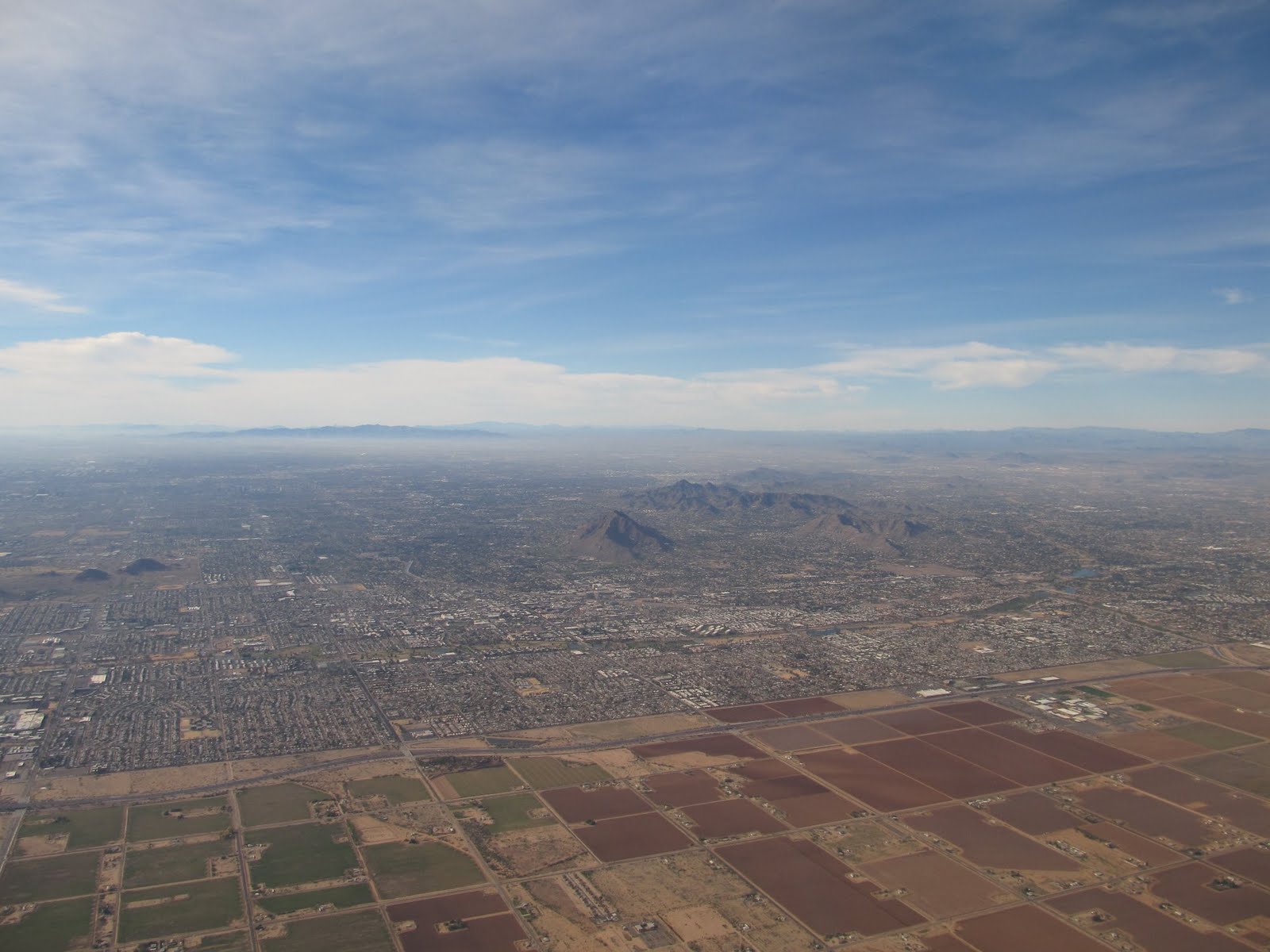 An aerial view of low-density suburban development in the Phoenix metropolitan area. Thank you, Phoenix, for always being there when I need to illustrate sprawl.
It begins with an idea that, in and of itself, isn't really offensive - rather than build new schools to support the city of Surrey's growing school-age population, just transport Surrey children to Vancouver schools. Now, I'm not sure how education is funded in British Columbia, whether tax revenues from each district support that district's schools, or if education taxes all go into a big hat and are redistributed by Victoria, or what - but if it's possible to keep existing schools open and use that $250 million for equally pressing things, such as transit expansion, it's something we should do.
But Ferry doesn't stop there. Instead, it's a segue on how Surrey is growing faster than Vancouver - hell, it's set to overtake Vancouver in population in the next few decades - "undoubtedly because it costs less to own or rent a fair-sized home there." This is true only because it's kept artificially so. I can't speak for rental rates there, because in my search for a place I didn't look anywhere south of the Fraser. I know enough to recognize that Vancouver is the hinge around which my life in the Lower Mainland pivots, even if I could never afford to actually own anything there.
The reason I chose not to put down rent in the Terminal City was because I placed a premium on easy access to the SkyTrain, and given the geography of development there were vast swathes of the city I ended up looking right past. I didn't even consider Surrey for the same reason - I have no interest in spending however long it may take to wait for a bus, for that bus to reach one of the four SkyTrain stations in northern Surrey, and for that SkyTrain to then wind its way downtown. My commute from New Westminster is more than long enough.
Ferry, however, couldn't be more supportive of Surrey and other suburbs built in the same image. He sees the idea of suburban sprawl as under attack by "city-centric politicians, ivory-tower professors and other politically correct members of the chattering classes" who advocate for "compact, multi-unit living" and "keep yammering on about the supposed evils of suburban sprawl." He discards the argument of densification as decreasing carbon dioxide emissions with one of the most ridiculous notes I've ever come across in a legitimate newspaper: "Let's forget for a moment whether human-induced CO2 emissions really cause global warming, which seems increasingly doubtful."
Fucking Christ! Does this man have any grasp of science whatsoever? Does he think that our factories, our coal-fired power plants, our cars' tailpipes emit some sort of "artificial carbon dioxide" or "CO2 plus" that doesn't act as a heat-trapping gas? Carbon dioxide has been known to act as a greenhouse gas for generations! Back in Grade 4, in 1990, I did a school essay on the greenhouse effect and used as sources already old library books that acknowledged the role of carbon dioxide in generating the greenhouse effect! This is not new science! The only thing new is the appearance of conservative idiots and corporate shills who have a vested interest in maintaining the status quo, or do not want to admit that their actions may be greatly harming the future and so look for other people to blame!
NYYYYAAAAAARRRRRRRGGGGGGHHHHHHHH
Okay. Okay. I'm good now. Before I go any further, I'd like to note that aside from an eleven-month stint between graduating university and finding a good job, I have lived in apartments since leaving home nearly ten years ago. I can understand what Ferry means when he says he left London because he wanted "a sizeable house, not a cramped apartment with thin walls." My apartment may not be cramped, but it's not uncommon for me to have to wait until the thumping of my neighbor's stereo disappears before turning in for the night. I'm not living in a single-family home; my residence is something much closer to the "eco-dense sardine cans" at which Ferry sneers. The life I lead is far, far preferable to one in the suburbs. I have no desire to ever get a house out in the sprawl. If ever I own anything, it will be a condo.
But no! According to the word of Ferry, suburbs are good. We have "oodles of space for housing, farming or doing whatever we damn well please," and that "we should be promoting suburban sprawl, not curbing it... and helping people own large, airy, stress-free houses."
These quotes are packed so full of asinine ridiculousness I barely know where to begin. I don't have to have been a homeowner to know that the idea of houses as "stress-free" is utterly insane. First, let's take a look at that scourge of every homeowner... the mortgage. Sure, it's basically a kind of rent that you pay to the bank, but at the end you own the house and can do with it as you please - whereas money you pay on rent, you never see again (except in the form of maintenance, management, common area lightbulb replacement, and all that other fun stuff). But I don't know of any rental contracts that have you continuing to pay for twenty or thirty or forty years. A lot can go wrong in that time. There's plenty of opportunity for rough patches. I doubt a bank would be more forgiving than a sympathetic landlord.
Second - yes, Canada does have a great deal of land available for housing, farming, or whatever. There's only one problem: it's the same damn land! Back in Ontario, hectares upon hectares of good agricultural land are plowed under every year to slap down yet another subdivision of cardboard estates. The Ontario government was forced to legislate protection for the environmentally-sensitive Oak Ridges Moraine, because the developers sure as hell wouldn't steer clear of it if they could make money slamming down suburbs. The more land is devoted to suburbs, the less there is for agriculture, and the more we depend on importation to survive. This is something that the Lower Mainland, being effectively an island, needs to be careful of. At one point this winter, the bread aisle at Safeway was nearly bare because an avalanche had closed the Trans-Canada and the shipment couldn't get through from Calgary. This is something I never encountered in Ontario.
Finally - promoting suburban sprawl. I had no idea that the Province had stationed columnists in the 1950s, because that's where this seems to be coming from. We've sprawled for decades, and what has it got us? Huge areas of low-density development that are difficult and expensive to serve with public transit, cut off from the services of the city and requiring a personal automobile in order to get anything done. Sprawl has had its chance, and given that we of the 21st century have the opportunity to take stock of our history and improve on our mistakes, to charge on with those mistakes because it is ideologically convenient is a crime against the future. Advocating the promotion of suburban sprawl is like advocating the installation of gas lamps in all the light standards on Columbia Street, because they look so much prettier than electrics.
I know that people like the idea of suburbs, that they seek the sense of "space and freedom" that Ferry lionizes. Sprawl is not the only way to get this - it's just the easiest way, the one that has seven decades' worth of memetic engineering working in its favor. We can have suburbs without having sprawl. I would've written on this today, but I've said enough for now. You want to know my alternative? Come back on Tuesday and I'll tell you what it is.
Friday, January 21, 2011
We're Developing a Problem Here
I nearly put my fist through my monitor when I read "Urban sprawl rules choking Toronto development: building industry," the Globe and Mail's latest tale of wholly-deserved corporate woe. It would seem that the existence of the Greenbelt, an area of agricultural, forest, and watershed land surrounding the Greater Toronto Area and made so by provincial law, is "choking development" - according, of course, to the development industry, those people who see a pristine meadow or an intact forest and are overwhelmed by visions of the cookie-cutter suburbs or soulless power centers that will rise up there as soon as that pesky "nature" is swept away.
Personally, I think that the Greenbelt has a valid and extremely important reason to not only be maintained, but strengthened. Not only does it protect the Oak Ridges Moraine, an ecologically important and vulnerable landform, but it provides a necessary impediment to expansion. Vancouver wouldn't be the city it is today if it wasn't hemmed in by the water and the mountains; aside from the lake, southern Ontario has no similar geographical stumbling blocks, so it's up to artificial ones to do their work. Limits encourage people to solve problems and try new avenues to success - whereas in a situation where everything is straightforward and open, the easy choice is going to be taken every single time. But we have to put in hurdles to those easy choices, or what we're going to end up with is low-density sprawl coating the land like a fungus.
 An aerial view of part of the low-density Phoenix metropolitan area
The constant construction of new sprawling subdivisions of single-family residential homes is a windfall to the development industry, sure, but they're the only ones who truly profit by it in the end. Today's suburbs aren't communities but hollowed-out zones to hang one's hat and rest one's head. When I lived in Barrie, I was fortunate that I happened to live in one of the first rings of suburbs... back in 1998, I was only a forty-minute walk from my downtown high school. Thirteen years later, someone living at the fringe of Barrie would be lucky to be able to walk to downtown in twice as much time. Sprawling subdivisions are based on the idea that the automobile brings freedom, but in practice they're practically tools of oppression - if you have to use your car to get anywhere, if you're obligated to fritter away your day behind a steering wheel without any alternative... how free are you, really?
This strategy of building, this insane drive to plow under more and more land, borders on the instinctual now - the industries have been building this way for nearly seventy years, ever since Levittown. We can't allow them to keep on this way forever - their goals are not the same as ours. What we need are livable suburbs, ones built along transit lines like the streetcar suburbs of old, and densification to create walkable communities. We can't let the attitudes of the twentieth century continue to shape the twenty-first, if we want to greet the twenty-second in any semblance of good order.
There needs to be choice - not just the assumption that a car and a house in the suburbs should be the only game in town.
Personally, I think that the Greenbelt has a valid and extremely important reason to not only be maintained, but strengthened. Not only does it protect the Oak Ridges Moraine, an ecologically important and vulnerable landform, but it provides a necessary impediment to expansion. Vancouver wouldn't be the city it is today if it wasn't hemmed in by the water and the mountains; aside from the lake, southern Ontario has no similar geographical stumbling blocks, so it's up to artificial ones to do their work. Limits encourage people to solve problems and try new avenues to success - whereas in a situation where everything is straightforward and open, the easy choice is going to be taken every single time. But we have to put in hurdles to those easy choices, or what we're going to end up with is low-density sprawl coating the land like a fungus.
 An aerial view of part of the low-density Phoenix metropolitan area
The constant construction of new sprawling subdivisions of single-family residential homes is a windfall to the development industry, sure, but they're the only ones who truly profit by it in the end. Today's suburbs aren't communities but hollowed-out zones to hang one's hat and rest one's head. When I lived in Barrie, I was fortunate that I happened to live in one of the first rings of suburbs... back in 1998, I was only a forty-minute walk from my downtown high school. Thirteen years later, someone living at the fringe of Barrie would be lucky to be able to walk to downtown in twice as much time. Sprawling subdivisions are based on the idea that the automobile brings freedom, but in practice they're practically tools of oppression - if you have to use your car to get anywhere, if you're obligated to fritter away your day behind a steering wheel without any alternative... how free are you, really?
This strategy of building, this insane drive to plow under more and more land, borders on the instinctual now - the industries have been building this way for nearly seventy years, ever since Levittown. We can't allow them to keep on this way forever - their goals are not the same as ours. What we need are livable suburbs, ones built along transit lines like the streetcar suburbs of old, and densification to create walkable communities. We can't let the attitudes of the twentieth century continue to shape the twenty-first, if we want to greet the twenty-second in any semblance of good order.
There needs to be choice - not just the assumption that a car and a house in the suburbs should be the only game in town.
Monday, January 17, 2011
What I Learned in the Arid Zone
Forty-eight hours in Phoenix, Arizona enabled me to see a lot. Not everything, mind you, considering that Phoenix is the fifth-largest city in the United States, but sometimes all you need to really see something is to have no prior experience with it. This was the first time I'd travelled to the core of the American Southwest, and everything there was new. Like, for example, the prickly pear cacti; they were everywhere in Phoenix, from Papago Park to the landscaping around skyscrapers, and yet I could never bring myself to totally accept them. They just looked too fake to be real, like plastic props on a soundstage.
Yesterday, I got the same feeling from downtown Phoenix itself. It had the vibe common to many American downtowns I've visited - a feeling of emptiness, of people having thrown plastic covers over all the buildings so they don't collect dust until they get back from wherever they've gone. Like the people think there's no reason to go there if it doesn't involve work in one of the skyscrapers, most of which appear to house bank offices, or an event at Chase Field or US Airways Center.
Sure, I know that there's a downtown mall in the Arizona Center as a potential trip generator, but even a couple of blocks away its presence was imperceptible - businesses were closed for the day and vehicular and pedestrian traffic were almost nonexistent. There's hardly any residential presence there, if any - the only condo towers I ever saw in my time there were a pair in downtown Tempe. It definitely didn't feel like the downtown of a major metropolis - it's too small to anchor the rest of the city, far too small. Even New Westminster's downtown feels far more active than Phoenix's on a Sunday, and it's a city of sixty thousand that experiences frequent rain in winter.
 Looking toward downtown Phoenix from Hole in the Rock, Papago Park
It's because Phoenix, and the entire Valley of the Sun, is a land of sprawl. I had plenty of time to look out the windows during landing and takeoff, and there were no clouds to obscure my view of a metropolitan area that seemed to be composed almost entirely of residential subdivisions, cul-de-sacs, air-conditioned shopping malls, and golf courses - no "second downtowns" like North York along Yonge Street, hardly any apartment buildings more than a couple of stories tall. That tells in the demographics: the Valley of the Sun has a population of 4.3 million people in 37,744 square kilometers, more than half the size of Nova Scotia. In comparison, Metro Vancouver's 2.1 million people occupy a mere 2,877 square kilometers, while the 5.5 million who call the Greater Toronto Area home only take up 7,124 square kilometers.
This might have made perfect sense in decades past, constantly building out new developments so people could own their dream homes in the land of endless sun, when they would keep on pumping the oil forever and everything would be right as rain. Therein, of course, lies the problem. Phoenix has an additional complication that neither Vancouver nor Toronto have to worry about, as it is in the middle of the Sonoran Desert. Fully ninety percent of its water is drawn from three rivers - one of which is the Colorado, which has not reliably reached the sea for years now. In the course of my walkabouts I would come across immaculate grass landscaping or vast suburban tracts, and think - where the hell is all the water coming from?
It may be a historical irony that Detroit's motto includes the phrase "resurget cineribus," Latin for "it shall rise from the ashes" - appropriate, considering the decivilization program it's currently embarking upon. But it's the phoenix that really rises from the ashes... and having been there, I saw nothing to dissuade me from my belief that Phoenix may well be the Detroit of the 21st century. Hollowed out not entirely by economics - although the real estate industry there did take an understandably huge hit back in 2008 - but by environmental pressures. It wouldn't be the first time in history that the local population was forced out due to drought. Hell, that's how it got its name, from being built on the ruins of a previous civilization.
Some parts of it feel quiet enough to be abandoned already.
Yesterday, I got the same feeling from downtown Phoenix itself. It had the vibe common to many American downtowns I've visited - a feeling of emptiness, of people having thrown plastic covers over all the buildings so they don't collect dust until they get back from wherever they've gone. Like the people think there's no reason to go there if it doesn't involve work in one of the skyscrapers, most of which appear to house bank offices, or an event at Chase Field or US Airways Center.
Sure, I know that there's a downtown mall in the Arizona Center as a potential trip generator, but even a couple of blocks away its presence was imperceptible - businesses were closed for the day and vehicular and pedestrian traffic were almost nonexistent. There's hardly any residential presence there, if any - the only condo towers I ever saw in my time there were a pair in downtown Tempe. It definitely didn't feel like the downtown of a major metropolis - it's too small to anchor the rest of the city, far too small. Even New Westminster's downtown feels far more active than Phoenix's on a Sunday, and it's a city of sixty thousand that experiences frequent rain in winter.
 Looking toward downtown Phoenix from Hole in the Rock, Papago Park
It's because Phoenix, and the entire Valley of the Sun, is a land of sprawl. I had plenty of time to look out the windows during landing and takeoff, and there were no clouds to obscure my view of a metropolitan area that seemed to be composed almost entirely of residential subdivisions, cul-de-sacs, air-conditioned shopping malls, and golf courses - no "second downtowns" like North York along Yonge Street, hardly any apartment buildings more than a couple of stories tall. That tells in the demographics: the Valley of the Sun has a population of 4.3 million people in 37,744 square kilometers, more than half the size of Nova Scotia. In comparison, Metro Vancouver's 2.1 million people occupy a mere 2,877 square kilometers, while the 5.5 million who call the Greater Toronto Area home only take up 7,124 square kilometers.
This might have made perfect sense in decades past, constantly building out new developments so people could own their dream homes in the land of endless sun, when they would keep on pumping the oil forever and everything would be right as rain. Therein, of course, lies the problem. Phoenix has an additional complication that neither Vancouver nor Toronto have to worry about, as it is in the middle of the Sonoran Desert. Fully ninety percent of its water is drawn from three rivers - one of which is the Colorado, which has not reliably reached the sea for years now. In the course of my walkabouts I would come across immaculate grass landscaping or vast suburban tracts, and think - where the hell is all the water coming from?
It may be a historical irony that Detroit's motto includes the phrase "resurget cineribus," Latin for "it shall rise from the ashes" - appropriate, considering the decivilization program it's currently embarking upon. But it's the phoenix that really rises from the ashes... and having been there, I saw nothing to dissuade me from my belief that Phoenix may well be the Detroit of the 21st century. Hollowed out not entirely by economics - although the real estate industry there did take an understandably huge hit back in 2008 - but by environmental pressures. It wouldn't be the first time in history that the local population was forced out due to drought. Hell, that's how it got its name, from being built on the ruins of a previous civilization.
Some parts of it feel quiet enough to be abandoned already.
Tuesday, January 11, 2011
Between Downtown and Dog River
Recently I've begun watching Corner Gas - mostly because the Comedy Network was running it nonstop on New Year's Eve and New Year's Day - and it's pushed my thoughts in some unexpected directions. Though I've never lived in a small town like Dog River, Saskatchewan - or any small town at all, for that matter - it's in that sort of community that most of humanity lived for most of history; it's only in the last couple of centuries that cities have really taken the prize. But things are constantly in flux; things that were once rocksteady are crumbling into dust now.
I can understand why some people wouldn't want to live in small towns - the isolation, the potential of an insular local culture, the lack of services and opportunities that exist in larger communities. That won't necessarily stay the same as the years go by, though.
 The post office in Gagetown, New Brunswick, serving a population of 719
The future of how we live is something that comes up time and again in futurist works, partially because it has deep, meaningful resonance: everyone lives somewhere. Frequently, I think, the answers are deeply influenced by personal politics or the pervading assumptions of society. Take the Transhuman Space setting, one of the more in-depth looks at a potential world of 2100 that I've come across - it's a world of decivilization, where cities are being bulldozed and returned to nature in favor of arcologies and suburbs.
Honestly, I never found that particularly believable. Sure, there are active decivilization efforts right now; Detroit's leading that charge, demolishing abandoned homes in an effort to densify the city in the urban prairie. Arcologies themselves have their own problems - they remind me of postwar housing developments in a way, and I can't help but suspect that an arcology might tend to resemble Cabrini-Green more than Green Acres. As for suburbs... for me, they deliver all the drawbacks of urban and rural life, with very few of the benefits.
My theory - based on little more than my opinion, to be sure, but still a theory nonetheless - is that suburbs will be disproportionately impacted by the problems we'll face through the rest of the twenty-first century. Cities and small towns both have lineages that go back to the dawn of civilization; suburbs are more like a weird fusion of the two. Should technologies like telepresence and 3D printing become more and more ubiquitous, a lot of the drawbacks of living in a small town would disappear: it doesn't matter where you live so long as you have a good enough internet connection to remotely operate whatever it is you're operating, and 3D printers could easily make small communities self-sufficient in basic goods.
Cities have their own reasons for being, and I don't expect them to go away either.
I can understand why some people wouldn't want to live in small towns - the isolation, the potential of an insular local culture, the lack of services and opportunities that exist in larger communities. That won't necessarily stay the same as the years go by, though.
 The post office in Gagetown, New Brunswick, serving a population of 719
The future of how we live is something that comes up time and again in futurist works, partially because it has deep, meaningful resonance: everyone lives somewhere. Frequently, I think, the answers are deeply influenced by personal politics or the pervading assumptions of society. Take the Transhuman Space setting, one of the more in-depth looks at a potential world of 2100 that I've come across - it's a world of decivilization, where cities are being bulldozed and returned to nature in favor of arcologies and suburbs.
Honestly, I never found that particularly believable. Sure, there are active decivilization efforts right now; Detroit's leading that charge, demolishing abandoned homes in an effort to densify the city in the urban prairie. Arcologies themselves have their own problems - they remind me of postwar housing developments in a way, and I can't help but suspect that an arcology might tend to resemble Cabrini-Green more than Green Acres. As for suburbs... for me, they deliver all the drawbacks of urban and rural life, with very few of the benefits.
My theory - based on little more than my opinion, to be sure, but still a theory nonetheless - is that suburbs will be disproportionately impacted by the problems we'll face through the rest of the twenty-first century. Cities and small towns both have lineages that go back to the dawn of civilization; suburbs are more like a weird fusion of the two. Should technologies like telepresence and 3D printing become more and more ubiquitous, a lot of the drawbacks of living in a small town would disappear: it doesn't matter where you live so long as you have a good enough internet connection to remotely operate whatever it is you're operating, and 3D printers could easily make small communities self-sufficient in basic goods.
Cities have their own reasons for being, and I don't expect them to go away either.
Wednesday, January 5, 2011
Finding An Honest Image at Honest Ed's
After spending a few months in Metro Vancouver, I've begun to get a feel for the place and to figure out the things I like about it. When I met up with him on New Year's Eve, Randy McDonald put it simply and, to my mind, accurately - Vancouver is comfortable in its own skin. Mind you, this is in contrast to Toronto, which is getting more frazzled by the minute as to whether it really is a World-Class City.
Is it? Perhaps. It's probably the closest to that prize than any other Canadian city, but it's one of those question that lurks in the city's subconscious and tickles god knows how many urban neuroses. A big part of it, I think, is that Toronto didn't do anything to attain its current primacy aside from, well, exist - it got the top prize by default, when Anglos by the tens of thousands poured out of Montreal and down the 401 back in the 1970s. Other cities had to really struggle for dominance, and in many cases it took decades, if not centuries.
Thinking back on it now, I think there remains a big disconnect between the way Toronto envisions itself, and the way the city really is - like a fourteen-year-old wearing his dad's suit. The official image is ubiquitous: a photo taken from a good vantage point on the Islands, the CN Tower in the middle and the forest of skyscrapers endless on both sides.
I took this video on New Year's Eve, at the corner of Bloor West and Bathurst, and I think it represents a piece of what Toronto really is - bright, loud, perhaps a bit obnoxious and desperate for your attention, but friendly beneath it all.
And that's what Toronto is.
Is it? Perhaps. It's probably the closest to that prize than any other Canadian city, but it's one of those question that lurks in the city's subconscious and tickles god knows how many urban neuroses. A big part of it, I think, is that Toronto didn't do anything to attain its current primacy aside from, well, exist - it got the top prize by default, when Anglos by the tens of thousands poured out of Montreal and down the 401 back in the 1970s. Other cities had to really struggle for dominance, and in many cases it took decades, if not centuries.
Thinking back on it now, I think there remains a big disconnect between the way Toronto envisions itself, and the way the city really is - like a fourteen-year-old wearing his dad's suit. The official image is ubiquitous: a photo taken from a good vantage point on the Islands, the CN Tower in the middle and the forest of skyscrapers endless on both sides.
I took this video on New Year's Eve, at the corner of Bloor West and Bathurst, and I think it represents a piece of what Toronto really is - bright, loud, perhaps a bit obnoxious and desperate for your attention, but friendly beneath it all.
And that's what Toronto is.
Saturday, December 4, 2010
To Go Through All the Unfamiliar Places
When I go out on urban wandering expeditions, there are always two things I make sure to carry with me: a Metro Vancouver mapbook in my backpack, and a fold-up TransLink Metro Vancouver transit map in my pocket. I still lack the instinctive familiarity of the street layout in this area, and while "head toward that bridge way over there" can work on a macro level, it's also an extremely easy way to get lost while you think you're heading in the right direction.
These days, it feels like I'm one of an increasingly small group of old-style navigators. With mobile phones ubiquitous among everyone except me, and with the integration of web-browsing and specifically Google Maps functionality into modern phones, there's increasingly less necessity for people to carry physical maps around with them.
Or, at least, it seems to me that there's the increasingly common perception that that's the case. As that perception becomes cemented in society to an ever-greater extent, we unwittingly provide ever-greater opportunities for us to get into trouble. I started thinking this through after watching a video by Tom Scott, an Ignite London presentation about how flash mobs can stumble into horrific things. It's embedded below - I seriously recommend that you watch it. Sure, it's a story, but one with real teeth - ten or fifteen years ago, it would've been firmly science fiction.
In Tom Scott's tale, the sudden arrival of hundreds of mobile-using flash mobbers crashed the local network, and its transformation into a flash riot may have been precipitated - at least in part - by all of these people who had got there by following directions on their phones, and in the absence of those internet-based geographic tools had no idea where they were in relation to what they were familiar with, and no idea how to get out. That's a frightening situation, that. Ignorance feeds fear, and when fear gets high enough, rationality goes out the window.
Nevertheless, navigation by mobile phone is not the problem. In fact, for many people it's a godsend; some people aren't able to hold a coherent map in their heads, and in cases like that phone-maps fall into the niche of "external brains" that's been batted around in science fiction for decades. No, the problem is choosing to get around with phone-based navigation in an unfamiliar area and not having a backup plan.
For me, it's relatively simple - I find the nearest transit stop and board the first bus that presents itself. While not all bus routes in Metro Vancouver link up with the SkyTrain, the network's extensive enough that even without a guidemap I'd be able to blunder my way to familiar territory eventually. The biggest issue I have with mobile phones is my perception that they've begun to influence thinking at a cultural level, that they may help lead to a seat-of-the-pants culture where things are dealt with only as they arise.
I may be wrong. I hope to be wrong. Nevertheless, whenever I go out I'll always make sure I have that map in my backpack.
These days, it feels like I'm one of an increasingly small group of old-style navigators. With mobile phones ubiquitous among everyone except me, and with the integration of web-browsing and specifically Google Maps functionality into modern phones, there's increasingly less necessity for people to carry physical maps around with them.
Or, at least, it seems to me that there's the increasingly common perception that that's the case. As that perception becomes cemented in society to an ever-greater extent, we unwittingly provide ever-greater opportunities for us to get into trouble. I started thinking this through after watching a video by Tom Scott, an Ignite London presentation about how flash mobs can stumble into horrific things. It's embedded below - I seriously recommend that you watch it. Sure, it's a story, but one with real teeth - ten or fifteen years ago, it would've been firmly science fiction.
In Tom Scott's tale, the sudden arrival of hundreds of mobile-using flash mobbers crashed the local network, and its transformation into a flash riot may have been precipitated - at least in part - by all of these people who had got there by following directions on their phones, and in the absence of those internet-based geographic tools had no idea where they were in relation to what they were familiar with, and no idea how to get out. That's a frightening situation, that. Ignorance feeds fear, and when fear gets high enough, rationality goes out the window.
Nevertheless, navigation by mobile phone is not the problem. In fact, for many people it's a godsend; some people aren't able to hold a coherent map in their heads, and in cases like that phone-maps fall into the niche of "external brains" that's been batted around in science fiction for decades. No, the problem is choosing to get around with phone-based navigation in an unfamiliar area and not having a backup plan.
For me, it's relatively simple - I find the nearest transit stop and board the first bus that presents itself. While not all bus routes in Metro Vancouver link up with the SkyTrain, the network's extensive enough that even without a guidemap I'd be able to blunder my way to familiar territory eventually. The biggest issue I have with mobile phones is my perception that they've begun to influence thinking at a cultural level, that they may help lead to a seat-of-the-pants culture where things are dealt with only as they arise.
I may be wrong. I hope to be wrong. Nevertheless, whenever I go out I'll always make sure I have that map in my backpack.
Subscribe to:
Comments (Atom)