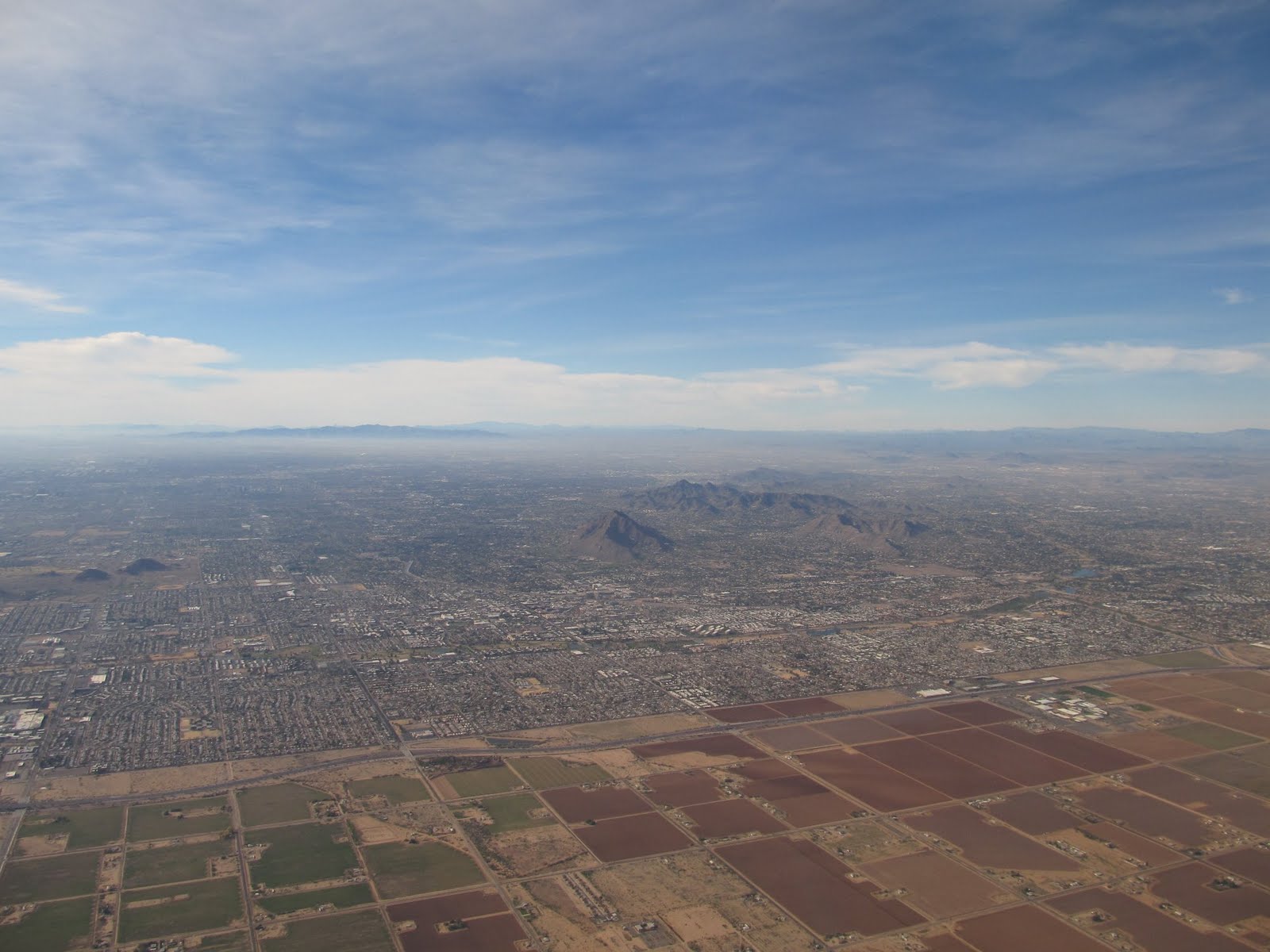
You'll find psychological boundaries no matter where you go, and Toronto is no exception. It's a common stereotype that for the "downtown elites" hizzoner da mayor and his ideological allies are so fond of taking potshots at, everything north of Bloor is a wasteland and Eglinton Avenue is the Arctic Circle. Personally, I live north of Danforth and it's pretty green--but if Eglinton is the Arctic Circle, then Steeles Avenue borders another planet entirely. I was up there in Markham last month for the Ad Astra convention, held in a Holiday Inn just north of Steeles at Woodbine. Compared to urban design like this, Scarborough is a transit utopia. The sign on Woodbine Avenue welcoming people--well, let's be honest here, drivers--to York Region calls it "Ontario's rising star." At least we can be sure they're not talking about the height of their buildings.
I, the copyright holder of this work, hereby release it under the Creative Commons Attribution-Non Commercial-Share Alike 3.0 Unported license.
This means that you are free to Share (to copy, distribute and transmit the work) and to Remix (to adapt the work) under the following conditions: Attribution (you must attribute the work in the manner specified by the author or licensor, but not in any way that suggests that they endorse you or your use of the work), Noncommercial (you may not use this work for commercial purposes), and Share Alike (if you alter, transform, or build upon this work, you may distribute the resulting work only under the same or similar license to this one).
I was flipping through the channels on the hotel television last night, and what did I light upon but the Fox Business Network, one of the arms of the Fox News empire? I was drawn in by the spectacle immediately--since Fox News doesn't have a Canadian presence, all I know of it is its reputation, but a few moments of watching demonstrated that some reputations are not without merit.
The show was Lou Dobbs Tonight, and the current segment was an interview with Stanley Kurtz, author of Spreading the Wealth: How Obama is Robbing the Suburbs to Pay for the Cities, which has gotta be one of the most unbiased titles I've ever seen, what? The thrust of Kurtz's argument was simple: Barack Obama wants to get rid of American suburbs. Why? Well, because he's a Democrat, I suppose, and according to Fox this is bad because "America is a suburban nation."
As interviews go, it wasn't much; Dobbs asked softball questions while Kurtz fulminated about how a second term for President Obama would see a Sustainable Communities Initiative used to "hold federal aid hostage" in a bid to encourage people to move from suburbs to cities, and that he would preside over a "redistribution of tax money" by "[forcing] regional tax base sharing on suburbs."
This is not a revolutionary idea. Even in the segment they acknowledged that something of the sort is currently used in Minneapolis-St. Paul, and it sounds similar to what happens in Metro Vancouver--Surrey is nothing if not a suburb, after all--or the regional municipalities of the Greater Toronto Area. In the eyes of Fox, though, it's anathema. "Redistribution," I've come to conclude, is one of those heavily loaded words in American political parlance, and it sounds very much like one of those data points that would be eagerly picked up on by people who claim that President Obama is a Marxist.
Which itself, incidentally, is a ridiculous idea. If he was really a Marxist he would've made it clear by now--I mean, look at the banks. Why would a Marxist president not just nationalize them when given such a sterling opportunity? Claims that he's waiting for the second term are ridiculous; even now there's no guarantee that he'll get it, since Nate Silver gives Romney and Ryan a little less than one chance in three right now. But I digress.
What I found interesting about this was the unspoken assumption that tied it all together: that the suburbs are economically independent, the "rugged individualists" of settlements, and that asking them to combine their tax bases with those of cities is stealing from them. Indeed, if you don't look at the numbers too hard it's easy to think that suburbs are independent--but that overlooks a lot. The biggest thing is that the suburbs were subsidized from the get-go, and still are today; it can be expensive to provide necessary services such as sewer, water, power, garbage collection, road maintenance, and so on due to the scale of some low-density communities, after all. Some suburbs have larger footprints than major metropolises, but they don't have the capacity to generate tax revenue the same way dense cities can. For a lot of suburbs, the natural choice is to build out because building out brings in more property tax revenue... except that brings further costs due to the extension of those services.
I don't think regional coordination of tax revenues would be a bad idea, because with the spread of suburbs plenty of things are regional--it's the standard sort of refrain you hear in Toronto, with people complaining about 905ers filling the roads and the subways to get to work and back without paying the taxes that maintain them. Nor do I think there's any need for active federal intervention to get people to move out of the suburbs. As the gasoline that the suburbs are founded on becomes more expensive, they will shift into more tenable patterns. It doesn't matter if the United States is a "suburban nation" now. Just because the United States, or any country, can be described in a certain way now, it doesn't mean that it should continue along the same trajectory indefinitely. Sameness breeds stagnation.
Though that might explain why Lou Dobbs was so opinionated about the extension of a federal offshore drilling moratorium. On the whole it didn't seem particularly "fair and balanced" to me.
The land I grew up on was on the edge of the country, a long time ago; after the tornado clobbered that part of Barrie in 1985, the developers came in to lay down the first phase of what ended up being a near-continuous program of suburban expansion that pushed the city frontier kilometers to the south, deep into what had been unspoiled rural land within even my living memory. Barrie may have been one of the fastest-growing cities in Canada at the time, but its experience is hardly unique. In the Greater Toronto Area in particular, the land is under constant stress from consistent and continuous suburban encroachment, even as the factors that made our twentieth-century flight to the suburbs possible are changing rapidly.
In retrospect, I tended to play SimCity 4 this way; your simulated cities don't start to densify until you reach a necessary critical mass of population, and in order to reach that mass it's pretty much necessary to zone light residential over huge parcels of wilderness until enough people move in - and even then, it's tempting to just continue doing that until your city physically cannot expand anymore, since it's an easy way of bringing in tax revenue. In this respect, simulated cities have much in common with real ones.
This way of doing things particularly pronounced in the Greenbelt, a large area of protected land set aside by the Government of Ontario that's supposed to be off-limits to development, as it includes among other things the fragile and vital Oak Ridges Moraine. Despite this, it's being nibbled away in a dozen places, as are other undeveloped rural lands in the GTA - witness the example of the Regional Municipality of Durham, where recently Ajax was the only city to argue in favor of densifying the existing built-up areas rather than just laying down new suburbs - and it may only get worse, with the Toronto Star's recent coverage at how the Greenbelt may have truly been successful at pricing the housing market beyond the reach of most people, which - combined with the general lack of family orientation in Toronto's recent condo boom - has created an intense pent-up demand that's ready to erupt, bulldozing every farmer's field in its way.
The ones that have managed to hold out this long, that is.
Suburban sprawl in the Greater Toronto Area - probably some part of Mississauga, considering the descent path into Pearson.
Demand should not be the final arbiter. To be blunt, the continued existence of the Greenbelt, as a protected buffer zone of wilderness and country lands of the sort that used to be dominant in southern Ontario only decades ago, is more important than the popular desire to have a house with a white picket fence. No one is entitled to home ownership, not the same way we're entitled to things like free expression, and we'll be dealing with the consequences of that meme dominating our society for decades down the road. Still, the real problem here is that the government seems to have fumbled the ball so horribly that there are almost no alternatives to a house if 1) you want to own, not rent and 2) you are a family. With the forest of condominums in downtown Toronto thickening every day, and more and more new stands appearing elsewhere in the GTA, there's no excuse for this kind of residential myopia. Thanks to years and decades of poor decisions, Ontario may be on the edge of a housing crisis.
This would be something very instructive for the Lower Mainland to learn from, because damn if it's not a lesson that doesn't need to be applied to Vancouver itself. One of the reasons I live in New Westminster is because even rental prices in Vancouver itself were pretty much uniformly out of what I considered to be my league; as for owning a home in Vancouver, unless you want to be in hock to the bank for fifty years, forget it!
Yet Metro Vancouver particularly still has the advantage of time on its side - the pressures haven't been as great, it seems, and they didn't start as far back as they did around Toronto. There are still spots of open countryside that are reachable in under an hour by bicycle from New Westminster. The Lower Mainland doesn't have any equivalent to the Greenbelt as far as I know - if it does, please correct me - and if that's to continue being the case, I'd very much like it to be because the right decisions were made and the demand for leapfrogging subdivisions into the countryside just doesn't exist.
Besides, even if there is, it's not necessarily a good idea. I wouldn't want to buy a house on Lulu Island, considering what's going to happen to that land when the Big One comes.
Aside from a few inferences I've been able to pick up from television, film, and literature here and there, I'm not all that sure what North American city living was like eighty years ago. I suspect it can't have met the desires of everyone, though, considering the suburban exodus that began in the years after the Second World War - an exodus that still echoes today; look no farther than Toronto for the influence that a suburban emphasis can have on the political sphere, for instance. At the same time, I think it's highly reflective of how vast the cultural differences are between the 1950s and the 2010s.
The other day I encountered a 1950s television ad, "Two Ford Freedom," via the Seattle Transit Blog. It's an unintentional time capsule of '50s sensibilities, filled with such earnestness and innocence that at first it was hard for me to believe it was real - so syrupy sweet that I have to wonder if there was an unspoken cultural agreement not to look behind certain things, because the alternative was just too darn unpleasant.
There are a lot of deep problems hiding behind the superficial happiness of that commercial. So, in that respect, it's actually perfectly reflective of the 1950s!
"When he was gone, I was practically a prisoner in my own home," the nameless housewife says. "I couldn't get out to see my friends, couldn't take part in PTA activities - I couldn't even shop when I wanted to." With advertising like that, I can understand why people were just jumping at the chance to get a suburban house of their very own, surrounded by identical houses and isolated from all the services that improve quality of life! I tell you, cities of the '40s and '50s must have been something - either that, or the privations of the Depression and the war were such that having a house was the Important Thing, More Important Than All Other Important Things.
As someone who grew up in a suburban setting - admittedly, the very inner fringe of a suburb, but still - the housewife's complaints ring familiar, to a degree. If I wanted to go anywhere and couldn't bug Mom to give me a lift, I would have to take my bike, negotiate the intricate complexities of Barrie Transit, or just not go. The advantage of the 1990s is that those alternatives existed - not so in the 1950s suburban paradise.
Across the United States and Canada, public transit systems were under incredible strain from the explosive growth of suburbanization, the disappearance of significant portions of their ridership, and the conflicting demands of motorists. New suburbs just didn't have public transit, and commuter rail is out there either - aside from the Long Island Rail Road and the South Shore Line, I don't believe any of the present commuter rail systems in North America had begun service in the '50s. The bicycle, which in the nineteenth century was hailed as a means to liberate women, had by the 1950s become effectively a child's toy in mainstream North American culture - it wasn't until the '70s that bikes really started taking off for adults.
The solution is, of course, absolutely '50s. Rather than strive for a life that doesn't reduce people to prisoners in their own homes, just buy another car! Don't try to put any effort into the underlying problems that are evident in your society, don't even acknowledge them - just surrender to the Man and get behind that wheel. Just make sure it's a Ford!
After all, as she says - or as I expected her to say - "why be stuck with one expensive car, when you can be stuck with two?"
People will always need to get around. Even if we withdraw into ourselves, hide in our bedrooms and use teleoperated robots to do everything that needs to be done under that ball of fire known as the "daystar," those robots will always need to get around. Transportation planning is, thus, one of the more important roles of a government - and I feel it needs to come down to a government, since it's far easier to get a government to look at the long-term than a private, profit-centered agency.
They'll need to get around, and they'll need places to live/control their robots from. One of the concepts that's been tossed about time and again over the twentieth century is the death of the city - the idea that we're poised on the edge of a technological revolution that'll finally make concentrations of people, businesses, services, and infrastructure obsolete, and allow us all to live in low-density sprawl scattered across the land; sometimes so scattered that you need a personal helicopter to get anywhere in a reasonable time. In reality, though, the cities have proved resilient. Even those cities that were hollowed out by white flight in the mid-20th century have at least survived the rise of suburbs that have done their level best to strangle them. But there are still people, like The Province's Jon Ferry, who believe that suburbs need to be encouraged even more - that all of us want a life that, to me at least, seems like something as relevant to the modern world as Leave It to Beaver.
The problem is that, whether by an active memetic engineering campaign, cultural drift, or both, the term "suburb" has pretty much come to be associated with the typical city-fringe, spread-out, low-density areas - I hesitate to use the term "neighborhood" in the context of such a suburb - dominated by houses, local businesses generally limited to strip malls and big boxes, with limited public transit options and a general dependence on automobiles in order to get around in a reasonable manner.
Suburbs such as these, in the Levittown mold, are artifacts of the twentieth century - remnants of a time when fuel was cheap, land was cheap, and there was a strong, healthy middle class that could afford what The Onion called "ant-like conformity." Honestly, I don't think those factors will prevail in the twenty-first century like they did in the twentieth. As demand ramps up in the developing world, and as oil speculators prove themselves time and again to be panicky squirrels willing to drag the global economy to the brink of ruin because of what a civil war in Libya might do to supply, petroleum and gas will become steadily more expensive. Electric cars could feasibly pick up some of the slack, but not nearly enough - we're still a ways away from being able to convert from an oil-based transportation model. Suburbs tend to be built on good agricultural land; as transportation becomes more expensive, we'll need all the agriculture we can get as close to the cities as we can get it, to cut down on transportation costs.
That doesn't mean, however, that I think we've got no option but to huddle in urban sardine can apartments. There's more than one way to build a suburb, even if we've been using the same blueprint for seventy years now.
A Metro Light Rail train passes through Tempe, Arizona
A hundred years ago, there were suburbs - streetcar suburbs, made possible by the streetcar lines that then criss-crossed major cities across North America. Places like Parkdale in Toronto and Kitsilano in Vancouver still retain the character of that early suburban push, a push that made it possible for people to walk from their home along a side road to the streetcar, and take it whereever they needed to go. It was the proliferation of automobiles after the Second World War, and the resultant collapse in ridership, that saw streetcars disappear from all but a handful of North American cities.
Today, we might do well looking at this concept in a different way - a concept which I'm sure someone else has already come up with before me, but if that's the case, it means it's more than just disorganized neurons firing. Light rail villages - combining the space and freedom aspects that are attractive about suburbs, but avoiding the sprawling, dehumanizing, atomizing effects of modern suburban sprawl.
Start with a village square. There will be a light rail station here, and a small business area - the sort of thing you'd expect to see in a small town's downtown, or what you still see along the main streets of surviving streetcar suburbs. Beyond this, side roads radiate out to the residential areas where you'll find houses with big yards and plenty of space - but not that endless rows of them. This is supposed to be a village - only a couple of thousand people would live here. The village would be surrounded by a small greenbelt, perhaps of forests or farms - the light rail would connect to additional villages in both directions, and ultimately to a transit exchange or major urban center. There'd still be roads, of course - but the point of the design would be to reduce the degree to which an automobile is a necessity, to make driving a choice.
It is all about choice, in the end. But when there's only one dominant option, it's not much of a choice at all.
I don't hate suburbs themselves. It's more the manner in which the concept of suburbs has been realized over the last seventy years that I really disagree with. I grew up in a suburban development, and I learned well how isolating and artificial life there can be - and this was an inner suburb, close enough to my downtown high school that I could walk home in less than an hour. After twenty years of sprawling at the fringes, my old address is practically downtown. If not for the bus stop literally right across the street from the house, I don't know what I'd have done.
The point is, they're not for everyone - but the myopic focus upon suburban development that has dominated city planning across most of North America for the last seventy years has assumed just that. The problem is that the "truths" of the twentieth century aren't going to cut it anymore. We shouldn't continue to build low-density, car-centric developments - to blithely assume that we will always have a so-cheap-it-doesn't-matter power source to fuel our automobiles is a very large gamble, and it's one that would affect all of society if the wheel doesn't stop where the suburb boosters have put down their chips.
Not everyone, of course, sees it the same way I do. The other day, I had the dubious privilege of stumbling onto Jon Ferry's column in The Province - a paper which had never really seemed right-wing until that moment - a column which has got to be one of the most ill-informed, ideological, disingenuous pieces of twaddle I've ever encountered in a major newspaper. It starts even with the headline - "Suburban sprawl is what we really want."
Oh really, Jon Ferry. Well, thank god the drifting, voiceless people of British Columbia have you to tell them what they want.
An aerial view of low-density suburban development in the Phoenix metropolitan area. Thank you, Phoenix, for always being there when I need to illustrate sprawl.
It begins with an idea that, in and of itself, isn't really offensive - rather than build new schools to support the city of Surrey's growing school-age population, just transport Surrey children to Vancouver schools. Now, I'm not sure how education is funded in British Columbia, whether tax revenues from each district support that district's schools, or if education taxes all go into a big hat and are redistributed by Victoria, or what - but if it's possible to keep existing schools open and use that $250 million for equally pressing things, such as transit expansion, it's something we should do.
But Ferry doesn't stop there. Instead, it's a segue on how Surrey is growing faster than Vancouver - hell, it's set to overtake Vancouver in population in the next few decades - "undoubtedly because it costs less to own or rent a fair-sized home there." This is true only because it's kept artificially so. I can't speak for rental rates there, because in my search for a place I didn't look anywhere south of the Fraser. I know enough to recognize that Vancouver is the hinge around which my life in the Lower Mainland pivots, even if I could never afford to actually own anything there.
The reason I chose not to put down rent in the Terminal City was because I placed a premium on easy access to the SkyTrain, and given the geography of development there were vast swathes of the city I ended up looking right past. I didn't even consider Surrey for the same reason - I have no interest in spending however long it may take to wait for a bus, for that bus to reach one of the four SkyTrain stations in northern Surrey, and for that SkyTrain to then wind its way downtown. My commute from New Westminster is more than long enough.
Ferry, however, couldn't be more supportive of Surrey and other suburbs built in the same image. He sees the idea of suburban sprawl as under attack by "city-centric politicians, ivory-tower professors and other politically correct members of the chattering classes" who advocate for "compact, multi-unit living" and "keep yammering on about the supposed evils of suburban sprawl." He discards the argument of densification as decreasing carbon dioxide emissions with one of the most ridiculous notes I've ever come across in a legitimate newspaper: "Let's forget for a moment whether human-induced CO2 emissions really cause global warming, which seems increasingly doubtful."
Fucking Christ! Does this man have any grasp of science whatsoever? Does he think that our factories, our coal-fired power plants, our cars' tailpipes emit some sort of "artificial carbon dioxide" or "CO2 plus" that doesn't act as a heat-trapping gas? Carbon dioxide has been known to act as a greenhouse gas for generations! Back in Grade 4, in 1990, I did a school essay on the greenhouse effect and used as sources already old library books that acknowledged the role of carbon dioxide in generating the greenhouse effect!This is not new science! The only thing new is the appearance of conservative idiots and corporate shills who have a vested interest in maintaining the status quo, or do not want to admit that their actions may be greatly harming the future and so look for other people to blame!
NYYYYAAAAAARRRRRRRGGGGGGHHHHHHHH
Okay. Okay. I'm good now. Before I go any further, I'd like to note that aside from an eleven-month stint between graduating university and finding a good job, I have lived in apartments since leaving home nearly ten years ago. I can understand what Ferry means when he says he left London because he wanted "a sizeable house, not a cramped apartment with thin walls." My apartment may not be cramped, but it's not uncommon for me to have to wait until the thumping of my neighbor's stereo disappears before turning in for the night. I'm not living in a single-family home; my residence is something much closer to the "eco-dense sardine cans" at which Ferry sneers. The life I lead is far, far preferable to one in the suburbs. I have no desire to ever get a house out in the sprawl. If ever I own anything, it will be a condo.
But no! According to the word of Ferry, suburbs are good. We have "oodles of space for housing, farming or doing whatever we damn well please," and that "we should be promoting suburban sprawl, not curbing it... and helping people own large, airy, stress-free houses."
These quotes are packed so full of asinine ridiculousness I barely know where to begin. I don't have to have been a homeowner to know that the idea of houses as "stress-free" is utterly insane. First, let's take a look at that scourge of every homeowner... the mortgage. Sure, it's basically a kind of rent that you pay to the bank, but at the end you own the house and can do with it as you please - whereas money you pay on rent, you never see again (except in the form of maintenance, management, common area lightbulb replacement, and all that other fun stuff). But I don't know of any rental contracts that have you continuing to pay for twenty or thirty or forty years. A lot can go wrong in that time. There's plenty of opportunity for rough patches. I doubt a bank would be more forgiving than a sympathetic landlord.
Second - yes, Canada does have a great deal of land available for housing, farming, or whatever. There's only one problem: it's the same damn land! Back in Ontario, hectares upon hectares of good agricultural land are plowed under every year to slap down yet another subdivision of cardboard estates. The Ontario government was forced to legislate protection for the environmentally-sensitive Oak Ridges Moraine, because the developers sure as hell wouldn't steer clear of it if they could make money slamming down suburbs. The more land is devoted to suburbs, the less there is for agriculture, and the more we depend on importation to survive. This is something that the Lower Mainland, being effectively an island, needs to be careful of. At one point this winter, the bread aisle at Safeway was nearly bare because an avalanche had closed the Trans-Canada and the shipment couldn't get through from Calgary. This is something I never encountered in Ontario.
Finally - promoting suburban sprawl. I had no idea that the Province had stationed columnists in the 1950s, because that's where this seems to be coming from. We've sprawled for decades, and what has it got us? Huge areas of low-density development that are difficult and expensive to serve with public transit, cut off from the services of the city and requiring a personal automobile in order to get anything done. Sprawl has had its chance, and given that we of the 21st century have the opportunity to take stock of our history and improve on our mistakes, to charge on with those mistakes because it is ideologically convenient is a crime against the future. Advocating the promotion of suburban sprawl is like advocating the installation of gas lamps in all the light standards on Columbia Street, because they look so much prettier than electrics.
I know that people like the idea of suburbs, that they seek the sense of "space and freedom" that Ferry lionizes. Sprawl is not the only way to get this - it's just the easiest way, the one that has seven decades' worth of memetic engineering working in its favor. We can have suburbs without having sprawl. I would've written on this today, but I've said enough for now. You want to know my alternative? Come back on Tuesday and I'll tell you what it is.
One aspect of the future that didn't show up very much in science fiction, but which is lurching toward reality at an increasingly rapid pace, is the concept of vertical farming - that is, agriculture conducted not on a traditional farm, but within a purpose-built skyscraper. The true effectiveness of large-scale vertical farming is still up in the air, owing to the newness of the concept, but if it lives up to the possibilities it may well revolutionize patterns of development in the twenty-first century. If we're looking to build a resilent society, bringing food production into the city is a necessity - municipalities today do not maintain strategic food reserves.
What I've been thinking about recently are some of the other potential consequences of a shift in agriculture from traditional rural to controlled urban methods, particularly in terms of land use. It can be argued that, in addition to their agricultural role, farms also end up serving as "land banks" - just as banks will give you interest on your savings account in exchange for letting them work with your money in the meantime, farms reap rewards out of the soil until some developer comes along, buys out the farmers, and slaps down a soulless cookie-cutter subdivision with streets all named after the sort of things that used to grow there. This happens again and again in Ontario - just recently, a pioneering project to stem the town of Markham's sprawl into adjacent farmlands was rejected, thanks in part to the ceaseless pressure of developers who, it seems, won't be happy until every patch of green is plowed under.
A large-scale shift to vertical farming, should it live up to expectations, could upset this balance in many ways. Farming is, to be blunt, not the sort of profession that makes a person rich. If agriculture starts moving away from farmers' fields into controlled environments, it might not take long to reach a tipping point where farms become valuable only for the land they're sitting on - perhaps sparking a land rush among developers jockeying for the best territory on which to put their empty suburbs. That, in turn, could bury any shot at suburban densification.
It wouldn't necessarily have to be that way, though. Ontario already has a provincially-protected Greenbelt and has made an attempt at conserving the environmentally-sensitive Oak Ridges Moraine, although admittedly the enforcement of that protection has been spotty at best considering 200,000 people already live within it. A sufficiently forward-looking government could buy up the land ahead of the developers, perhaps to set up a network of provincial parks and secure the land against the relentless pace of development. There's no reason other governments in other jurisdictions couldn't do similar things.
The plowing-under of nature is, regrettably, one of the things that did frequently appear in science fiction, and which has long since become science fact. If urban agriculture does lead to the contraction of rural farmland, if we move fast enough we may yet stand in the bulldozers' way.
With the budgetary situation as strained as it is, there are a lot of people in Ontario and Canada who won't always get what they want. The recent postponement and foreshortening of Toronto's planned Transit City LRT lines is one of the more talked-about examples in the media, but Toronto's not the only city that's having to deal with 2010's new normal. The city of Peterborough, a regional center of 77,000 people 125 kilometers northeast of Toronto, has as of late been trying to become more integrated into GO Transit's regional transit network. It's something that's already begun - there's currently a GO Bus route that connects Peterborough with Oshawa GO Station, an alternative that didn't exist when I lived there. In the early 2000s, the Greyhound down the 115 was pretty much the only game in town. Nevertheless, as even people with a passing interest in transit may have noticed, there's a large chunk of people out there who just don't ride buses. Plenty of these people will, however, ride trains - be they streetcars, subways, or the commuter rail system that forms the backbone of GO Transit's regional network. With that in mind, Peterborough MP Dean Del Mastro of the Conservative Party has recently been championing the establishment of regular commuter rail service between Peterborough and Toronto.
Metrolinx threw cold water on that prospect on Monday, when it released a report suggesting that "the most basic commuter rail service" in 2016 would come with a price tag of $541-million, with the most thorough service calculated to cost $1.5-billion - greatly in excess of the $150-million each the provincial and federal governments committed in 2008, contingent on the findings of Monday's report. Del Mastro is, unsurprisingly, not taking it sitting down. "It's not possible that this would cost $25 million a year to operate," said Del Mastro as quoted by the PeterboroughExaminer - because, you know, an MP with no apparent background in railway planning absolutely knows what he's talking about more than the people who actually do this sort of thing for a living.
Beyond that, though, I have to ask a question that everyone else involved in this situation seems to be taking for granted - would Peterborough be better off with a direct commuter rail link to Toronto? I, personally, would say no. As I mentioned before, I lived in Peterborough for three years while attending Trent University, and it was a good city. In part, I liked it because it was seemingly preferable in all respects to Barrie, a similarly-sized city that even then was dominated by sprawling subdivisions. I didn't find many Barrie-style suburbs at all while I was in Peterborough. Peterborough seems to be a regional center to a far greater degree than Barrie is - and it doesn't seem as easy to live a commuter lifestyle there. Peterborough's more than an hour and a half by car from Toronto on the best days. Barrie is significantly closer.
If this issue was about extending all-day rail service, the arithmetic would be different. But it's not, and there's no way I can support what Del Mastro's pushing. To put it bluntly, when municipalities around the province are running up aganst deficit walls and being told to forget the promises made to them, he's still gung-ho about spending $300-million so that a small number of people can work in Toronto and buy big houses in Peterborough. This is not the sort of thing the government should be encouraging! The fact that he's crying out for this when a number of people greater than the entire population of Peterborough is being left in the lurch by the cuts to Transit City is just icing.
There's a time and a place for everything. If this was something else - say, a Peterborough Light Rail demonstration project, or something else of direct public benefit, I'd likely be behind it. As far as I'm concerned, the time is not now and Peterborough isn't the place. It's too nice of a city to be ruined by easy commuting.
Last night I raced a streetcar on foot and won. In its defense, though, it was a race through the Entertainment District on the first day of a long weekend, and the first warm day of the year at that. After it had sat at the Spadina intersection for four or five traffic light cycles because the cars kept inching past it into the crammed lanes beyond, refusing to allow it an opportunity to continue, I decided to take my destiny into my own hands and walk. On reaching Bathurst Street, where the Entertainment District and Fashion District traffic thankfully peters out, I waited a few minutes and boarded the same streetcar I had left behind at Spadina. It might've been easier to just stay on the streetcar - but I didn't have a seat and didn't feel like standing around. At least the way I did it, I got a walk out of it.
Past Bathurst the streetcar really moved, as they are wont to do, and it gave me a chance to reflect. I can't imagine myself as having done that when I was younger, but what I've come to realize is the sheer weight of the habits that are formed in early childhood and just endure. My current project to photograph every streetcar operated by the Toronto Transit Commission shouldn't come as a surprise, I think, from someone who always dashed to the train set for free play in kindergarten. But I never just walked when I was a kid, the way I do now. My question is simple - why? My potential answer - environment.
To put it simply, I have to wonder if the difference between urban and suburban development is prominent in how those exploratory urges are expressed.
I grew up in Barrie which, although outside the Greater Toronto Area, is a sprawling city with quick links to Toronto thanks to Highway 400 passing through it. Today, it's surrounded by vast tracts of residential subdivisions scattered over what was good agricultural land ten years ago, but even in the 1990s it wasn't exactly a model of New Urbanism. Neighborhoods tended to bleed together, the only real difference being in the design of the houses that lined the streets. Whenever I ended up going downtown on my own without taking Barrie Transit, I would take my bike - at least it was faster.
I think that suburbs are designed in such a way that walking from place to place is subconsciously discouraged - not that this was an intentional introduction by the people who built them, but a result of optimizing them for automobile journeys. When I walked along Sheppard Avenue East a few weeks ago, I felt like I'd covered a lot of ground by the time I reached Kennedy - ultimately, it ended up being only 3.5 kilometers. I'd recently done a wandering walk from my apartment to Yonge and Dundas, weaving and wandering through dense downtown neighborhoods, hardly feeling tired at all.
It's the scale, I think, that discourages. In dense areas like downtown Toronto, the cityscape around you is always changing, and things are tight-packed and clustered together. Sometimes the suburbs, by contrast, feel like they've been built for giants - buildings are far back from the road and widely separated from each other, there aren't nearly as many people on the sidewalks, and the cityscape seems unchanging - just the same houses or apartment blocks between the major intersections, and the same shopping plazas with gas stations and convenience stores at those intersections. In a dense community, exploration is rewarded almost immediately, which can distract from the length of the journey - but in more sparsely-built suburbs, the journey is harder to ignore.
At least, that's a possibility. I'd be interested in hearing how off-base you think I am.
Now that we're a decade removed from the 20th century, it's easier to look back and evaluate it as a whole. It was a century of such tumult that by the time its echoes start to fade away, it won't be long before the 22nd century dawns. It was a time when old ways were upended and societies were rewritten, and technology played an integral role in that. The way I see it, the automobile is probably the single most influential technological shaper of the 20th century - but we can't let it define the 21st century in the same way.
Before the age of the automobile, cities were densely-packed because they had to be - horse-drawn or, later, electric streetcars were the only affordable means of mass transit - but the development of streetcar suburbs like my own neighborhood of Parkdale, followed by the arrival and the general accessibility of the automobile, allowed cities to fling themselves out over the landscape. While Los Angeles County is a concrete ramble today, seventy years ago there were still wide parcels of undeveloped land there.
It's easy to understand why the automobile was so popular - it imparts an idea of freedom, of being unchained. Without automobiles, the suburban explosion of the late 1940s and 1950s would not have happened in a form resembling the one we know. While the early pattern of streetcar suburbs consisted of bands of residential development fanning out from streetcar lines, the automobile imposed no such order on the landscape. Behind the wheel of an automobile a person could go anywhere, and the new suburbs were built accordingly.
Thus, in the second decade of the 21st century, we find ourselves living in a world where many of the basic operating principles seem to have been set down in the care-free, car-filled 1950s, springing from a view of the future that held automobiles as a general good, and saw no negative consequences that the twin fists of Technology and SCIENCE! couldn't overcome. Maybe they'd have been right, environmentally speaking, if we'd transitioned from internal combustion to electric power much, much sooner. But environmental issues aren't the only ones created by the enshrinement of the automobile.
The problem, I think, is this - so much of our social infrastructure has been designed around the concept of the automobile that in many, many places owning one is no longer a luxury and has become a necessity. As far as I'm concerned, this is totally the wrong way to do it. I've never seen the "freedom" of the automobile as quite living up to its propaganda, and I don't like the idea of being obligated to own an automobile because people sixty years ago thought that cars were a cultural ideal. Fortunately, since I live in a major city with a large and functional transit system - definitely a rarity in North America - I don't have to own one, and it's that lack to which I credit my current middle-class lifestyle.
In the suburbs themselves, though? Forget it. Since they're built so extensively around the assumption that every person, or at least every family, has a car, the car-less are left out in the cold - worsened by the limited nature of public transit in suburban communities, as the density is too low to sustain frequent, reliable service. While I lived in Barrie, if I wanted to strike out on my own my only option was Barrie Transit - a system then built on a handful of routes with buses passing the stops every thirty minutes, so long as they stuck to the schedule, which wasn't necessarily so. During my time at university I relied on Peterborough Transit to get around, which was frequently an interesting proposition in itself - at that time, Peterborough Transit buses didn't depart the downtown bus depot until all the routes had arrived, and so the posted schedule and actual arrival and departure times gradually but surely parted ways as time went by.
Automobiles aren't entirely to blame for this, but they do play a significant role. As people shifted from public transit to private automobiles, the transit agencies' ridership and revenue decreased. The abandonment of streetcars in favor of buses in all but a handful of North American cities only hastened this. Steve Munro recently posted a 1952 report to the Toronto Transit Commission which acknowledged that streetcar abandonment policies in larger North American cities had, even by then, seen "results which... leaves open to serious question the wisdom of the decisions made."
To avoid an automobile being a necessity in a modern city, a strong public transportation system is absolutely vital. That's my concept of freedom, to be able to go around my city as I choose, and not be forced behind a wheel because of decisions that were made decades ago. The most important freedom is choice, and it's that lack of freedom of choice in transportation that will, I think, tarnish the suburban luster in the 21st century.
"Mississauga isn't a real city, like us." That's how I would rib a friend of mine who lived in that city, but I can't say that I didn't at least partially believe in the truth of the statement. Mississauga is Toronto's immediate western neighbor, is the sixth-largest city in Canada, and is bigger than places like Milwaukee and Cleveland - but if you're not from around here, you've probably never heard of it. That's how Mississauga rolls. It is considerably less dense than Toronto, and as it was mostly farmland fifty years ago, it is dominated by the post-war suburban model of development.
Since 1978, Mississauga has been under the rule of "Hurricane" Hazel McCallion, who had better be some kind of robot or Highlander because if she ever dies, the city is going to spiral into chaos because no one will know what to do. Under her authority, Mississauga has remained free of debt, which is frequently bandied about in Mississauga vs. Toronto flame wars as evidence of Mississauga's superiority.
Personally, I ask, what use is it having no debt if you have to build a place like Mississauga in order to achieve it? The reason I ribbed my Mississaugan friend the way I did is because Mississauga does not feel like a city - it feels like Barrie, with five hundred thousand more people crammed in. It's a massive suburb that has sprawled and sprawled until it can sprawl no more.
Which, incidentally, is the problem. Yesterday the Toronto Star published an opinion piece by Christopher Hume, "High time for change in Mississauga," criticizing the bureaucratic inertia produced by Mayor McCallion's continued electoral victories as well as the city's unpreparedness to face the future.
"...it could serve as a poster community of how not to build a city," Hume wrote, and I agree with him. Mississauga is the immediate postwar ideal writ large - long streets and wide streets crisscrossing, built to allow cars to speed from subdivision to sprawling subdivision - though, granted, this is not a poison limited to Mississauga - and so on. His commenters weren't all nodding their heads, though. There are quite a few in the article's comment thread spewing venom about how high-density development is bad because "people are not bees," and that people "want a backyard for their families" and "like driving their own car and not [being] herded onto buses like sheep or cattle heading into the slaughter house."
Public transit has always, always been vilified by proponents of suburban development. After all, it makes it possible for people to live in places other than sprawling subdivisions.
The real problem is not Mississauga. Mississauga is just an expression of the ideas, the concepts, the drives which are the problem. It is possible, extremely possible, for people to have space of their own in the city. My apartment is space enough for me, and I'm no bee. The problem is a general unwillingness to recognize that we can't have everything we want. Modern models of development are attractive because their true cost isn't reflected on the price tag of a house. When people buy houses in suburban developments like those that comprise most of Mississauga, they think of owning a space that's theirs and theirs alone, not the dependency they're forcing themselves into. In my own opinion, raising a child in the suburbs does that child no favors.
Barring some revolutionary bolt from the blue, it seems to me that we're going to have to radically reorient our society in the 21st century if we want to come out stronger on the other end of it. Mississauga, to me, is reflective of 20th century attitudes that refuse to die. The greatest challenge we're going to face is not a technological one, but a psychological one. An unwillingness to think, to consider the consequences of one's actions, is hardly a virtue.
There's an old anecdote that in the United States a hundred years is a long time, and in the United Kingdom a hundred miles is a long way. It seems to me that North American society has forgotten the truth of it. A lot of bad habits can become so ingrained to seem unimpeachable in far less than a hundred years, and the road and highway networks of Canada and the United States make distances seem artificially compressed.
I realized this in my bones yesterday, during the tail end of my crazy bicycle adventure. I'd taken the GO train to Oshawa GO Station, and intended to cycle back to my home near Exhibition GO Station - a distance of 53.7 kilometers by the rails. Nothing, right? I'd done forty-two kilometers before, and the only killer chunk of that was a long, steep hill on Wilson Avenue in Downsview.
It wasn't until I crossed from Pickering to Scarborough, found myself forced to switch from comfortable lakeside bicycle trails to Lawrence Avenue East - which, though an official bike route, doesn't have anything to actually make it so - that I found I was still only halfway home. Scarborough, if you're unaware, is big. Much of it was rural up until the postwar housing boom, and Scarborough is where you will find the sort of suburban developments that could just as easily be in Scottsdale.
Even before then, my ride through Pickering wasn't stress-free either, once the trail so thoughtfully dumped me onto Liverpool Street and then Bayly Street, which parallels Highway 401 and struck me as its younger sibling - wide lanes, wide grassy shoulders, few opportunities to enter or exit, and aside from a single sidewalk on the south side of the lanes, no consideration given to road users not driving cars.
The extent to which this philosophy of rambling suburbs connected by wide, howling highways and mini-expressways dominates North American development makes it even more disturbing to realize that it's only in the last sixty years that it became the law of the land. What's worse, in my opinion, is that it's actually harder to destroy than to create in this context.We would have a far more difficult time adapting our existing infrastructure to new modes of living than our predecessors had building that infrastructure in the first place.
The phrase "tyranny of distance" originates from the sprawling decentralization of Australian civilization, with metropolitan centers in the southeast, northeast, and west cut off from each other by thousands of kilometers of hostile terrain. Canada, by contrast, is centralized in its own peripheries, with the vast majority of the population brushing up against the American border because that's where the best lands that we have can be found - until, of course, they're plowed under for more developments that prize wide lanes and sparse settlement.
We think that the world is smaller than it is because of how easy we can get from place to place, either physically or by online proxy. That's nothing but an illusion. Driving for pleasure from Oshawa to Toronto might mean a relaxing bop around back roads, not to mention even more kilograms of carbon dioxide chilling in the atmosphere, but what have you accomplished? Nothing, except reinforcement of the perspective you already had - that if traffic's good, Toronto's half an hour or forty-five minutes away.
In the end, I didn't even make it that far. After five hours on the saddle I'd gone way beyond the limits of my endurance, and I diverted to Guildwood GO Station and took the train the rest of the way home.
If we want to learn the lessons that will be necessary to solve our pressing problems, if we want to exit the twenty-first century in a better state than when we entered into it, we can't keep falling back on old perspectives. There are some things that can only be meaningfully experienced with no filters. Taking a hundred miles, or even ten, on a bicycle demonstrates just how long those distances can be when they're paid for not with gasoline, but with dripping sweat and aching muscles.
They say that cars bring freedom. Personally, I prefer the freedom of the grocery store being close enough for me to walk.
More personal disclosure time: the sort of thing I wrote about on Monday most definitely leads to me taking a jaundiced view of what I'm writing about today.
Back in 2007, a colorful piece of Disney futurism called Magic Highway U.S.A.made its wayacross the internet. First broadcast in 1958 as part of the Disneyland series, it looked forward from a time where the Interstate Highway System was just beginning to transform the way Americans travelled to a perfect retrofuture where the roads were wide, journeys swift and the automobile king.
A good way to gain insight to a specific point in history is to look at its futurism, its science fiction. Nineteenth-century Britain's preoccupation with a rival European power found expression in invasion literature such as 1871's The Battle of Dorking, and a century later Japan's seemingly invincible economy saw science-fictional works predicated around the United States eclipsed by the Rising Sun.
In the 1950s, everything was swell, so long as you weren't black, a woman, an atheist, a communist, a beatnik, or any kind of minority, and were American. The Second World War was over and America was stronger than ever, ready and able to spread freedom, democracy, and Mom's apple pie to every part of the world, thanks to the twin fists of Prosperity and Science. Magic Highway U.S.A. reflects that postwar optimism and forecasts a world in which great highways "link together all nations, and help create a better understanding among the peoples of the world... and a better way of life for the future."
In this Magic Highway U.S.A. reflects the boundless, triumphal optimism of a country that had not yet learned to fear the Soviet nuclear threat, and had not been humbled by Vietnam. The highways would be laid down, the people would be free to drive where they pleased, and everything would be awesome.
Another truth about science fiction is that one can learn nearly as much from what isn't said as what is. Take a look at it yourself, if you haven't; I've found it here on YouTube, but there's no telling if this is authorized by Disney, and so I offer no guarantees as to whether this video is actually live as you read this. If so, you're missing out - but I do have a couple of stills from the movie below, as well.
Magic Highway U.S.A. stresses scale. Bigness! The highways themselves are massive, the network is massive, and the machines that build it are massive, from mobile bridgebuilders to the monstrous roadbuilder, which devours the land with a toothy maw and lays down road like some tremendous steel behemoth. It's suggested with such casual flippancy that I somehow doubt there was much in the way of an environmental impact assessment before it rumbled through. What we don't see are the prefabricated suburbs being flown in from roaring factories, slung below a fleet of carrier helicopters each with blades the breadth of a football stadium, but that would hardly be out of place in Magic Highway U.S.A.'s vision of the future.
"In one sweep, a giant roadbuilder changes rough ground into a wide, finished highway."
The film's vision of a country "[decentralized]... into vast urban areas" is a simple extension of the suburban impulse which was, in 1958, still in its infancy. Our perspective changes from a tightly-packed labyrinth of buildings without a scrap of ground or grass visible, to a few stands of towers that stretch toward the horizon, linked together by wide roads almost free of traffic and standing largely separate from one another.
They tried that once in North York, by the by, with a new model suburb based around tall residential towers isolated from each other by wide-open areas. Today it's called Jane and Finch and has some of the highest crime and poverty rates in the city. I'm not saying that correlation equals causation here, but for me it's hardly a stellar advertisement for the concept.
These "urban areas" look far less like cities than they do farmers' fields that yielded a bumper crop of skyscrapers. The only allowance for pedestrian travel we're shown is in a shopping center, where "moving sidewalks make window shopping effortless," and "escalator ramps carry office workers from level to level."
At no point in Magic Highway U.S.A. is anything non-mechanical ever depicted as moving. Motor cars and moving sidewalks are the arteries of this world of statues. Nor does it acknowledge that anyone gets around by any method other than a car; obviously, the General Motors streetcar conspiracy was only the beginning in this future. Even freight trains have been replaced by "truck trains," which "combine railroad volume with highway flexibility."
Environmental consequences? What environmental consequences? For that matter, what environment? The use of cantilevered skyways above the sort of desert where Wile E. Coyote and the Roadrunner dueled is framed as preserving "the beauty and grandeur of mountain travel," not the beauty and grandeur of nature itself. While I'll admit that highway networks do go a long way to bind together peoples and countries, they're hardly the unalloyed good that Magic Highway U.S.A. represents - at the least, with present methods, they encourage negative impacts such as carbon pollution. In this future, they certainly don't have a problem with building highways straight through equatorial rain forests.
To be fair, Magic Highway U.S.A. doesn't assume that the internal combustion engine will reign supreme forever, and this is one point where I wish it had hit the mark. It posits automobiles switching first to jets, then to nuclear power, and finally "the sun-powered electro-suspension car, which needs no wheels."
Yes, of course! All we have to do in order to have Hover-Boards is to make sure they're solar-powered! Mattel's only got six years; they'd better get cracking!
"These spectacular conceptions will lead to new dimensions for the American highway." And, one would hope, perfectly reliable cars...
At the time it was made, Magic Highway U.S.A. was earnestly showing a world that was supposed to be pleasant and full of promise, a utopia that we could all look forward to. Fifty-one years later, it looks to me more like a roadmap to social breakdown. Not only does its world of the future encourage sprawl and dependency, it practically makes them mandatory. It is so married to the concept of the personal automobile that there is no allowance at all for their absence. In this world of the future, people would probably think they were better off dead than have their driver's license revoked. Personally, I can only be thankful that the techno-utopian excesses of Magic Highway U.S.A. did not come true.
Personal disclosure time: I've absolutely no motive to be charitable about anything the City of Barrie does, because I was made to live in that sprawling suburban labyrinth for nearly thirteen years of my life. I'm thankful that university allowed me to escape, and I never want to live there again. It seems, however, that the Barrie government wants to bring itself ever closer to me anyway, like a zombie cut in half dragging itself across the rocks.
What's happened is simple, understandable as a mere extension of previous policy, and to my mind still indefensible. The province of Ontario has given the go-ahead for the city of Barrie to annex yet more chunks of Innisfil, a town to the south that seems to exist solely to provide Barrie with something to annex, where it will proceed to build a number of new transit-oriented developments linked to downtown and Barrie South GO station by quick, speedy, reliable light rail vehicles.
Hah. Got you, didn't I? What they're really going to do is the same thing Barrie has always done - they're going to drop down some more ill-designed residential subdivisions in virgin land and call it a day. This is nothing new for them. Back when I lived there, I thought I knew the place like the back of my hand. I can't say the same now, as half of the city that exists now wasn't even built in 2001.
That is if you can call an agglomeration of meandering suburban roads, inexpertly stapled to a downtown core more appropriate for a community of 30,000 than 130,000, a "city."
Personally I find this move distressing - in this day and age, suburbs are the last things we should be investing in, when the rewards of densification and new urbanism have the potential to reinvent our way of life in a positive manner - but not unexpected. What really gets me is the way the Toronto Star, where I became aware of this, frames the issue.
"Drive up 400 could get worse," the headline reads. "Highway 400, notorious for its bumper-to-bumper traffic, could get a lot more crowded," says the first line of the story. It's telling that the Star chooses to focus purely on the traffic consequences of this planning decision. Not the social impacts, not the environmental costs, but the fact that drivers on the 400 will have to spend more time on it than before because of more people using it. (God forbid they take the GO train - public transit's for the plebes, I suppose.)
The greatest problem with this is that the consequences will be invisible. All we'll have is more endless rows of houses where once were farmers' fields. Because, really, we don't need agricultural land - we can always buy food from other countries! The concept of food security is just so gauche, isn't it?