Power is a tricky thing. It's one of our basest natures to seek power, to accumulate more and more of it, so that we and our family might be secure or so that we can reshape the world according to our ideas of how it should look or because of the sheer rush of having power over others. The pursuit of power is behind practically everything in human history, and it's led us to no shortage of dark places. With that in mind we should be careful to whom we entrust the reins of power, and always wary of those who actively seek it with good reason to believe that they will find it.
I know this might sound a bit hypocritical considering that a year ago I was running for Mayor of Toronto. I qualify that because my campaigning was pretty much entirely limited to this weblog, and next to candidates like Ford and Smitherman and Joe Pantalone, I didn't expect to even come close to winning.
Keeping tabs on who has what power becomes particularly important in government. There are always people jockeying for position, seeking to favor themselves and their group over the other guys, governments looking for leverage against oppositions and oppositions probing for weak spots to bring the government down. They have to be watched carefully, because if they think they can get away with a something they're apt to try to run away with the legislature.
This is particularly important now. With Wisconsin the focus of what little news coverage there is that isn't following Charlie Sheen, governors in other states are able to practically hide in plain sight, and push through their own "dream bills" while no one is looking. Take, for example, Missouri's SB 222, which modifies the state's child labor laws and "eliminates the prohibition on employment of children under age fourteen," which will of course absolutely not have any negative consequences!
Or, more to the point, look at Michigan - where Republican governor Rick Snyder and the Republican majorities* in the state House of Representatives and Senate are working to push into being the "Local Government and School District Fiscal Accountability Act." Sounds bloodless enough, right? Don't forget that one of the arts of politics is coming up with new names for odious things. Tocqueville said that, I think, or something like it - or someone else did.
Regardless! Do you want to know what this bill does? Well, in a process vaguely consistent with its name, it allows Michigan's financial authority to review the financial problems of a municipal government or school district - and based upon this review, the Governor can declare that government or district to be in a state of "financial emergency," which would require the appointment of an emergency manager "to develop a financial and operating plan for the local government."
Sounds understandable enough, right? Just wait. Once this emergency manager has been appointed, he or she has the authority to modify, terminate, or renegotiate any contracts entered into by the municipality, and - if you thought what was happening in Wisconsin was just on its own - the personal authority to "reject, modify, or terminate the terms of an existing contract or collective bargaining agreement (CBA)." This is given its own bullet point.
Oh, and that's not all. These appointed, unelected emergency managers, presumably answering to the Governor of Michigan, are also granted the power "to disincorporate or dissolve the municipal government with the approval of the Governor; or recommend consolidation with another municipal government."
...
It's been fourteen years, but I still remember how wildly unpopular the forced amalgamation of the cities of Metro Toronto was - that didn't stop the government from doing it anyway, because it was convenient for Mike Harris. And even then, the Conservatives couldn't turf the Metro councillors out of power just like that.
Some people - I don't think I'm assuming overmuch when I suggest "Republicans" - may not think this is particularly serious, that this is nothing more than a government taking drastic action to avoid some grim meathook future. That is total disingenuous bullshit. Michigan is set to codify not only union-busting legislation, but city-busting legislation, and if you think this won't be abused you're delusional. The contents of that bill go way, way beyond what any government should have without proper oversight and civic involvement. Just read it! The definitions, processes, and functions are absolutely opaque - this could be very easily abused. By anyone, come to that - what some people forget is that their guys won't be in power forever. Just watch this.
We need to keep a firm eye on our governments - because down in the States, it looks like they're getting ready to run off with them.
* Would "The Republican Governor and His Republican Majority" make a good name for a band?
Thursday, March 10, 2011
Wednesday, March 9, 2011
Photo: That'll Leave A Mark
I captured this shot somewhere along I-5 between Seattle and the Canadian border, the last leg of a very long journey through the United States. I have to wonder what, exactly, could have caused that kind of damage to the SUV on the trailer - or whether this is just after wreckage has already been stripped away. The general lack of damage to the main body, though, gives me reason to hope that whoever was in it wasn't injured. This vehicle would fit in perfectly with the rest in the parking lot of the ICBC salvage yard in Queensborough.
I, the copyright holder of this work, hereby release it under the Creative Commons Attribution-Non Commercial-Share Alike 3.0 Unported license.
This means that you are free to Share (to copy, distribute and transmit the work) and to Remix (to adapt the work) under the following conditions: Attribution (you must attribute the work in the manner specified by the author or licensor, but not in any way that suggests that they endorse you or your use of the work), Noncommercial (you may not use this work for commercial purposes), and Share Alike (if you alter, transform, or build upon this work, you may distribute the resulting work only under the same or similar license to this one).
I, the copyright holder of this work, hereby release it under the Creative Commons Attribution-Non Commercial-Share Alike 3.0 Unported license.This means that you are free to Share (to copy, distribute and transmit the work) and to Remix (to adapt the work) under the following conditions: Attribution (you must attribute the work in the manner specified by the author or licensor, but not in any way that suggests that they endorse you or your use of the work), Noncommercial (you may not use this work for commercial purposes), and Share Alike (if you alter, transform, or build upon this work, you may distribute the resulting work only under the same or similar license to this one).
Tuesday, March 8, 2011
Space and Freedom, Part Two
last time, on Acts of Minor Treason
People will always need to get around. Even if we withdraw into ourselves, hide in our bedrooms and use teleoperated robots to do everything that needs to be done under that ball of fire known as the "daystar," those robots will always need to get around. Transportation planning is, thus, one of the more important roles of a government - and I feel it needs to come down to a government, since it's far easier to get a government to look at the long-term than a private, profit-centered agency.
They'll need to get around, and they'll need places to live/control their robots from. One of the concepts that's been tossed about time and again over the twentieth century is the death of the city - the idea that we're poised on the edge of a technological revolution that'll finally make concentrations of people, businesses, services, and infrastructure obsolete, and allow us all to live in low-density sprawl scattered across the land; sometimes so scattered that you need a personal helicopter to get anywhere in a reasonable time. In reality, though, the cities have proved resilient. Even those cities that were hollowed out by white flight in the mid-20th century have at least survived the rise of suburbs that have done their level best to strangle them. But there are still people, like The Province's Jon Ferry, who believe that suburbs need to be encouraged even more - that all of us want a life that, to me at least, seems like something as relevant to the modern world as Leave It to Beaver.
The problem is that, whether by an active memetic engineering campaign, cultural drift, or both, the term "suburb" has pretty much come to be associated with the typical city-fringe, spread-out, low-density areas - I hesitate to use the term "neighborhood" in the context of such a suburb - dominated by houses, local businesses generally limited to strip malls and big boxes, with limited public transit options and a general dependence on automobiles in order to get around in a reasonable manner.
Suburbs such as these, in the Levittown mold, are artifacts of the twentieth century - remnants of a time when fuel was cheap, land was cheap, and there was a strong, healthy middle class that could afford what The Onion called "ant-like conformity." Honestly, I don't think those factors will prevail in the twenty-first century like they did in the twentieth. As demand ramps up in the developing world, and as oil speculators prove themselves time and again to be panicky squirrels willing to drag the global economy to the brink of ruin because of what a civil war in Libya might do to supply, petroleum and gas will become steadily more expensive. Electric cars could feasibly pick up some of the slack, but not nearly enough - we're still a ways away from being able to convert from an oil-based transportation model. Suburbs tend to be built on good agricultural land; as transportation becomes more expensive, we'll need all the agriculture we can get as close to the cities as we can get it, to cut down on transportation costs.
That doesn't mean, however, that I think we've got no option but to huddle in urban sardine can apartments. There's more than one way to build a suburb, even if we've been using the same blueprint for seventy years now.
A hundred years ago, there were suburbs - streetcar suburbs, made possible by the streetcar lines that then criss-crossed major cities across North America. Places like Parkdale in Toronto and Kitsilano in Vancouver still retain the character of that early suburban push, a push that made it possible for people to walk from their home along a side road to the streetcar, and take it whereever they needed to go. It was the proliferation of automobiles after the Second World War, and the resultant collapse in ridership, that saw streetcars disappear from all but a handful of North American cities.
Today, we might do well looking at this concept in a different way - a concept which I'm sure someone else has already come up with before me, but if that's the case, it means it's more than just disorganized neurons firing. Light rail villages - combining the space and freedom aspects that are attractive about suburbs, but avoiding the sprawling, dehumanizing, atomizing effects of modern suburban sprawl.
Start with a village square. There will be a light rail station here, and a small business area - the sort of thing you'd expect to see in a small town's downtown, or what you still see along the main streets of surviving streetcar suburbs. Beyond this, side roads radiate out to the residential areas where you'll find houses with big yards and plenty of space - but not that endless rows of them. This is supposed to be a village - only a couple of thousand people would live here. The village would be surrounded by a small greenbelt, perhaps of forests or farms - the light rail would connect to additional villages in both directions, and ultimately to a transit exchange or major urban center. There'd still be roads, of course - but the point of the design would be to reduce the degree to which an automobile is a necessity, to make driving a choice.
It is all about choice, in the end. But when there's only one dominant option, it's not much of a choice at all.
Monday, March 7, 2011
Photo: Korean Air and the Crow
Between yesterday's and tomorrow's posts on suburbs, I thought I'd use today to get as far away from it as I could - or above it all, come to that, as it'd be appropriate. I only wish the sky had been more generally blue yesterday morning, instead of the washed-out off-white you get when sun and cloud mix.
Regardless. Pictured today is Korean Air Flight 71 on final approach into Vancouver International Airport from Seoul-Incheon, operating a Boeing 777-200. It's easy to be specific in this regard because there's only one Korean Air flight coming into Vancouver in the morning. This was taken yesterday from the Queensborough Bridge.
The crow - if that is a crow, I think it is - was entirely unexpected.
I, the copyright holder of this work, hereby release it under the Creative Commons Attribution-Non Commercial-Share Alike 3.0 Unported license.
This means that you are free to Share (to copy, distribute and transmit the work) and to Remix (to adapt the work) under the following conditions: Attribution (you must attribute the work in the manner specified by the author or licensor, but not in any way that suggests that they endorse you or your use of the work), Noncommercial (you may not use this work for commercial purposes), and Share Alike (if you alter, transform, or build upon this work, you may distribute the resulting work only under the same or similar license to this one).
Regardless. Pictured today is Korean Air Flight 71 on final approach into Vancouver International Airport from Seoul-Incheon, operating a Boeing 777-200. It's easy to be specific in this regard because there's only one Korean Air flight coming into Vancouver in the morning. This was taken yesterday from the Queensborough Bridge.
The crow - if that is a crow, I think it is - was entirely unexpected.
I, the copyright holder of this work, hereby release it under the Creative Commons Attribution-Non Commercial-Share Alike 3.0 Unported license.This means that you are free to Share (to copy, distribute and transmit the work) and to Remix (to adapt the work) under the following conditions: Attribution (you must attribute the work in the manner specified by the author or licensor, but not in any way that suggests that they endorse you or your use of the work), Noncommercial (you may not use this work for commercial purposes), and Share Alike (if you alter, transform, or build upon this work, you may distribute the resulting work only under the same or similar license to this one).
Sunday, March 6, 2011
Space and Freedom, Part One
i've been struggling with this for a while okay
I don't hate suburbs themselves. It's more the manner in which the concept of suburbs has been realized over the last seventy years that I really disagree with. I grew up in a suburban development, and I learned well how isolating and artificial life there can be - and this was an inner suburb, close enough to my downtown high school that I could walk home in less than an hour. After twenty years of sprawling at the fringes, my old address is practically downtown. If not for the bus stop literally right across the street from the house, I don't know what I'd have done.
The point is, they're not for everyone - but the myopic focus upon suburban development that has dominated city planning across most of North America for the last seventy years has assumed just that. The problem is that the "truths" of the twentieth century aren't going to cut it anymore. We shouldn't continue to build low-density, car-centric developments - to blithely assume that we will always have a so-cheap-it-doesn't-matter power source to fuel our automobiles is a very large gamble, and it's one that would affect all of society if the wheel doesn't stop where the suburb boosters have put down their chips.
Not everyone, of course, sees it the same way I do. The other day, I had the dubious privilege of stumbling onto Jon Ferry's column in The Province - a paper which had never really seemed right-wing until that moment - a column which has got to be one of the most ill-informed, ideological, disingenuous pieces of twaddle I've ever encountered in a major newspaper. It starts even with the headline - "Suburban sprawl is what we really want."
Oh really, Jon Ferry. Well, thank god the drifting, voiceless people of British Columbia have you to tell them what they want.
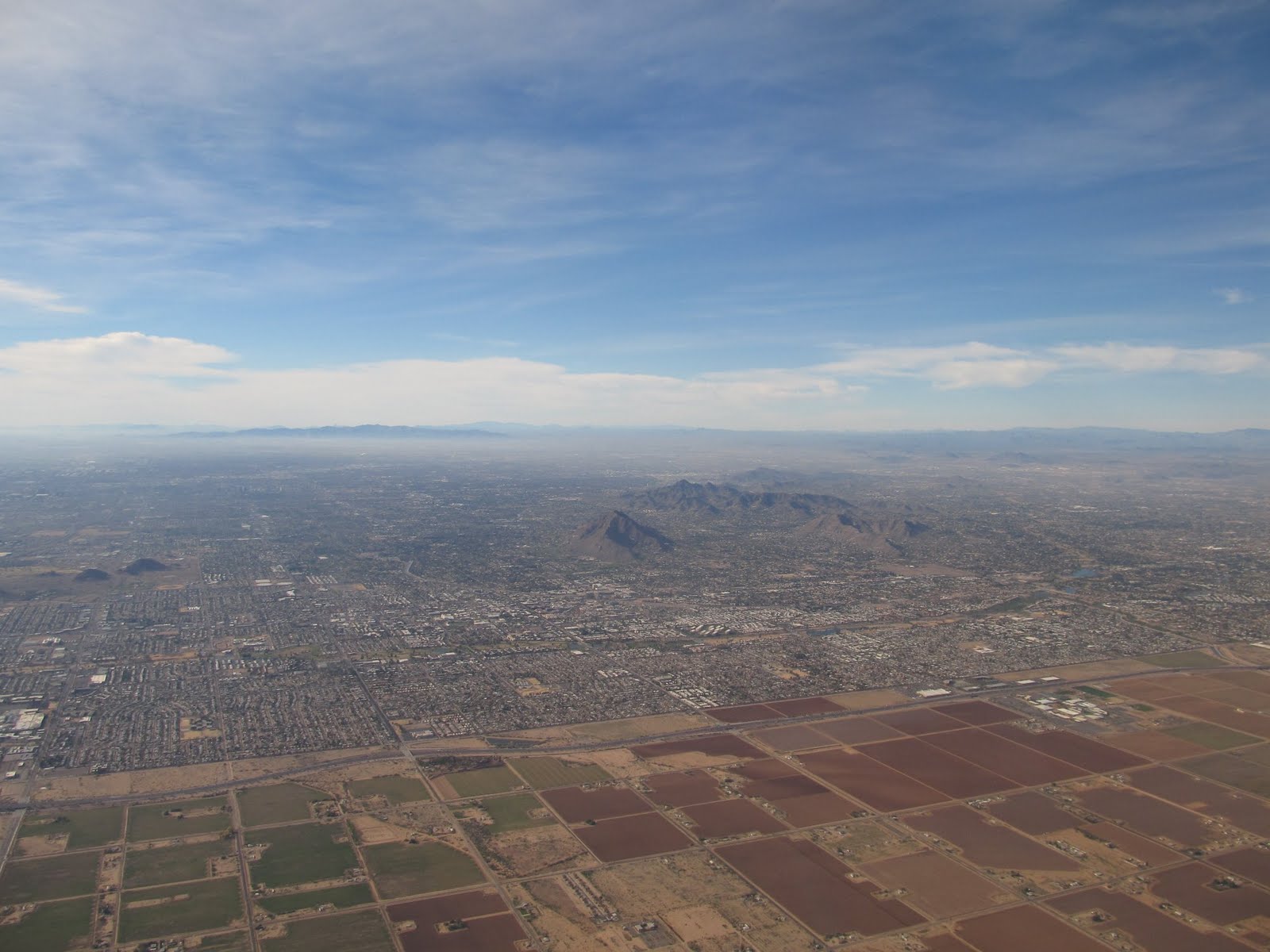
An aerial view of low-density suburban development in the Phoenix metropolitan area. Thank you, Phoenix, for always being there when I need to illustrate sprawl.
It begins with an idea that, in and of itself, isn't really offensive - rather than build new schools to support the city of Surrey's growing school-age population, just transport Surrey children to Vancouver schools. Now, I'm not sure how education is funded in British Columbia, whether tax revenues from each district support that district's schools, or if education taxes all go into a big hat and are redistributed by Victoria, or what - but if it's possible to keep existing schools open and use that $250 million for equally pressing things, such as transit expansion, it's something we should do.
But Ferry doesn't stop there. Instead, it's a segue on how Surrey is growing faster than Vancouver - hell, it's set to overtake Vancouver in population in the next few decades - "undoubtedly because it costs less to own or rent a fair-sized home there." This is true only because it's kept artificially so. I can't speak for rental rates there, because in my search for a place I didn't look anywhere south of the Fraser. I know enough to recognize that Vancouver is the hinge around which my life in the Lower Mainland pivots, even if I could never afford to actually own anything there.
The reason I chose not to put down rent in the Terminal City was because I placed a premium on easy access to the SkyTrain, and given the geography of development there were vast swathes of the city I ended up looking right past. I didn't even consider Surrey for the same reason - I have no interest in spending however long it may take to wait for a bus, for that bus to reach one of the four SkyTrain stations in northern Surrey, and for that SkyTrain to then wind its way downtown. My commute from New Westminster is more than long enough.
Ferry, however, couldn't be more supportive of Surrey and other suburbs built in the same image. He sees the idea of suburban sprawl as under attack by "city-centric politicians, ivory-tower professors and other politically correct members of the chattering classes" who advocate for "compact, multi-unit living" and "keep yammering on about the supposed evils of suburban sprawl." He discards the argument of densification as decreasing carbon dioxide emissions with one of the most ridiculous notes I've ever come across in a legitimate newspaper: "Let's forget for a moment whether human-induced CO2 emissions really cause global warming, which seems increasingly doubtful."
Fucking Christ! Does this man have any grasp of science whatsoever? Does he think that our factories, our coal-fired power plants, our cars' tailpipes emit some sort of "artificial carbon dioxide" or "CO2 plus" that doesn't act as a heat-trapping gas? Carbon dioxide has been known to act as a greenhouse gas for generations! Back in Grade 4, in 1990, I did a school essay on the greenhouse effect and used as sources already old library books that acknowledged the role of carbon dioxide in generating the greenhouse effect! This is not new science! The only thing new is the appearance of conservative idiots and corporate shills who have a vested interest in maintaining the status quo, or do not want to admit that their actions may be greatly harming the future and so look for other people to blame!
NYYYYAAAAAARRRRRRRGGGGGGHHHHHHHH
Okay. Okay. I'm good now. Before I go any further, I'd like to note that aside from an eleven-month stint between graduating university and finding a good job, I have lived in apartments since leaving home nearly ten years ago. I can understand what Ferry means when he says he left London because he wanted "a sizeable house, not a cramped apartment with thin walls." My apartment may not be cramped, but it's not uncommon for me to have to wait until the thumping of my neighbor's stereo disappears before turning in for the night. I'm not living in a single-family home; my residence is something much closer to the "eco-dense sardine cans" at which Ferry sneers. The life I lead is far, far preferable to one in the suburbs. I have no desire to ever get a house out in the sprawl. If ever I own anything, it will be a condo.
But no! According to the word of Ferry, suburbs are good. We have "oodles of space for housing, farming or doing whatever we damn well please," and that "we should be promoting suburban sprawl, not curbing it... and helping people own large, airy, stress-free houses."
These quotes are packed so full of asinine ridiculousness I barely know where to begin. I don't have to have been a homeowner to know that the idea of houses as "stress-free" is utterly insane. First, let's take a look at that scourge of every homeowner... the mortgage. Sure, it's basically a kind of rent that you pay to the bank, but at the end you own the house and can do with it as you please - whereas money you pay on rent, you never see again (except in the form of maintenance, management, common area lightbulb replacement, and all that other fun stuff). But I don't know of any rental contracts that have you continuing to pay for twenty or thirty or forty years. A lot can go wrong in that time. There's plenty of opportunity for rough patches. I doubt a bank would be more forgiving than a sympathetic landlord.
Second - yes, Canada does have a great deal of land available for housing, farming, or whatever. There's only one problem: it's the same damn land! Back in Ontario, hectares upon hectares of good agricultural land are plowed under every year to slap down yet another subdivision of cardboard estates. The Ontario government was forced to legislate protection for the environmentally-sensitive Oak Ridges Moraine, because the developers sure as hell wouldn't steer clear of it if they could make money slamming down suburbs. The more land is devoted to suburbs, the less there is for agriculture, and the more we depend on importation to survive. This is something that the Lower Mainland, being effectively an island, needs to be careful of. At one point this winter, the bread aisle at Safeway was nearly bare because an avalanche had closed the Trans-Canada and the shipment couldn't get through from Calgary. This is something I never encountered in Ontario.
Finally - promoting suburban sprawl. I had no idea that the Province had stationed columnists in the 1950s, because that's where this seems to be coming from. We've sprawled for decades, and what has it got us? Huge areas of low-density development that are difficult and expensive to serve with public transit, cut off from the services of the city and requiring a personal automobile in order to get anything done. Sprawl has had its chance, and given that we of the 21st century have the opportunity to take stock of our history and improve on our mistakes, to charge on with those mistakes because it is ideologically convenient is a crime against the future. Advocating the promotion of suburban sprawl is like advocating the installation of gas lamps in all the light standards on Columbia Street, because they look so much prettier than electrics.
I know that people like the idea of suburbs, that they seek the sense of "space and freedom" that Ferry lionizes. Sprawl is not the only way to get this - it's just the easiest way, the one that has seven decades' worth of memetic engineering working in its favor. We can have suburbs without having sprawl. I would've written on this today, but I've said enough for now. You want to know my alternative? Come back on Tuesday and I'll tell you what it is.
I don't hate suburbs themselves. It's more the manner in which the concept of suburbs has been realized over the last seventy years that I really disagree with. I grew up in a suburban development, and I learned well how isolating and artificial life there can be - and this was an inner suburb, close enough to my downtown high school that I could walk home in less than an hour. After twenty years of sprawling at the fringes, my old address is practically downtown. If not for the bus stop literally right across the street from the house, I don't know what I'd have done.
The point is, they're not for everyone - but the myopic focus upon suburban development that has dominated city planning across most of North America for the last seventy years has assumed just that. The problem is that the "truths" of the twentieth century aren't going to cut it anymore. We shouldn't continue to build low-density, car-centric developments - to blithely assume that we will always have a so-cheap-it-doesn't-matter power source to fuel our automobiles is a very large gamble, and it's one that would affect all of society if the wheel doesn't stop where the suburb boosters have put down their chips.
Not everyone, of course, sees it the same way I do. The other day, I had the dubious privilege of stumbling onto Jon Ferry's column in The Province - a paper which had never really seemed right-wing until that moment - a column which has got to be one of the most ill-informed, ideological, disingenuous pieces of twaddle I've ever encountered in a major newspaper. It starts even with the headline - "Suburban sprawl is what we really want."
Oh really, Jon Ferry. Well, thank god the drifting, voiceless people of British Columbia have you to tell them what they want.
An aerial view of low-density suburban development in the Phoenix metropolitan area. Thank you, Phoenix, for always being there when I need to illustrate sprawl.It begins with an idea that, in and of itself, isn't really offensive - rather than build new schools to support the city of Surrey's growing school-age population, just transport Surrey children to Vancouver schools. Now, I'm not sure how education is funded in British Columbia, whether tax revenues from each district support that district's schools, or if education taxes all go into a big hat and are redistributed by Victoria, or what - but if it's possible to keep existing schools open and use that $250 million for equally pressing things, such as transit expansion, it's something we should do.
But Ferry doesn't stop there. Instead, it's a segue on how Surrey is growing faster than Vancouver - hell, it's set to overtake Vancouver in population in the next few decades - "undoubtedly because it costs less to own or rent a fair-sized home there." This is true only because it's kept artificially so. I can't speak for rental rates there, because in my search for a place I didn't look anywhere south of the Fraser. I know enough to recognize that Vancouver is the hinge around which my life in the Lower Mainland pivots, even if I could never afford to actually own anything there.
The reason I chose not to put down rent in the Terminal City was because I placed a premium on easy access to the SkyTrain, and given the geography of development there were vast swathes of the city I ended up looking right past. I didn't even consider Surrey for the same reason - I have no interest in spending however long it may take to wait for a bus, for that bus to reach one of the four SkyTrain stations in northern Surrey, and for that SkyTrain to then wind its way downtown. My commute from New Westminster is more than long enough.
Ferry, however, couldn't be more supportive of Surrey and other suburbs built in the same image. He sees the idea of suburban sprawl as under attack by "city-centric politicians, ivory-tower professors and other politically correct members of the chattering classes" who advocate for "compact, multi-unit living" and "keep yammering on about the supposed evils of suburban sprawl." He discards the argument of densification as decreasing carbon dioxide emissions with one of the most ridiculous notes I've ever come across in a legitimate newspaper: "Let's forget for a moment whether human-induced CO2 emissions really cause global warming, which seems increasingly doubtful."
Fucking Christ! Does this man have any grasp of science whatsoever? Does he think that our factories, our coal-fired power plants, our cars' tailpipes emit some sort of "artificial carbon dioxide" or "CO2 plus" that doesn't act as a heat-trapping gas? Carbon dioxide has been known to act as a greenhouse gas for generations! Back in Grade 4, in 1990, I did a school essay on the greenhouse effect and used as sources already old library books that acknowledged the role of carbon dioxide in generating the greenhouse effect! This is not new science! The only thing new is the appearance of conservative idiots and corporate shills who have a vested interest in maintaining the status quo, or do not want to admit that their actions may be greatly harming the future and so look for other people to blame!
NYYYYAAAAAARRRRRRRGGGGGGHHHHHHHH
Okay. Okay. I'm good now. Before I go any further, I'd like to note that aside from an eleven-month stint between graduating university and finding a good job, I have lived in apartments since leaving home nearly ten years ago. I can understand what Ferry means when he says he left London because he wanted "a sizeable house, not a cramped apartment with thin walls." My apartment may not be cramped, but it's not uncommon for me to have to wait until the thumping of my neighbor's stereo disappears before turning in for the night. I'm not living in a single-family home; my residence is something much closer to the "eco-dense sardine cans" at which Ferry sneers. The life I lead is far, far preferable to one in the suburbs. I have no desire to ever get a house out in the sprawl. If ever I own anything, it will be a condo.
But no! According to the word of Ferry, suburbs are good. We have "oodles of space for housing, farming or doing whatever we damn well please," and that "we should be promoting suburban sprawl, not curbing it... and helping people own large, airy, stress-free houses."
These quotes are packed so full of asinine ridiculousness I barely know where to begin. I don't have to have been a homeowner to know that the idea of houses as "stress-free" is utterly insane. First, let's take a look at that scourge of every homeowner... the mortgage. Sure, it's basically a kind of rent that you pay to the bank, but at the end you own the house and can do with it as you please - whereas money you pay on rent, you never see again (except in the form of maintenance, management, common area lightbulb replacement, and all that other fun stuff). But I don't know of any rental contracts that have you continuing to pay for twenty or thirty or forty years. A lot can go wrong in that time. There's plenty of opportunity for rough patches. I doubt a bank would be more forgiving than a sympathetic landlord.
Second - yes, Canada does have a great deal of land available for housing, farming, or whatever. There's only one problem: it's the same damn land! Back in Ontario, hectares upon hectares of good agricultural land are plowed under every year to slap down yet another subdivision of cardboard estates. The Ontario government was forced to legislate protection for the environmentally-sensitive Oak Ridges Moraine, because the developers sure as hell wouldn't steer clear of it if they could make money slamming down suburbs. The more land is devoted to suburbs, the less there is for agriculture, and the more we depend on importation to survive. This is something that the Lower Mainland, being effectively an island, needs to be careful of. At one point this winter, the bread aisle at Safeway was nearly bare because an avalanche had closed the Trans-Canada and the shipment couldn't get through from Calgary. This is something I never encountered in Ontario.
Finally - promoting suburban sprawl. I had no idea that the Province had stationed columnists in the 1950s, because that's where this seems to be coming from. We've sprawled for decades, and what has it got us? Huge areas of low-density development that are difficult and expensive to serve with public transit, cut off from the services of the city and requiring a personal automobile in order to get anything done. Sprawl has had its chance, and given that we of the 21st century have the opportunity to take stock of our history and improve on our mistakes, to charge on with those mistakes because it is ideologically convenient is a crime against the future. Advocating the promotion of suburban sprawl is like advocating the installation of gas lamps in all the light standards on Columbia Street, because they look so much prettier than electrics.
I know that people like the idea of suburbs, that they seek the sense of "space and freedom" that Ferry lionizes. Sprawl is not the only way to get this - it's just the easiest way, the one that has seven decades' worth of memetic engineering working in its favor. We can have suburbs without having sprawl. I would've written on this today, but I've said enough for now. You want to know my alternative? Come back on Tuesday and I'll tell you what it is.
Labels:
british columbia,
choice,
cities,
environment,
suburbs
Saturday, March 5, 2011
Photo: Staring Down a Streetcar
I may have to go and visit Seattle soon, if only because it doesn't feel right for there to be so many roads around here with no rails in them. Not like Toronto, where despite the puff and bluster of hizzoner da mayor, thus far at least they continue rumbling down the lanes just as they have for the last hundred and fifty years. Except they're not pulled by horses anymore, like they were at the beginning.
Here, CLRV 4130 takes on passengers at the intersection of Yonge and King on a westbound 501 King run in July 2010 - the way I got home back when I still lived there.
I, the copyright holder of this work, hereby release it under the Creative Commons Attribution-Non Commercial-Share Alike 3.0 Unported license.
This means that you are free to Share (to copy, distribute and transmit the work) and to Remix (to adapt the work) under the following conditions: Attribution (you must attribute the work in the manner specified by the author or licensor, but not in any way that suggests that they endorse you or your use of the work), Noncommercial (you may not use this work for commercial purposes), and Share Alike (if you alter, transform, or build upon this work, you may distribute the resulting work only under the same or similar license to this one).
Here, CLRV 4130 takes on passengers at the intersection of Yonge and King on a westbound 501 King run in July 2010 - the way I got home back when I still lived there.
I, the copyright holder of this work, hereby release it under the Creative Commons Attribution-Non Commercial-Share Alike 3.0 Unported license.This means that you are free to Share (to copy, distribute and transmit the work) and to Remix (to adapt the work) under the following conditions: Attribution (you must attribute the work in the manner specified by the author or licensor, but not in any way that suggests that they endorse you or your use of the work), Noncommercial (you may not use this work for commercial purposes), and Share Alike (if you alter, transform, or build upon this work, you may distribute the resulting work only under the same or similar license to this one).
Friday, March 4, 2011
There Ain't No Such Thing As A Free Laundry
Ten years ago, universities were at last taking an interest in Barrie Central Collegiate's class of 2001. I remember that time well - it was stressful, trying to figure out where to go, weighing the advantages of one university against another, and hoping that the one you wanted wouldn't reject you. Nevertheless, the fact was that for an OAC student at that time, if you had the means there was one university that would absolutely take you: Carleton University in Ottawa. I clearly recall the time in Writer's Craft class where Expressposted application packages from Carleton arrived for everyone in the class, no questions asked. I don't know if it's changed in the last decade, but back then the joke was that the only thing you needed to attend Carleton was a pulse... and even that might have been negotiable.
It's been years since I thought about Carleton - the only reason I am now is because of an article on CBC News which demonstrates that a sense of ethics is another thing you don't necessarily need to go to Carleton. But I'll admit that's a cheap shot, though - not to mention unfair. This sort of thing could have happened anywhere.
This sort of thing was the abuse of a computer glitch in the dorm's laundry - as a result, one particular machine would process payment for a load without actually deducting it from the student's card, and the system was set up in such a way that students exploiting this glitch could then use any machine for free. To say that it caught on is understating the situation a bit; before this loophole was noticed, students ran up $28,000 in free laundry charges - charges that the university is now charging back to them.
The CBC News story reports that some students "are furious with the university's decision to nail them with an unforeseen fee." The way I see it, they should be furious with themselves, their teachers, or their parents for not instilling them with ethics or an awareness of what "free" is. All too often, people don't stop to consider that free is just another way of saying "someone else paid for this."
The story also provides a student quote that nearly bowled me over from the sheer entitlement of it - "As a student you just gotta kind of go for the cheapest route. And if that comes down to kind of screwing the laundry machine for free laundry machine services … then of course why wouldn't you, right?"
Because it's wrong. Because it's unethical. Because, if you really need some reason that can be denominated in dollars and cents, the university will be forced to jack up its tuition fees to cover the money it loses from students abusing the system - or it would have had to, had it not put the responsibility back on those who created it in the first place.
It's true that people steal casually - because they don't bother to worry their pretty little heads about what they're doing, or they chase themselves around in circles justifying it. Back when I was in university I worked as a gas station attendant for some extra bucks, and there were times where people would glug down $5 or $10 or $15 worth of gasoline and then drive off before I could get their license plate number down. Maybe they really were desperate - or maybe they just didn't care, or told themselves they were stealing from some big, faceless corporation - which, as The Simpsons tells us, makes it okay. But that money came out of my paycheck, one that was never very big to begin with.
Maybe we need more of an emphasis on basic ethics in education. It's sad that this sort of thing doesn't seem to be emphasized in many families, and we can see the results now - how much of the Wall Street antics that led up to the economic crash would you quantify as ethical?
TANSTAAFL!
Thursday, March 3, 2011
Photo: One Rusted Rail
For a city that owes its existence to the railway, it's surprising to see how much abandoned railway infrastructure there seems to be in Vancouver. I came across one overgrown line while on walkabout at West Broadway and Arbutus, and tracked it until it ended without fanfare at a chain-link fence near Granville Island. It's one of the multiple routes I checked a while ago through Google Maps, looking for a pattern of rails that could take West Coast Express trains to Surrey; this line is obviously not exactly one of the top contenders. Beyond Broadway, the rails are mostly overgrown, and through Kits part of the right-of-way has been converted into community garden plots.
I, the copyright holder of this work, hereby release it under the Creative Commons Attribution-Non Commercial-Share Alike 3.0 Unported license.
This means that you are free to Share (to copy, distribute and transmit the work) and to Remix (to adapt the work) under the following conditions: Attribution (you must attribute the work in the manner specified by the author or licensor, but not in any way that suggests that they endorse you or your use of the work), Noncommercial (you may not use this work for commercial purposes), and Share Alike (if you alter, transform, or build upon this work, you may distribute the resulting work only under the same or similar license to this one).
I, the copyright holder of this work, hereby release it under the Creative Commons Attribution-Non Commercial-Share Alike 3.0 Unported license.This means that you are free to Share (to copy, distribute and transmit the work) and to Remix (to adapt the work) under the following conditions: Attribution (you must attribute the work in the manner specified by the author or licensor, but not in any way that suggests that they endorse you or your use of the work), Noncommercial (you may not use this work for commercial purposes), and Share Alike (if you alter, transform, or build upon this work, you may distribute the resulting work only under the same or similar license to this one).
Wednesday, March 2, 2011
Passing for Passes
It's the start of a new month, and aside from saying goodbye to another raft of dollars in the form of rent, that means it's the time to replace my monthly transit pass. I've used these to get around for nearly four years now, first in Toronto and now in New Westminster, and I like the sort of life I can lead when I carry my wheels around in my wallet. The only time it ever gets dicey, come to that, is when I have to replace it. Actually, I had a slight scare this time - when I went to my usual place to pick up a March pass on February 28th, the clerk said that he was sold out - and he wouldn't be getting more.
As it turned out, they did get more the next day. But I did have reason to be worried. Unlike in Toronto, where you can buy a monthly Metropass at any point during the month in question - though I don't know why you would bother if it's more than half over, since in that situation you could use weekly passes just as easily - TransLink monthly passes are available only during "the last few days of the preceding month as well as the first few days of the applicable month." They're not any more specific than that... but even then, that leaves a bad taste in my mouth.
What makes this an even more potentially thorny issue is that TransLink, for reasons I cannot fathom, does not sell weekly passes at all - the fare structure jumps directly from DayPasses to monthly passes. Had I been unable to find a two-zone card - necessary, since New Westminster is in fare zone 2 - I would have had no option but to burn through $3.75 FareSaver tickets to get to Vancouver during the day.
Part of this is due to the differences in customer service intrinsic between the systems in Vancouver and Toronto. I never had to worry about replacing my Metropass when I still lived in Toronto, because I could buy a new one from the collector in any station, or alternatively from one of the pass vending machines that started to appear in 2009. I can't understand why transit passes, of all things, would be subject to artificial scarcity here in Metro Vancouver. I mean, look at it. It's not as if it's packed full of advanced technology.
Clockwise from upper left: a TransLink two-zone FareCard, a Toronto Transit Commission Metropass, and a Los Angles County Metropolitan Transportation Authority TAP card.
The TransLink fare card is, in fact, the least technologically advanced of the three pictured above. It is nothing more than a printed piece of paper. Metropasses have magnetic strips to unlock the turnstiles at subway stations, and I believe that the TAP cards may have RFID stuff all up ins. This will change eventually; fare gates will likely be installed in the SkyTrain in the not-too-distant future, and TransLink is paving the way for a new fare card system similar to TAP - I voted to call it Compass, myself.
It's not like I can just go to one of the ticket vending machines at any SkyTrain station and buy a monthly pass, though. For whatever reason - some strange and unspoken reason, one I'd be interested in knowing - they're not sold via the TVMs. Every other kind of fare is, but not monthly passes. If it was something more sophisticated, like a magnetic strip card or a TAP card, I might understand - but in Toronto and Los Angeles, both of those can be got through vending machines.
I have my March pass - but every once in a while, I do worry about the prospects of a day where for whatever reason, I'm not able to find the next month's. I like my transit pass tax deductions, after all.
As it turned out, they did get more the next day. But I did have reason to be worried. Unlike in Toronto, where you can buy a monthly Metropass at any point during the month in question - though I don't know why you would bother if it's more than half over, since in that situation you could use weekly passes just as easily - TransLink monthly passes are available only during "the last few days of the preceding month as well as the first few days of the applicable month." They're not any more specific than that... but even then, that leaves a bad taste in my mouth.
What makes this an even more potentially thorny issue is that TransLink, for reasons I cannot fathom, does not sell weekly passes at all - the fare structure jumps directly from DayPasses to monthly passes. Had I been unable to find a two-zone card - necessary, since New Westminster is in fare zone 2 - I would have had no option but to burn through $3.75 FareSaver tickets to get to Vancouver during the day.
Part of this is due to the differences in customer service intrinsic between the systems in Vancouver and Toronto. I never had to worry about replacing my Metropass when I still lived in Toronto, because I could buy a new one from the collector in any station, or alternatively from one of the pass vending machines that started to appear in 2009. I can't understand why transit passes, of all things, would be subject to artificial scarcity here in Metro Vancouver. I mean, look at it. It's not as if it's packed full of advanced technology.
Clockwise from upper left: a TransLink two-zone FareCard, a Toronto Transit Commission Metropass, and a Los Angles County Metropolitan Transportation Authority TAP card.The TransLink fare card is, in fact, the least technologically advanced of the three pictured above. It is nothing more than a printed piece of paper. Metropasses have magnetic strips to unlock the turnstiles at subway stations, and I believe that the TAP cards may have RFID stuff all up ins. This will change eventually; fare gates will likely be installed in the SkyTrain in the not-too-distant future, and TransLink is paving the way for a new fare card system similar to TAP - I voted to call it Compass, myself.
It's not like I can just go to one of the ticket vending machines at any SkyTrain station and buy a monthly pass, though. For whatever reason - some strange and unspoken reason, one I'd be interested in knowing - they're not sold via the TVMs. Every other kind of fare is, but not monthly passes. If it was something more sophisticated, like a magnetic strip card or a TAP card, I might understand - but in Toronto and Los Angeles, both of those can be got through vending machines.
I have my March pass - but every once in a while, I do worry about the prospects of a day where for whatever reason, I'm not able to find the next month's. I like my transit pass tax deductions, after all.
Tuesday, March 1, 2011
Photo: Squirrel of Secrets
I first noticed this squirrel while it was climbing up a tree along Fourth Street in New Westminster. It knows the score. Just look at its eye. You can see everything going around in there, plans we'll never know or understand. Oh yeah. It knows.
I just wish that branch wasn't between it and the lens.
I, the copyright holder of this work, hereby release it under the Creative Commons Attribution-Non Commercial-Share Alike 3.0 Unported license.
This means that you are free to Share (to copy, distribute and transmit the work) and to Remix (to adapt the work) under the following conditions: Attribution (you must attribute the work in the manner specified by the author or licensor, but not in any way that suggests that they endorse you or your use of the work), Noncommercial (you may not use this work for commercial purposes), and Share Alike (if you alter, transform, or build upon this work, you may distribute the resulting work only under the same or similar license to this one).
I just wish that branch wasn't between it and the lens.
I, the copyright holder of this work, hereby release it under the Creative Commons Attribution-Non Commercial-Share Alike 3.0 Unported license.This means that you are free to Share (to copy, distribute and transmit the work) and to Remix (to adapt the work) under the following conditions: Attribution (you must attribute the work in the manner specified by the author or licensor, but not in any way that suggests that they endorse you or your use of the work), Noncommercial (you may not use this work for commercial purposes), and Share Alike (if you alter, transform, or build upon this work, you may distribute the resulting work only under the same or similar license to this one).
Subscribe to:
Posts (Atom)