We like to believe that the aristocracy is a thing of the past, that in the modern world people ascend to the high strata of government and society based on merit and skill and not blood, and that any one of us can grow up to be the President someday, so long as you're a natural-born American citizen - because, let's face it, "you can be anything you want to be, even Secretary-General of the United Nations" doesn't quite have the same resonance for a kid. Maybe, in some limited respects, it's even true.
Ultimately, it doesn't make a difference. Whether we have an aristocracy of blood, an aristocracy of wealth, or an aristocracy of talent, human nature means they will all act in broadly similar ways - whether it's enriching themselves at the expense of the ordinary people, doing favors for their friends even if society as a whole would be harmed as a result - witness Prime Minister Stephen Harper's championing of a renewed Bill C-61, something the big American entertainment conglomerates love - and generally acting as if their own interests are of more value than the interests of society.
Next month's G20 summit, taking place right here in downtown Toronto, is putting this all into stark perspective for me. I'll admit that the summit organizers are at least dimly aware of and thus somewhat responsive to the city that will be hosting their meeting - witness the relocation of the "free speech zone," itself a wonderfully democratic innovation, from the residential Trinity-Bellwoods Park on Queen Street West to Queen's Park.
Nevertheless, the fact remains that because the world leaders, or the organization coordinating their meeting, are so wedded to "traditional" ways of getting things done, the people of Toronto are going to have a sneak peek at what a police state looks like. From what I've heard there will be three-meter-high fencing downtown, security screenings for pedestrians and drivers entering the downtown core, cameras everywhere, and $1-billion in security spread between Toronto and the G8 summit in Huntsville. Where, I have to ask, is the justification for all this? In what universe is it acceptable to throw down the locks on a city for no other apparent reason than that cities are always where conferences happen?
In the past, aristocrats were always about appearances. They had to be, because otherwise no one would know who was in charge and who was lesser, and who could run a kingdom like that? Take, say, Louis XIV of France. In that painting on Wikipedia he looks, to me, like a laughable fop - that's what three hundred years of fashion shift will do, and I have little reason to hold monarchs in any esteem - but at the time, what he was wearing was stylin'. Mainly because he was wearing it. Today, it's somewhat different - the business suit is a remarkable leveller - but only somewhat. Prestige is still important, and prestige is one of the few reasonable explanations I can think of as to why the federal government would choose to hold the G20 summit in downtown Toronto rather than something more easily secured, like Exhibition Place or a military base.
Whether or not it's a desire to avoid a "loss of face" that would occur if the G20 was held somewhere reasonable and not a major metropolis, or something else entirely, I can only speculate. It doesn't matter, though. The aristocrats will almost always get their way.

Wednesday, May 26, 2010


Tuesday, May 25, 2010
PDP #225: The House of Caecilius
Plenty of people find it odd when I mention that while I stopped studying French in Grade 10, I studied Latin all throughout high school. There are some schools that do still offer Latin programs, and Barrie Central Collegiate in the late '90s was one of them. The curriculum was based on the Cambridge Latin Course coursebooks, focusing first on a family living in the last days of Pompeii - Lucius Caecilius Iucundus, his wife, his son, their dog and their slaves.
Caecilius, at least, was a real person, though more recent discoveries suggest that he died a considerable time before the eruption of Mount Vesuvius in 0079. While in Pompeii back in 1998, one of the places we stopped at was his house on Stabiae Street, where two thousand years ago Caecilius in horto sedet.
 I, the copyright holder of this work, hereby release it into the public domain. This applies worldwide. In case this is not legally possible, I grant anyone the right to use this work for any purpose, without any conditions, unless such conditions are required by law.
Caecilius, at least, was a real person, though more recent discoveries suggest that he died a considerable time before the eruption of Mount Vesuvius in 0079. While in Pompeii back in 1998, one of the places we stopped at was his house on Stabiae Street, where two thousand years ago Caecilius in horto sedet.
 I, the copyright holder of this work, hereby release it into the public domain. This applies worldwide. In case this is not legally possible, I grant anyone the right to use this work for any purpose, without any conditions, unless such conditions are required by law.
Monday, May 24, 2010
An Antidote to Anti-Light Rail Venom
A couple of weeks ago, I wrote a post that dealt in part with the bad rap that light rail unjustly has in Toronto. One comment I got on Twitter, in response to the question of why it seems conservatives exalt subways over light rail, was that "LRT only looks cheaper - [it] destroys businesses over short and long term, [and] destroys neighborhoods with grade separation." This is hardly a unique perspective; back in March, the National Post reported on a coalition of merchants along St. Clair Avenue West suing the City of Toronto for $100-million for gross negligence, public abuse of authority, and so on.
The true problem is that even though this is that, rather unfairly, the overruns and delays surrounding the St. Clair West right-of-way have become closely associated with the entire idea of light rail in the minds of many Torontonians, particularly those who weren't that closely acquainted with it before. What I take issue with is the casual assumption that this is the way it always has to be - that it's impossible to build new streetcar or light rail lines without causing street chaos for years on end. Fortunately, we don't even have to leave Toronto to find a counter-example.
 South of Front, north of Bremner, this doesn't look like a destroyed neighborhood to me.
Spadina Avenue has a long history of streetcar service, going back to the late nineteenth century, but in two distinct ages. In 1948, the original Spadina streetcar gave way to the Shuffle Demons' beloved Spadina bus, and in 1966 all track on Spadina except that between King and College was ripped up. That was the situation until the 1990s, when work began on a reactivation of the Spadina streetcar and its extension south to Harbourfront. Spadina merchants don't seem to have welcomed it with open arms at the time - Transit Toronto reports that busineses "were concerned over the loss of parking" and believed that the right-of-way - itself a rather simpler and more unobtrusive design that would be built on St. Clair West two decades later - would "act as a 'Berlin Wall' down the middle of the street."
If you've been to Spadina recently, it's clear that the worst fears of merchants along it did not come to pass. Spadina remains heavily travelled by pedestrians, motorists, and streetcars, and thirteen years after the completion of the right-of-way the streetscape seems to be chugging along. Similarly, by 2023 I would hope that opinions will have cooled regarding the right-of-way construction on St. Clair West.
What it comes down to is that construction overruns like this are not an intrinsic property of on-surface urban rail construction. It's a problem that has many generators, from a laundry list of inefficient contractors to poor coordination to a lack of central planning and the eight-month judicial freeze slapped on the project at the behest of Save Our St. Clair. We can't let one poor flavor poison the debate forever.
The true problem is that even though this is that, rather unfairly, the overruns and delays surrounding the St. Clair West right-of-way have become closely associated with the entire idea of light rail in the minds of many Torontonians, particularly those who weren't that closely acquainted with it before. What I take issue with is the casual assumption that this is the way it always has to be - that it's impossible to build new streetcar or light rail lines without causing street chaos for years on end. Fortunately, we don't even have to leave Toronto to find a counter-example.
 South of Front, north of Bremner, this doesn't look like a destroyed neighborhood to me.
Spadina Avenue has a long history of streetcar service, going back to the late nineteenth century, but in two distinct ages. In 1948, the original Spadina streetcar gave way to the Shuffle Demons' beloved Spadina bus, and in 1966 all track on Spadina except that between King and College was ripped up. That was the situation until the 1990s, when work began on a reactivation of the Spadina streetcar and its extension south to Harbourfront. Spadina merchants don't seem to have welcomed it with open arms at the time - Transit Toronto reports that busineses "were concerned over the loss of parking" and believed that the right-of-way - itself a rather simpler and more unobtrusive design that would be built on St. Clair West two decades later - would "act as a 'Berlin Wall' down the middle of the street."
If you've been to Spadina recently, it's clear that the worst fears of merchants along it did not come to pass. Spadina remains heavily travelled by pedestrians, motorists, and streetcars, and thirteen years after the completion of the right-of-way the streetscape seems to be chugging along. Similarly, by 2023 I would hope that opinions will have cooled regarding the right-of-way construction on St. Clair West.
What it comes down to is that construction overruns like this are not an intrinsic property of on-surface urban rail construction. It's a problem that has many generators, from a laundry list of inefficient contractors to poor coordination to a lack of central planning and the eight-month judicial freeze slapped on the project at the behest of Save Our St. Clair. We can't let one poor flavor poison the debate forever.
Sunday, May 23, 2010
PDP #224: Ready to GO
GO Transit operates one of the largest commuter rail networks in North America. Unsurprisingly, it takes a great many trains to service that network. This past Friday, while on my way to Harbourfront, I found a veritable army of GO rolling stock camped out at the North Bathurst Yard under Spadina Avenue, waiting for the afternoon and evening trips to Richmond Hill, Barrie, Stouffville, and so on. It really made me appreciate the scale of the operation; when all you usually see is one train pushing into or out of a station, it's easier to take it for granted.
Fun fact: there areeighty seventy Bombardier Bi-Level Coaches in this photograph - more than the total inventory of any single agency operating them, save GO Transit itself and Metrolink in Los Angeles.
EDIT: I miscounted - one of the trains was counted twice. Still, the fun fact holds: the third-largest inventory of Bi-Levels is held by Sounder Commuter Rail in Seattle, which operates fifty-eight of them.
 I, the copyright holder of this work, hereby release it into the public domain. This applies worldwide. In case this is not legally possible, I grant anyone the right to use this work for any purpose, without any conditions, unless such conditions are required by law.
Fun fact: there are
EDIT: I miscounted - one of the trains was counted twice. Still, the fun fact holds: the third-largest inventory of Bi-Levels is held by Sounder Commuter Rail in Seattle, which operates fifty-eight of them.
 I, the copyright holder of this work, hereby release it into the public domain. This applies worldwide. In case this is not legally possible, I grant anyone the right to use this work for any purpose, without any conditions, unless such conditions are required by law.
Saturday, May 22, 2010
Farming Up, Plowing Under
One aspect of the future that didn't show up very much in science fiction, but which is lurching toward reality at an increasingly rapid pace, is the concept of vertical farming - that is, agriculture conducted not on a traditional farm, but within a purpose-built skyscraper. The true effectiveness of large-scale vertical farming is still up in the air, owing to the newness of the concept, but if it lives up to the possibilities it may well revolutionize patterns of development in the twenty-first century. If we're looking to build a resilent society, bringing food production into the city is a necessity - municipalities today do not maintain strategic food reserves.
What I've been thinking about recently are some of the other potential consequences of a shift in agriculture from traditional rural to controlled urban methods, particularly in terms of land use. It can be argued that, in addition to their agricultural role, farms also end up serving as "land banks" - just as banks will give you interest on your savings account in exchange for letting them work with your money in the meantime, farms reap rewards out of the soil until some developer comes along, buys out the farmers, and slaps down a soulless cookie-cutter subdivision with streets all named after the sort of things that used to grow there. This happens again and again in Ontario - just recently, a pioneering project to stem the town of Markham's sprawl into adjacent farmlands was rejected, thanks in part to the ceaseless pressure of developers who, it seems, won't be happy until every patch of green is plowed under.
A large-scale shift to vertical farming, should it live up to expectations, could upset this balance in many ways. Farming is, to be blunt, not the sort of profession that makes a person rich. If agriculture starts moving away from farmers' fields into controlled environments, it might not take long to reach a tipping point where farms become valuable only for the land they're sitting on - perhaps sparking a land rush among developers jockeying for the best territory on which to put their empty suburbs. That, in turn, could bury any shot at suburban densification.
It wouldn't necessarily have to be that way, though. Ontario already has a provincially-protected Greenbelt and has made an attempt at conserving the environmentally-sensitive Oak Ridges Moraine, although admittedly the enforcement of that protection has been spotty at best considering 200,000 people already live within it. A sufficiently forward-looking government could buy up the land ahead of the developers, perhaps to set up a network of provincial parks and secure the land against the relentless pace of development. There's no reason other governments in other jurisdictions couldn't do similar things.
The plowing-under of nature is, regrettably, one of the things that did frequently appear in science fiction, and which has long since become science fact. If urban agriculture does lead to the contraction of rural farmland, if we move fast enough we may yet stand in the bulldozers' way.
What I've been thinking about recently are some of the other potential consequences of a shift in agriculture from traditional rural to controlled urban methods, particularly in terms of land use. It can be argued
 that, in addition to their agricultural role, farms also end up serving as "land banks" - just as banks will give you interest on your savings account in exchange for letting them work with your money in the meantime, farms reap rewards out of the soil until some developer comes along, buys out the farmers, and slaps down a soulless cookie-cutter subdivision with streets all named after the sort of things that used to grow there. This happens again and again in Ontario - just recently, a pioneering project to stem the town of Markham's sprawl into adjacent farmlands was rejected, thanks in part to the ceaseless pressure of developers who, it seems, won't be happy until every patch of green is plowed under.
A large-scale shift to vertical farming, should it live up to expectations, could upset this balance in many ways. Farming is, to be blunt, not the sort of profession that makes a person rich. If agriculture starts moving away from farmers' fields into controlled environments, it might not take long to reach a tipping point where farms become valuable only for the land they're sitting on - perhaps sparking a land rush among developers jockeying for the best territory on which to put their empty suburbs. That, in turn, could bury any shot at suburban densification.
It wouldn't necessarily have to be that way, though. Ontario already has a provincially-protected Greenbelt and has made an attempt at conserving the environmentally-sensitive Oak Ridges Moraine, although admittedly the enforcement of that protection has been spotty at best considering 200,000 people already live within it. A sufficiently forward-looking government could buy up the land ahead of the developers, perhaps to set up a network of provincial parks and secure the land against the relentless pace of development. There's no reason other governments in other jurisdictions couldn't do similar things.
The plowing-under of nature is, regrettably, one of the things that did frequently appear in science fiction, and which has long since become science fact. If urban agriculture does lead to the contraction of rural farmland, if we move fast enough we may yet stand in the bulldozers' way.
Friday, May 21, 2010
PDP #223: A Bird in the Fence
Plenty of animals have adapted to the city life. Whether it's birds that have learned how to ride the subway or the incredibly fat pigeon I found just chilling in London Victoria station in 2004, their presence enriches the city - think about what it would be like if there was no birdsong echoing along quiet streets. I'm no ornithologist, so I have no idea what kind of bird this is, but I know it looked perfectly in its element while hanging out in the middle of a chain link fence at Monarch Park Collegiate along Coxwell Avenue.
 I, the copyright holder of this work, hereby release it into the public domain. This applies worldwide. In case this is not legally possible, I grant anyone the right to use this work for any purpose, without any conditions, unless such conditions are required by law.
 I, the copyright holder of this work, hereby release it into the public domain. This applies worldwide. In case this is not legally possible, I grant anyone the right to use this work for any purpose, without any conditions, unless such conditions are required by law.
Thursday, May 20, 2010
Don't Trust the Signal
A progressively more common element I've been noticing in modern future forecasts is the idea that interconnection will make it easier for people to live their lives without leaving their houses. An early example occurred in Oath of Fealty, where one of the Todos Santos residents made a living by remote-driving lunar construction equipment. As the web becomes more and more ubiquitous and capable, it's not only going to revolutionize telecommunication - it's got the potential to revolutionize life in general, our work time and our leisure time both. The important question is whether or not it should revolutionize things to the degree that it can.
One of the themes I tend to revisit is this: "there's no substitute for reality." This is something I wholeheartedly believe - that experiencing something through the intermediary of a glowing screen or words on a page can never measure up with direct experience. I wish I didn't have to state this, as it seems incredibly obvious - but what's obvious to one person is not necessarily so to another. Moreover, I can already see today the beginnings of reality manipulation. Take augmented reality, for instance. Today it's purely ordinary - you hold up an iPhone in front of your face, and you see a bit into the electronic world - but how long will it be before augmented reality devices not only become more immersive, but become capable of editing things out of a wearer's view of the world?
Imagine a world of cheap vacations, but where you never leave your house - you "go on vacation" remotely, a probe your proxy. Expedia.ca did something like this for their April Fool's gag this year, Virtual Vacations - it took me a few minutes to realize that it was fake, because it's the sort of thing I can imagine people actually paying for. Who needs the mind-opening experience of going to new places, experiencing new situations first-hand, when you can just sit in the comfort of home and watch it on your screen? For that matter, who's to say what you're even watching is accurate? Video feeds can be tampered with, and "vacation remotes" can be set down in Potemkin tourist zones. Why should the destination risk any chance at a poor remote vacation? Do the remote vacationers really have to know they're taking their vacations in some soundstage?
Dynamism depends on challenging boundaries. We can't expect to maintain a vibrant and dynamic society if more and more people become more and more content with the prospect of staying in their homes all the time. If people are to live, they can't do it through intermediaries - it really should be direct, or not at all.
One of the themes I tend to revisit is this: "there's no substitute for reality." This is something I wholeheartedly believe - that experiencing something through the intermediary of a glowing screen or words on a page can never measure up with direct experience. I wish I didn't have to state this, as it seems incredibly obvious - but what's obvious to one person is not necessarily so to another. Moreover, I can already see today the beginnings of reality manipulation. Take augmented reality, for instance. Today it's purely ordinary - you hold up an iPhone in front of your face, and you see a bit into the electronic world - but how long will it be before augmented reality devices not only become more immersive, but become capable of editing things out of a wearer's view of the world?
Imagine a world of cheap vacations, but where you never leave your house - you "go on vacation" remotely, a probe your proxy. Expedia.ca did something like this for their April Fool's gag this year, Virtual Vacations - it took me a few minutes to realize that it was fake, because it's the sort of thing I can imagine people actually paying for. Who needs the mind-opening experience of going to new places, experiencing new situations first-hand, when you can just sit in the comfort of home and watch it on your screen? For that matter, who's to say what you're even watching is accurate? Video feeds can be tampered with, and "vacation remotes" can be set down in Potemkin tourist zones. Why should the destination risk any chance at a poor remote vacation? Do the remote vacationers really have to know they're taking their vacations in some soundstage?
Dynamism depends on challenging boundaries. We can't expect to maintain a vibrant and dynamic society if more and more people become more and more content with the prospect of staying in their homes all the time. If people are to live, they can't do it through intermediaries - it really should be direct, or not at all.
Wednesday, May 19, 2010
PDP #222: Running Off the Rails
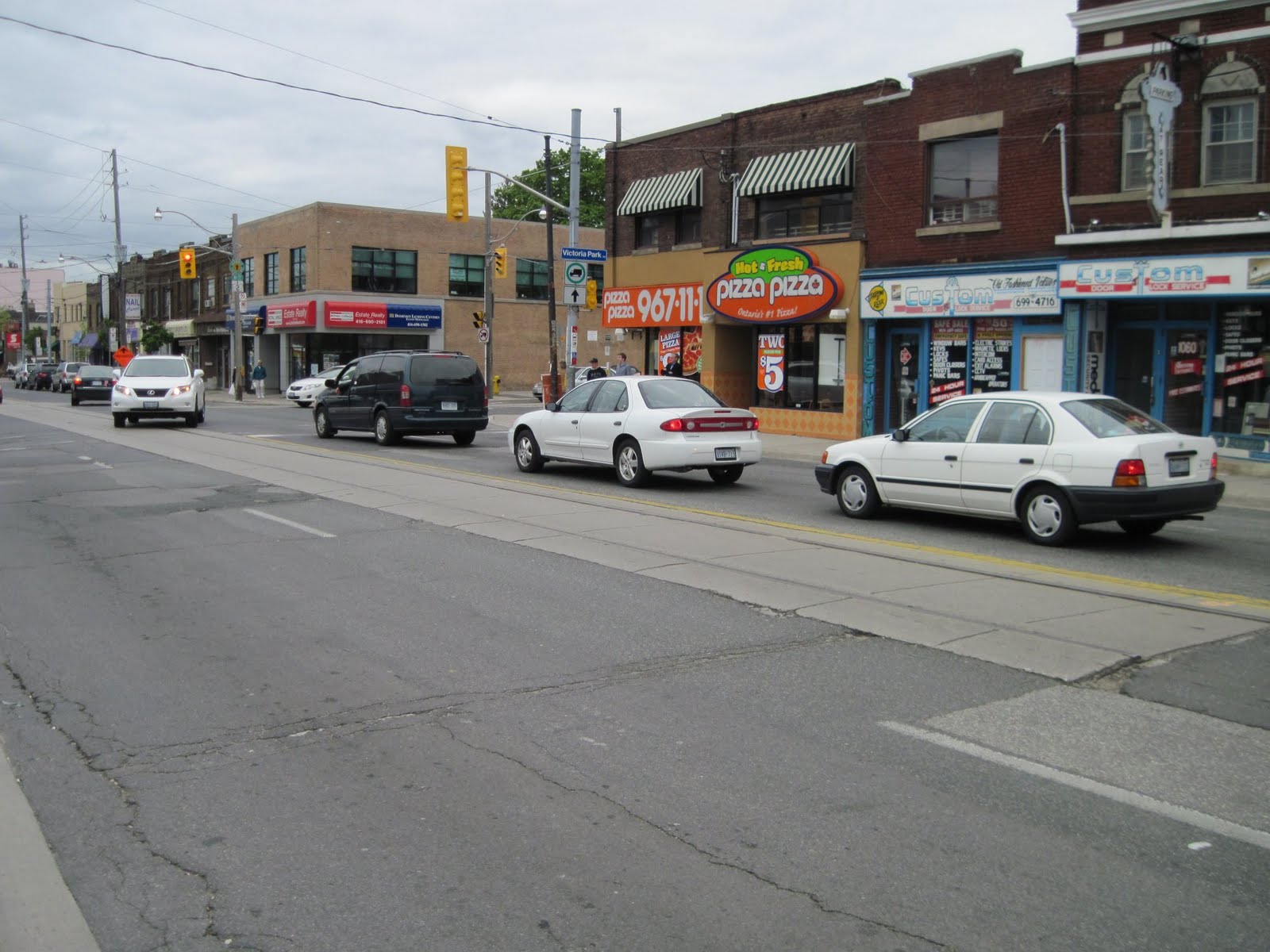
It may well be the easternmost limit of Toronto's streetcar system. On the east side of Victoria Park Avenue, extending a few meters into Scarborough, one set of streetcar rail continues along Kingston Road until it comes to an abrupt end. It's one of the only remnants of historic streetcar service in Scarborough - the rails originally continued a fair distance beyond this point, enough so that I'd have crossed them during my Oshawa-to-Toronto ride last year, but they were withdrawn to Victoria Park in 1954. The only strange thing about the rails here is the modern-seeming concrete they're embedded in; I was under the impression that at that time, the TTC still sank its rails into cobblestones.
 I, the copyright holder of this work, hereby release it into the public domain. This applies worldwide. In case this is not legally possible, I grant anyone the right to use this work for any purpose, without any conditions, unless such conditions are required by law.
 I, the copyright holder of this work, hereby release it into the public domain. This applies worldwide. In case this is not legally possible, I grant anyone the right to use this work for any purpose, without any conditions, unless such conditions are required by law.
Tuesday, May 18, 2010
The Illusion of Isolationism
It's really no surprise that the United States has, throughout its history, held the concepts of isolationism and non-interventionism in such high esteem. The last sixty-five years are anomalous in terms of the greater sweep of history - the United States became active in the world at large in 1945 to prevent Allied victory from being swept away, and has remained active since 1991 out of inertia and self-interest. Nevertheless, the world has changed substantially in the last twenty years, and as time goes by it seems more and more believable that the world's policeman might hang up his badge.
The concept of American non-interventionism stretches back to before the Revolutionary War, though perhaps its most significant signal boost was made by Thomas Jefferson in 1801, when he called for "peace, commerce, and honest friendship with all nations, entangling alliances with none." At the dawn of the nineteenth century, that was an eminently practicable philosophy. The young United States had all the resources and dynamism of a pioneer society and was poised to explode west over the Appalachians. National self-sufficiency was far simpler to manage, as the Industrial Revolution had yet to start chugging on when Jefferson took office, and the wide borderlands and vast seas gave the United States all the defense it needed.
Things have changed a bit in the last two hundred years. Thomas Jefferson never had to worry about pandemics or ICBMs or environmental disasters. But that hasn't dislodged the concepts of non-interventionism and isolationism from what seems to be a uniquely privileged place in the American world of the mind. I, personally, can't think of any country, except for Imperial China, that thought that way.
But it's not dead, IN AMERICA! Rand Paul, son of lolbertarian-favorite 2008 presidential candidate Ron Paul, is reportedly now the man to beat in today's Kentucky Senate primary. On his website he cites Jefferson's address and suggests that "allegiance to foreign institutions sacrifices our autonomy as a nation by transferring our legal authority to unelected and unaccountable leaders." Personally, if that's the case, my answer would be that the problem is with how those institutions are organized, not with the institutions in and of themselves.
 Just because the other shore's too far away to see, that doesn't mean it can't affect you.
The twenty-first century has created a world in which distance is no defense; the Atlantic and Pacific may as well be puddles for all they can prevent enemies reaching North America's shores. Nor do we live in a world where countries can rely on none but themselves. Take titanium, for example: during the Cold War it was an absolutely vital for advanced aerospace construction, and the United States needed as much of it as it could get.
We're also living in a world of grander problems than those Jefferson had to deal with. Take your pick from nuclear non-proliferation, environmental remediation, international stability, global patent and intellectual property regimes, or any of dozens of other issues that cross borders as freely as the air. Modern-day problems are of global scope, and while we live in a world where collaboration across countries and continents is becoming easier, it's also becoming more and more necessary.
The future is potentially bright, but the world has grown into a state of such complexity that no one state has the resources to chart a course through the rocks and shoals on its own. The age of being "in the world, but not of it" has, I think, passed forever. Cooperation and coordination is what will let us realize the best of the futures.
The concept of American non-interventionism stretches back to before the Revolutionary War, though perhaps its most significant signal boost was made by Thomas Jefferson in 1801, when he called for "peace, commerce, and honest friendship with all nations, entangling alliances with none." At the dawn of the nineteenth century, that was an eminently practicable philosophy. The young United States had all the resources and dynamism of a pioneer society and was poised to explode west over the Appalachians. National self-sufficiency was far simpler to manage, as the Industrial Revolution had yet to start chugging on when Jefferson took office, and the wide borderlands and vast seas gave the United States all the defense it needed.
Things have changed a bit in the last two hundred years. Thomas Jefferson never had to worry about pandemics or ICBMs or environmental disasters. But that hasn't dislodged the concepts of non-interventionism and isolationism from what seems to be a uniquely privileged place in the American world of the mind. I, personally, can't think of any country, except for Imperial China, that thought that way.
But it's not dead, IN AMERICA! Rand Paul, son of lolbertarian-favorite 2008 presidential candidate Ron Paul, is reportedly now the man to beat in today's Kentucky Senate primary. On his website he cites Jefferson's address and suggests that "allegiance to foreign institutions sacrifices our autonomy as a nation by transferring our legal authority to unelected and unaccountable leaders." Personally, if that's the case, my answer would be that the problem is with how those institutions are organized, not with the institutions in and of themselves.
 Just because the other shore's too far away to see, that doesn't mean it can't affect you.
The twenty-first century has created a world in which distance is no defense; the Atlantic and Pacific may as well be puddles for all they can prevent enemies reaching North America's shores. Nor do we live in a world where countries can rely on none but themselves. Take titanium, for example: during the Cold War it was an absolutely vital for advanced aerospace construction, and the United States needed as much of it as it could get.
We're also living in a world of grander problems than those Jefferson had to deal with. Take your pick from nuclear non-proliferation, environmental remediation, international stability, global patent and intellectual property regimes, or any of dozens of other issues that cross borders as freely as the air. Modern-day problems are of global scope, and while we live in a world where collaboration across countries and continents is becoming easier, it's also becoming more and more necessary.
The future is potentially bright, but the world has grown into a state of such complexity that no one state has the resources to chart a course through the rocks and shoals on its own. The age of being "in the world, but not of it" has, I think, passed forever. Cooperation and coordination is what will let us realize the best of the futures.
Monday, May 17, 2010
PDP #221: Stairway to Green
The thing about Toronto's ravines is that it's easy to overlook them or edit them out of our mental maps of the city. I didn't know about Glen Stewart Park myself until I stumbled upon the staircase leading down into it off Kingston Road this weekend. When I went down, the sounds of the city were muffled to nothing and it was like I was up north on a Cub Scout campout again. It was a living piece of nature, a reflection of what the whole city would have looked like a few hundred years ago, and an important anchor to the natural world. It's easy to forget about green when you live in the concrete jungle.
It feels like I should set a short story there or something.
 I, the copyright holder of this work, hereby release it into the public domain. This applies worldwide. In case this is not legally possible, I grant anyone the right to use this work for any purpose, without any conditions, unless such conditions are required by law.
It feels like I should set a short story there or something.
 I, the copyright holder of this work, hereby release it into the public domain. This applies worldwide. In case this is not legally possible, I grant anyone the right to use this work for any purpose, without any conditions, unless such conditions are required by law.
Subscribe to:
Posts (Atom)