This past Sunday night I hunkered down and watched the premiere of The Orville, Seth MacFarlane's new sci-fi series, because I hate myself and believe I deserve to suffer. None of the trailers or previews led me to expect greatness, and it certainly wasn't great. I tweeted many of my impressions at the time, and if you're really interested you can do an archive dive, but I feel my first impression is the most critical - it's aggressively mediocre. Still, it's been nibbling at the corners of my brain since I turned off the TV, and it's at least worth talking about.
The Orville is a unique show in that it is so transparently a Star Trek parody/homage/ripoff. This isn't unique across media, with 1999's Galaxy Quest being the first thing that came to mind when I heard of it, but it's different here. First, Galaxy Quest was a one-off; this is a series, though at least it being live-action means it can't stretch across decades the way Family Guy has. Second, Galaxy Quest knew what it was doing. The Orville doesn't. The fundamental problem with the series is that it's too Galaxy Quest to be Star Trek and too Star Trek to be Galaxy Quest. Galaxy Quest is that it gleefully deconstructed trope after Trek trope, from the captain's penchant for losing his shirt to casual interstellar exploration to things that only exist to put the heroes in danger.
The Orville, on the other hand, is one of the purest examples of the second artist effect I've yet encountered. If you haven't run up against it before, it's a phenomenon described by Charles Stross: the first artist goes outside, beholds the landscape, and paints it, but the second artist goes to the gallery, beholds the first artist's painting, and paints that. It's the artistic equivalent of clone degeneration, and The Orville is shot through with it. Why does the Orville have a navigator and a helmsman? Because the Enterprise did. Why is the Orville's bridge at the top of its primary hull with a big honking skylight in the roof? Because that's how the Enterprise was. Why does half of the bridge crew go down on away missions? Because that's how things were done on the Enterprise.
The Orville isn't a parody of Star Trek, even though it has so many opportunities to be. The episode's climax has the Orville under attack from a totally-not-Klingon ship, and the daredevil helmsman flies the ship on a death-defying series of attack runs that look like the video half of a motion simulator ride, weaving around the enemy ship, blasting all the way. It's a lot like a scene that was the climax of a Deep Space Nine episode, where the Defiant makes a death-defying series of attack runs, weaving around the enemy ship, blasting all the way. It was ridiculous then, it's ridiculous now, and yet both series play it completely straight. But even DS9 knew enough to keep that bit down to twenty-five seconds. In The Orville, it went on for so long I'm surprised Seth MacFarlane didn't cut away to five minutes of Conway Twitty.
The Orville isn't a homage to Star Trek, either; from the look and feel of the sets to the fades-to-black before commercial breaks to the same streaming-stars effect in quantum drive, it hews far too close to its source material to be called that. It doesn't poke at the structure it's built around the way Galaxy Quest did, and it wastes its advantage of being made in the future.
The future is of particular importance here. One thing I've seen again and again, both in official commentaries and in some reactions to it, was on the need for optimistic science fiction in this hellscape of a decade. But The Orville doesn't feel like the future because it isn't; it's the future of the 1960s. Sure, the chassis may be smooth and modern-looking, but under the hood there is absolutely nothing that 1967 would be surprised by. Hell, considering how much of the first episode consisted of Captain Ed Mercer, Seth MacFarlane's character, complaining about his ex-wife and his divorce to anyone who would listen, it sometimes feel like it is more honest to 1967 than to 2017.
For all its attempts at being not your father's Star Trek, with a navigator who cares a lot about being able to drink pop on the bridge and a helmsman who casually throws the word "bitch" around, the fact is that this is your father's Star Trek with its hat turned backward, earnestly willing to rap with you all in a most tubular manner. This attitude was made clear in the premiere's first scene, a place-setting shot of New York City in 2417. It's the standard sci-fi city, with monuments like the Statue of Liberty and Brooklyn Bridge contrasted with supertall skyscrapers, flying cars, and so on.
What weren't there were the seawalls. You see, for the past while, my usual encounters with future New York have been through The Expanse, which is everything The Orville isn't. In that series, Manhattan is surrounded by seawalls the size of small apartment buildings. It's a stark image, but given what we know, it's a reasonable extrapolation of what New York might look like in 2350. The Expanse looks ahead with eyes open and unblinking and sees some pretty ugly stuff. The Orville covers its eyes, plugs its ears, and builds its optimistic future with fifty-year-old blueprints.
The thing about The Orville is that there are so many ways MacFarlane could have done it without being what it is. Something that took inspiration from, say, The Irresponsible Captain Tylor would play to his strengths, but The Orville is far too wedded to being Star Trek without being Star Trek that it couldn't go too far without falling apart. It's like the holodeck: one shows up in the episode, and it requires no explanation where Star Trek: The Next Generation took five minutes explaining it, because MacFarlane can rely on audience knowledge. It's also like the holodeck in that beyond the door, the photons and force fields that give illusions substance dissolve into nothing.
In the end, that's all The Orville is, really - thoron fields and duranium shadows.

Showing posts with label TV. Show all posts
Showing posts with label TV. Show all posts
Monday, September 11, 2017


Thursday, October 4, 2012
SF, Star Trek, and the Status Quo
Today is an auspicious day in the annals of spaceflight. Fifty-five years ago the first artificial satellite, the Soviet Union's Sputnik 1, was launched into orbit. Eight years ago SpaceShipOne made its its second competitive flight, winning the Ansari X Prize. Three hundred and fifty-one years from now, the USS Enterprise (NCC-1701-D) will be commissioned into service, and given that synchronicity I feel like it's a good day to talk about Star Trek.
It's been quiet on that front recently, really. Aside from the upcoming movie Star Trek into Darkness--and here I thought they would have gone with something like Star Trek: To Boldly Go--there's nothing on the horizon. During the course of the last seven years, there's been two hours of new Star Trek produced; twice as much was made in the week from May 26 to June 2, 1999, when Deep Space 9 was airing its final episodes and Voyager was becoming the only active series. From 1987 to 2005, there was always a series in production. Star Trek dominated televised science fiction, and today that whole category seems to be in suspension except for things like Doctor Who... and that's space fantasy, anyway.
A few days ago I encountered an interview with Ronald D. Moore, one of the people responsible for Deep Space 9 unfolding how it did, where he talks about the movies being unable to cover quite the same ground or ask the same questions as the television shows because of their nature as movies. Generally, people don't go to the movies for things like that.
I'll agree that there is a niche for a new Star Trek series out there--and I think it should be approached in a rather different way than all the previous series have. I think that should Star Trek return to the airwaves, it should do so as an anthology series: call it Star Trek: Strange New Worlds.
What would it mean, having an anthology series? You wouldn't have a series that followed the same crew, the same ship, week in and week out. You wouldn't have the flagship of the Federation running into all the spatial anomalies and saving the galaxy time and time again. The stories would follow different ships, different crews, different people--not necessarily only once, of course, but the camera would no longer be bolted to a single bridge.
This would be a boon for storytelling, since it vastly opens up the possibilites that can be explored. Rather than searching for situations to affect the characters as they've been established--something that can get pretty damn crazy after a few years of running time--characters can be tailor-made to fit the situation that they're going up against... or, alternatively, to not fit it. There's plenty of dramatic hay to be made out of putting an unprepared character in a difficult situation, and seeing how they react to it.
More importantly, the stakes can be higher--the stakes for the characters, that is. One of the reasons Star Trek relied so heavily on technobabble for its plot resolutions, I feel, was because it was the easy way out. Making a difficult decision or taking the best of the bad roads might be dramatically interesting, but it upsets the status quo. Far better, in that respect, for Geordi to save the ship by reversing the polarity on the phase inducers and generating an anti-tachyon beam to destabilize the anomaly, rather than something that would result in the characters picking up scars. In an anthology series, the entire balance changes; every episode, we're meeting new people. The audience isn't as attached to them as they are to Kirk and Spock and Picard and Worf and so on.
To put it bluntly, they can die and it won't matter as much. There's no applecart to upset; what happens to one crew won't necessarily affect another. It would make things more interesting. Everyone knew that Voyager would get home--that doesn't have to be the case for some other starship that lacks a seven-year commitment.
It would be something that hasn't been done before in Star Trek, an opportunity to breathe new life into the franchise. I think, myself, that it would be worthwhile for the ones in charge to consider.
It's been quiet on that front recently, really. Aside from the upcoming movie Star Trek into Darkness--and here I thought they would have gone with something like Star Trek: To Boldly Go--there's nothing on the horizon. During the course of the last seven years, there's been two hours of new Star Trek produced; twice as much was made in the week from May 26 to June 2, 1999, when Deep Space 9 was airing its final episodes and Voyager was becoming the only active series. From 1987 to 2005, there was always a series in production. Star Trek dominated televised science fiction, and today that whole category seems to be in suspension except for things like Doctor Who... and that's space fantasy, anyway.
A few days ago I encountered an interview with Ronald D. Moore, one of the people responsible for Deep Space 9 unfolding how it did, where he talks about the movies being unable to cover quite the same ground or ask the same questions as the television shows because of their nature as movies. Generally, people don't go to the movies for things like that.
I'll agree that there is a niche for a new Star Trek series out there--and I think it should be approached in a rather different way than all the previous series have. I think that should Star Trek return to the airwaves, it should do so as an anthology series: call it Star Trek: Strange New Worlds.
What would it mean, having an anthology series? You wouldn't have a series that followed the same crew, the same ship, week in and week out. You wouldn't have the flagship of the Federation running into all the spatial anomalies and saving the galaxy time and time again. The stories would follow different ships, different crews, different people--not necessarily only once, of course, but the camera would no longer be bolted to a single bridge.
This would be a boon for storytelling, since it vastly opens up the possibilites that can be explored. Rather than searching for situations to affect the characters as they've been established--something that can get pretty damn crazy after a few years of running time--characters can be tailor-made to fit the situation that they're going up against... or, alternatively, to not fit it. There's plenty of dramatic hay to be made out of putting an unprepared character in a difficult situation, and seeing how they react to it.
More importantly, the stakes can be higher--the stakes for the characters, that is. One of the reasons Star Trek relied so heavily on technobabble for its plot resolutions, I feel, was because it was the easy way out. Making a difficult decision or taking the best of the bad roads might be dramatically interesting, but it upsets the status quo. Far better, in that respect, for Geordi to save the ship by reversing the polarity on the phase inducers and generating an anti-tachyon beam to destabilize the anomaly, rather than something that would result in the characters picking up scars. In an anthology series, the entire balance changes; every episode, we're meeting new people. The audience isn't as attached to them as they are to Kirk and Spock and Picard and Worf and so on.
To put it bluntly, they can die and it won't matter as much. There's no applecart to upset; what happens to one crew won't necessarily affect another. It would make things more interesting. Everyone knew that Voyager would get home--that doesn't have to be the case for some other starship that lacks a seven-year commitment.
It would be something that hasn't been done before in Star Trek, an opportunity to breathe new life into the franchise. I think, myself, that it would be worthwhile for the ones in charge to consider.
Monday, August 6, 2012
Fixing Continuum
Continuum hasn't gone away. The Vancouver-produced, Vancouver-filmed, luxuriating-in-Vancouver series aired the final episode of its first season yesterday, and over the past weeks it's been picking up attention across the internet. My guess is that a lot of it has to do with the lack of competition; 2012 is not exactly a golden age of televised science fiction. It's a show that I've been following, but in a combative sort of way... in that it's rare that an episode goes by without me pausing it for an extended period so that I can swear at the screen. Continuum may not have gone away, and while it's no The Starlost, the way I see it it's shot through with structural compromises that make it stagger when it could have sprinted.
This isn't the first time I've written about the series here, and it may not be the last. Continuum is particularly important now, I think, because it's a sort of standard bearer--not only for televised sf, but for Canadian television in general. It burns me up to see shows like this not living up to their potential, and because it's something that even a person as oblivious as myself can recognize.
If I had to sum up what this show has done in its first season, it would be this: "missed opportunities." Even though the whole "cop from the future thrown back to the past to apprehend dangerous criminals" concept has been done before, it's hardly been tapped out, and the flexibility of a series offers a hell of a lot more opportunities to dig into the possibilities that concept affords than does a two-hour movie. Nevertheless, if there's anything the writers of Continuum seem to be doing, it's navigating characters around spots where the status quo might be upset and where the characters could find room to grow.
 Let this photo represent time, because I like it. And, you know, the clock.
For me, this is most glaringly obvious when it comes to Kiera Cameron, protagonist and unintentional time traveller. At the end of the first episode she managed to finagle her way into working with the Vancouver Police Department, posing as a federal agent, to better pursue the criminals from the future. But the problem I find is that if viewers weren't specifically told she's from the future in the opening sequence of every episode, you wouldn't necessarily know it--especially not from her actions. To be honest, I don't buy Cameron as a person from the future.
Why? Well, first, there's the issue of basic culture that everyone grows up in, is surrounded by, and uses as a baseline in terms of their actions. From what we've been shown, it's needless to say that the basic culture of 2077 would be vastly different from that of the modern day. Imagine finding yourself back in 1947, for example--you wouldn't have to look very hard back then to find something repugnant, like the casual racism and sexism. What we've been shown of the future is enough to say that Cameron would have a hell of a difficult time adjusting to the present. Bear in mind that she comes from a time in which a Macross Missile Massacre is part of standard operating procedure for arresting unarmed suspects. A time where basic rights barely exist and a time in which personal surveillance is ubiquitous.
Sure, this is the sort of stuff Cameron would get used to, but until she did get used to there would be plenty of room for character development. Instead, she seems static--aside from the standard "time traveller doesn't know how to drive" shtick and a fascination with horses, which may have gone extinct in her future, there's not really anything. Look at Life on Mars for an alternative view--Sam Tyler only went back thirty-three years, and he didn't just adjust like it was pulling an old sock inside out.
Then there's the gadgets. It wouldn't be science fiction without the gadgets, right? That sort of thinking may be why they've been treated the way they have, exemplified by Eric Knudsen's teen genius character managing to repair Cameron's shorted-out service suit... a suit that's state-of-the-art sixty-five years from now, based on dizzyingly advanced technology. To go back to 1947 again, imagine if you damaged your smartphone while there--how believable do you think it would be for some local teen genius to fix it, considering that the transistor itself was only invented in that year, and the integrated circuits upon which modern microcomputers rely weren't manufactured until the 1960s?
Here, I feel the writers missed an excellent opportunity to create a character arc for Cameron. Sure, when she arrives in 2012 she's still got all her tools, her future gun, her suit, and so on, and thanks to them outclasses any local individual. The thing about tools, though... tools break. When her suit got overloaded during a fight partway through the season, it should have stayed unusable. After the terrorists actually succeeded in briefly taking control of her by using her head implants like a puppeteer's strings, she should have lost the use of that too--and with it her ability to identify fingerprints, read a person's vital signs, and so on right at a glance. Cameron's overarching goal is to return to the future, but she could have had a character arc that shows us how she copes and, more importantly, who she is when those pieces of the future fall away, one-by-one, leaving her trapped in an unfamiliar time and forced to do a job that she's relearning as she goes.
I don't know if Continuum has a writer's bible. Honestly, I wouldn't be surprised if it didn't. To me, it has more of the sense that there wasn't much pre-planning in this regard, that the writers came up with these things as they went. That wouldn't necessarily have been a problem even as recently as the 1990s, when episodic series were the rule, but it's 2012 now--a different world. The past, if you'll recall, is a foreign country. People do things differently there.
This isn't the first time I've written about the series here, and it may not be the last. Continuum is particularly important now, I think, because it's a sort of standard bearer--not only for televised sf, but for Canadian television in general. It burns me up to see shows like this not living up to their potential, and because it's something that even a person as oblivious as myself can recognize.
If I had to sum up what this show has done in its first season, it would be this: "missed opportunities." Even though the whole "cop from the future thrown back to the past to apprehend dangerous criminals" concept has been done before, it's hardly been tapped out, and the flexibility of a series offers a hell of a lot more opportunities to dig into the possibilities that concept affords than does a two-hour movie. Nevertheless, if there's anything the writers of Continuum seem to be doing, it's navigating characters around spots where the status quo might be upset and where the characters could find room to grow.
 Let this photo represent time, because I like it. And, you know, the clock.
For me, this is most glaringly obvious when it comes to Kiera Cameron, protagonist and unintentional time traveller. At the end of the first episode she managed to finagle her way into working with the Vancouver Police Department, posing as a federal agent, to better pursue the criminals from the future. But the problem I find is that if viewers weren't specifically told she's from the future in the opening sequence of every episode, you wouldn't necessarily know it--especially not from her actions. To be honest, I don't buy Cameron as a person from the future.
Why? Well, first, there's the issue of basic culture that everyone grows up in, is surrounded by, and uses as a baseline in terms of their actions. From what we've been shown, it's needless to say that the basic culture of 2077 would be vastly different from that of the modern day. Imagine finding yourself back in 1947, for example--you wouldn't have to look very hard back then to find something repugnant, like the casual racism and sexism. What we've been shown of the future is enough to say that Cameron would have a hell of a difficult time adjusting to the present. Bear in mind that she comes from a time in which a Macross Missile Massacre is part of standard operating procedure for arresting unarmed suspects. A time where basic rights barely exist and a time in which personal surveillance is ubiquitous.
Sure, this is the sort of stuff Cameron would get used to, but until she did get used to there would be plenty of room for character development. Instead, she seems static--aside from the standard "time traveller doesn't know how to drive" shtick and a fascination with horses, which may have gone extinct in her future, there's not really anything. Look at Life on Mars for an alternative view--Sam Tyler only went back thirty-three years, and he didn't just adjust like it was pulling an old sock inside out.
Then there's the gadgets. It wouldn't be science fiction without the gadgets, right? That sort of thinking may be why they've been treated the way they have, exemplified by Eric Knudsen's teen genius character managing to repair Cameron's shorted-out service suit... a suit that's state-of-the-art sixty-five years from now, based on dizzyingly advanced technology. To go back to 1947 again, imagine if you damaged your smartphone while there--how believable do you think it would be for some local teen genius to fix it, considering that the transistor itself was only invented in that year, and the integrated circuits upon which modern microcomputers rely weren't manufactured until the 1960s?
Here, I feel the writers missed an excellent opportunity to create a character arc for Cameron. Sure, when she arrives in 2012 she's still got all her tools, her future gun, her suit, and so on, and thanks to them outclasses any local individual. The thing about tools, though... tools break. When her suit got overloaded during a fight partway through the season, it should have stayed unusable. After the terrorists actually succeeded in briefly taking control of her by using her head implants like a puppeteer's strings, she should have lost the use of that too--and with it her ability to identify fingerprints, read a person's vital signs, and so on right at a glance. Cameron's overarching goal is to return to the future, but she could have had a character arc that shows us how she copes and, more importantly, who she is when those pieces of the future fall away, one-by-one, leaving her trapped in an unfamiliar time and forced to do a job that she's relearning as she goes.
I don't know if Continuum has a writer's bible. Honestly, I wouldn't be surprised if it didn't. To me, it has more of the sense that there wasn't much pre-planning in this regard, that the writers came up with these things as they went. That wouldn't necessarily have been a problem even as recently as the 1990s, when episodic series were the rule, but it's 2012 now--a different world. The past, if you'll recall, is a foreign country. People do things differently there.
Wednesday, May 30, 2012
A Continuum of Thought
Outside the field of pure literature - and even then, it can be scarce - Canadian science fiction is rather thin on the ground. With the United States right next door, it's not difficult to understand why. With a shared language and historically porous border, it's always been all that Canada can do to keep from being overwhelmed by American cultural exports, and there are few things that dovetail with the American spirit as well as science fiction does. Nor did we ever have our own version of Doctor Who, not with the CBC grudgingly supported by governments but never given what it needed for true independence. Especially when it comes to televised works, generally the best we've been able to get are Canadian/American productions like Stargate SG-1 and its successor series.
But now there's Continuum, a science fiction television series that began airing its first run of ten episodes last Sunday - created by a Canadian, produced by a Canadian company, filmed in Canada, aired on a Canadian specialty channel, and starring a cast that is almost entirely Canadian... I'm starting to recognize a pattern here. Continuum is one of those rare discoveries, a Canadian science fiction series. It's not often I discover things while they're still new. Usually I'm just oblivious and hampered by my lack of cable. Fortunately, not everyone is; it blew away existing records by pulling in 900,000 viewers on the first broadcast, so it may well escape the fate of previous Canadian-made series such as The Starlost.
Nevertheless, I figured it might be instructive to take a look at the first episode, and evaluate how the crew's begun to set the story up and where they might go.
Quick summary, then: Continuum follows Kiera Cameron, played by Rachel Nichols, a Vancouver cop (actually, "City Protective Services Protector") from 2077, who along with a group of terrorists about to be executed is thrown back to 2012 in a last-ditch time travel attempt gone horribly right. Cut off and alone sixty-five years before her own time, it's up to Cameron to apprehend the terrorists and, somehow, get home. On its own, not particularly groundbreaking; there's a whiff of a Terminator vibe, but since none of the characters are soldiers or robots there's probably little danger of Harlan Ellison threatening legal action here. But there are options. It's one of the few shows both filmed and set in Vancouver, which means that our heroine can wander up Granville Street in a daze without the producers having to unfurl the Stars and Stripes or line the road with U.S. Mail and USA Today boxes beforehand.
 Anyone in this photograph could be a time traveller.
That's not to say this series is a shining star. I've heard complaints about the acting, but that's not going to be something I focus on, since it has to skew pretty close to Manos: The Hands of Fate territory before I can really notice it without being told. Instead, I'm more interested in the writing - how the creators went about setting up their story, their conflict, and their future. After thinking about it for a couple of days, I can tell you right now that I definitely wouldn't have approached it in the same manner.
There's a rule in writing, possibly one of the most important rules: "show, don't tell." At its core, this means that good writing gets something across by demonstrating the truth of something, rather than just stating it. If a character is angry, you show them punching the walls, or being overwhelmingly calm, or whatever else is appropriate based on that character. You do not have them announce that something makes them feel angry.
It can be a bit more tricky when you're dealing with a visual medium, though it still exists - and I feel that the greatest flaw in Continuum so far is that it has told us too much. Take the terrorists, for example - they're part of a group struggling against a world where governments and corporations have colluded to such a degree that there's such a thing as the "Corporate Congress," where freedoms of speech and assembly have been stripped away. But the problem is they tell us too much about them. Until the episode specifically told me "hey, these guys are the villains," I was having a bit of trouble with it.
In fact, they tell us too much, too fast about the future. Personally, I think the nature of the future is something that should have been revealed slowly over the course of multiple episodes. Say, start off the episode with the prison scene, the characters are immediately transported back to 2012, and the future is gradually filled in not only through flashbacks where appropriate, but through the actions of the characters. The way people conduct themselves shows a lot about the sort of world they come from.
This sort of thing is present in the series' depiction of the future, to some degree - while for many people, the most striking thing about the 2077 SkyTrain Cameron rides to the prison might be that the announcements are made in Chinese only, for me it was that it was completely standing-room - no seats whatsoever. An implication of a crowded world, an uncomfortable world, just by the way it builds its transit. Likewise, the 2077 SkyTrain retains the same door-opening chime that you'll find on the system today - one of only a handful of elements connecting the Vancouvers of 2012 and 2077 together. In the establishing shot of the prison you can see the twisted, partially submerged wrecks of the cargo cranes at the foot of Main Street, and though I've seen media references to the Lions Gate Bridge remaining in background shots, I didn't pick up it. Nevertheless, the lack of many other familiar anchors works well, in its way - it's a sort of whisper, "something serious happened between now and then."
When it comes to Erik Knudsen's character, the 17-year-old technical genius Alec Sadler, I can't help but think his direct involvement in the episode's events was a negative. In-story, he's recently built the prototype of some kind of encrypted communication system that Cameron uses in 2077, and so he's able to hear and be heard by her, see through her eyes, and so on, presumably setting him up for the Mission Control role later in the series. In principle, there's nothing wrong with this; again, I just think it happened too fast. Cameron arrives in 2012, loses the terrorists, is disoriented and trying to report in, and Sadler immediately starts chiding her for breaking into his groundbreaking encryption.
It seems too convenient, really. Not only has he already developed the prototype of the technology that's used in the future, it has absolutely no compatibility issues with something sixty-five years more advanced, and when Cameron starts trying to report in he's already monitoring and jumps on it immediately. The problem I have with this is that it denies Cameron an opportunity for character development - we're denied the chance to see this person when she's completely cut off and completely alone, lost in an unfamiliar environment with little clue of where to go next.
Still, I'm interested in seeing where they take this. I just wish they could have left some more things unsaid for a while. If you're interested in checking the series out, Showcase has it up for online streaming here.
But now there's Continuum, a science fiction television series that began airing its first run of ten episodes last Sunday - created by a Canadian, produced by a Canadian company, filmed in Canada, aired on a Canadian specialty channel, and starring a cast that is almost entirely Canadian... I'm starting to recognize a pattern here. Continuum is one of those rare discoveries, a Canadian science fiction series. It's not often I discover things while they're still new. Usually I'm just oblivious and hampered by my lack of cable. Fortunately, not everyone is; it blew away existing records by pulling in 900,000 viewers on the first broadcast, so it may well escape the fate of previous Canadian-made series such as The Starlost.
Nevertheless, I figured it might be instructive to take a look at the first episode, and evaluate how the crew's begun to set the story up and where they might go.
Quick summary, then: Continuum follows Kiera Cameron, played by Rachel Nichols, a Vancouver cop (actually, "City Protective Services Protector") from 2077, who along with a group of terrorists about to be executed is thrown back to 2012 in a last-ditch time travel attempt gone horribly right. Cut off and alone sixty-five years before her own time, it's up to Cameron to apprehend the terrorists and, somehow, get home. On its own, not particularly groundbreaking; there's a whiff of a Terminator vibe, but since none of the characters are soldiers or robots there's probably little danger of Harlan Ellison threatening legal action here. But there are options. It's one of the few shows both filmed and set in Vancouver, which means that our heroine can wander up Granville Street in a daze without the producers having to unfurl the Stars and Stripes or line the road with U.S. Mail and USA Today boxes beforehand.
 Anyone in this photograph could be a time traveller.
That's not to say this series is a shining star. I've heard complaints about the acting, but that's not going to be something I focus on, since it has to skew pretty close to Manos: The Hands of Fate territory before I can really notice it without being told. Instead, I'm more interested in the writing - how the creators went about setting up their story, their conflict, and their future. After thinking about it for a couple of days, I can tell you right now that I definitely wouldn't have approached it in the same manner.
There's a rule in writing, possibly one of the most important rules: "show, don't tell." At its core, this means that good writing gets something across by demonstrating the truth of something, rather than just stating it. If a character is angry, you show them punching the walls, or being overwhelmingly calm, or whatever else is appropriate based on that character. You do not have them announce that something makes them feel angry.
It can be a bit more tricky when you're dealing with a visual medium, though it still exists - and I feel that the greatest flaw in Continuum so far is that it has told us too much. Take the terrorists, for example - they're part of a group struggling against a world where governments and corporations have colluded to such a degree that there's such a thing as the "Corporate Congress," where freedoms of speech and assembly have been stripped away. But the problem is they tell us too much about them. Until the episode specifically told me "hey, these guys are the villains," I was having a bit of trouble with it.
In fact, they tell us too much, too fast about the future. Personally, I think the nature of the future is something that should have been revealed slowly over the course of multiple episodes. Say, start off the episode with the prison scene, the characters are immediately transported back to 2012, and the future is gradually filled in not only through flashbacks where appropriate, but through the actions of the characters. The way people conduct themselves shows a lot about the sort of world they come from.
This sort of thing is present in the series' depiction of the future, to some degree - while for many people, the most striking thing about the 2077 SkyTrain Cameron rides to the prison might be that the announcements are made in Chinese only, for me it was that it was completely standing-room - no seats whatsoever. An implication of a crowded world, an uncomfortable world, just by the way it builds its transit. Likewise, the 2077 SkyTrain retains the same door-opening chime that you'll find on the system today - one of only a handful of elements connecting the Vancouvers of 2012 and 2077 together. In the establishing shot of the prison you can see the twisted, partially submerged wrecks of the cargo cranes at the foot of Main Street, and though I've seen media references to the Lions Gate Bridge remaining in background shots, I didn't pick up it. Nevertheless, the lack of many other familiar anchors works well, in its way - it's a sort of whisper, "something serious happened between now and then."
When it comes to Erik Knudsen's character, the 17-year-old technical genius Alec Sadler, I can't help but think his direct involvement in the episode's events was a negative. In-story, he's recently built the prototype of some kind of encrypted communication system that Cameron uses in 2077, and so he's able to hear and be heard by her, see through her eyes, and so on, presumably setting him up for the Mission Control role later in the series. In principle, there's nothing wrong with this; again, I just think it happened too fast. Cameron arrives in 2012, loses the terrorists, is disoriented and trying to report in, and Sadler immediately starts chiding her for breaking into his groundbreaking encryption.
It seems too convenient, really. Not only has he already developed the prototype of the technology that's used in the future, it has absolutely no compatibility issues with something sixty-five years more advanced, and when Cameron starts trying to report in he's already monitoring and jumps on it immediately. The problem I have with this is that it denies Cameron an opportunity for character development - we're denied the chance to see this person when she's completely cut off and completely alone, lost in an unfamiliar environment with little clue of where to go next.
Still, I'm interested in seeing where they take this. I just wish they could have left some more things unsaid for a while. If you're interested in checking the series out, Showcase has it up for online streaming here.
Saturday, March 31, 2012
What the CBC Means to Me
It's just another data point that the verbal assurances of the Conservative Party aren't worth the air molecules that got shook around so you could hear them. Nearly a year after finally seizing a majority government that may well owe its existence to a campaign of electoral fraud, the knives are coming out in Ottawa. Foreign aid? Cut. Military expenditures? Cut. Even Katimavik has been cut, and hell, I didn't even know Katimavik was still around; I thought Mulroney had got rid of it twenty years ago.
However, some of the biggest cuts were reserved for the Canadian Broadcasting Corporation, which is one hell of a way to honor its seventy-fifth anniversary. Specifically the CBC is facing a 10.4% cut, which will see its funding go down by $115 million in 2015 compared to 2012's outlay. Its budget is literally being decimated. Contrast this with what happened back in May 2011, when Heritage Minister James Moore assured us that the Conservatives "believe in the national public broadcaster. We have said that we will maintain or increase support for the CBC. That is our platform and we have said that before and we will commit to that." That's the great thing about the internet; it really bricks up the memory hole.
Already the usual suspects are coming out of the woodwork in regard to this. The other day Larry Miller, MP for Bruce—Grey—Owen Sound, appeared on Sun News to complain about how the CBC cuts didn't go far enough and bemoan that it was only a cut of 10% over three years, rather than a 10% cut per year. James Moore has already changed his tune, saying that the CBC "can be run more efficiently," which really smells like gravy to me. Are claims of the gravy train at the CBC soon to follow?
I involve myself in this because I believe the CBC is important, that it has an important place in our society and that it is key to the development of Canadian arts and culture - and if you're thinking of dismissing that as some Dipper bullshit, keep in mind that James Moore said, essentially, the exact same thing back in May. Though I still regularly read CBC News on its website and wander through the CBC Archives from time to time, it's been a while since I've watched CBC on TV or listened to it on the radio - in my defense, my rabbit ears can't pick up CBC and the antenna on my radio is thoroughly busted. But it wasn't always like that.

Let's go back, say, fifteen years - Earth, 1997: specifically Barrie, Ontario, in a house that was within sight of the CKVR transmission tower. Though the station had rebranded itself as "the New VR" in the first stage of a process that eventually led to the modern CTV Two network, it had been a CBC affiliate before that and at that point still simulcasted a fair bit of CBC programming. I had a cheapass CRT television balanced on top of my dresser, and thanks to the broadcast tower's proximity I didn't need rabbit ears to pick up the signal - not that rabbit ears would have been worth much; there weren't any other broadcasters in Barrie, and I wasn't going to be able to pick up a signal from Toronto with them.
I was still able to get things I considered worth watching, though. At 4 PM, I think, there was Jonovision - Jonathan Torrens' 90s talk show for teens - and I believe it was at 5 that Family Matters came on... you know, the show with Urkel. Sandwiched between them was a show that really stuck with me, not the least because it was made in Halifax and, for me, at the time Halifax was a distant and exotic place full of wonder and mystery: Street Cents.
This was a show targeted at teenagers, built around the idea of instilling wise consumer practices - knowing how to not be taken advantage of in the marketplace, how to spend your money intelligently, and to look beyond the claims of advertising and gauge the products themselves in order to make a more canny customer in a capitalist world. There are clips of it scattered all around YouTube, and even a full episode or two. I like to think that the show played a part in making me the overly suspicious bastard I am today. One laudable thing about it, which I can't recall if it even registered with me at the time, is that it aired commercial-free; what "commercials" existed were parodies and sendups. It existed to be a consumer review and education show for teens, and the presence of commercials would have led to a difficult balancing act - it's a bit more difficult to pass judgement when the judged are, in part, paying your bills.
A show like Street Cents, in the form the CBC broadcasted it, would never air on a major network... a major commercial network, that is. The only other place in North America I can imagine it landing on would be PBS - another public broadcaster like the CBC, which aired cherished childhood shows like Where in the World is Carmen Sandiego? and Reading Rainbow, and which has itself regularly come under attack from the Republicans. Really, can you imagine that kind of show on CTV, say, or NBC? Not only occupying precious time that could be filled with another goddamn celebrity dancing show, but not even generating any commercial revenue?
Some critics of the CBC attack it as a "state broadcaster," as if that was enough - this is bullshit, and an obfuscation of the truth. The CBC receives support from the government, but it isn't an arm of the government, and I think that's the key as to why the Conservatives dislike it so much. If the CBC really was a state broadcaster, the Conservatives wouldn't be cutting its budget - they'd be using it to parrot their messages from one end of the country to the other. When it comes to state broadcasters in Canada, where "state broadcaster" means "a broadcasting organ firmly loyal to the state and always acting to advance the interests of its leadership," you need look no farther than the Sun News Network - practically Canada's own Pravda.
James Moore may have been shooting smoke back in May, but that doesn't mean he didn't stumble onto the truth. The CBC is important; it is a key Canadian cultural institution. Its government funding allows it an independence that could give it power if only it was done right - power to look deeply into things without worrying about whether this story will offend that major advertiser. In an ideal world, the CBC wouldn't need to wade into the ratings battle with the commercial networks. The ideal would be for the CBC to be supported by television license fees, such as Japan's NHK, the BBC, and practically every other public broadcaster in the Anglosphere. But it would never fly, not now. Politicians in Metro Vancouver received death threats when they aired the possibility of taxing vehicles; what do you think the uproar would be if the government decided it was going to start taxing TVs?
The CBC continues to play an important role in Canada. The fact that the Conservatives hate it so much only gives it all the more reason to stick around, I think.
However, some of the biggest cuts were reserved for the Canadian Broadcasting Corporation, which is one hell of a way to honor its seventy-fifth anniversary. Specifically the CBC is facing a 10.4% cut, which will see its funding go down by $115 million in 2015 compared to 2012's outlay. Its budget is literally being decimated. Contrast this with what happened back in May 2011, when Heritage Minister James Moore assured us that the Conservatives "believe in the national public broadcaster. We have said that we will maintain or increase support for the CBC. That is our platform and we have said that before and we will commit to that." That's the great thing about the internet; it really bricks up the memory hole.
Already the usual suspects are coming out of the woodwork in regard to this. The other day Larry Miller, MP for Bruce—Grey—Owen Sound, appeared on Sun News to complain about how the CBC cuts didn't go far enough and bemoan that it was only a cut of 10% over three years, rather than a 10% cut per year. James Moore has already changed his tune, saying that the CBC "can be run more efficiently," which really smells like gravy to me. Are claims of the gravy train at the CBC soon to follow?
I involve myself in this because I believe the CBC is important, that it has an important place in our society and that it is key to the development of Canadian arts and culture - and if you're thinking of dismissing that as some Dipper bullshit, keep in mind that James Moore said, essentially, the exact same thing back in May. Though I still regularly read CBC News on its website and wander through the CBC Archives from time to time, it's been a while since I've watched CBC on TV or listened to it on the radio - in my defense, my rabbit ears can't pick up CBC and the antenna on my radio is thoroughly busted. But it wasn't always like that.

Let's go back, say, fifteen years - Earth, 1997: specifically Barrie, Ontario, in a house that was within sight of the CKVR transmission tower. Though the station had rebranded itself as "the New VR" in the first stage of a process that eventually led to the modern CTV Two network, it had been a CBC affiliate before that and at that point still simulcasted a fair bit of CBC programming. I had a cheapass CRT television balanced on top of my dresser, and thanks to the broadcast tower's proximity I didn't need rabbit ears to pick up the signal - not that rabbit ears would have been worth much; there weren't any other broadcasters in Barrie, and I wasn't going to be able to pick up a signal from Toronto with them.
I was still able to get things I considered worth watching, though. At 4 PM, I think, there was Jonovision - Jonathan Torrens' 90s talk show for teens - and I believe it was at 5 that Family Matters came on... you know, the show with Urkel. Sandwiched between them was a show that really stuck with me, not the least because it was made in Halifax and, for me, at the time Halifax was a distant and exotic place full of wonder and mystery: Street Cents.
This was a show targeted at teenagers, built around the idea of instilling wise consumer practices - knowing how to not be taken advantage of in the marketplace, how to spend your money intelligently, and to look beyond the claims of advertising and gauge the products themselves in order to make a more canny customer in a capitalist world. There are clips of it scattered all around YouTube, and even a full episode or two. I like to think that the show played a part in making me the overly suspicious bastard I am today. One laudable thing about it, which I can't recall if it even registered with me at the time, is that it aired commercial-free; what "commercials" existed were parodies and sendups. It existed to be a consumer review and education show for teens, and the presence of commercials would have led to a difficult balancing act - it's a bit more difficult to pass judgement when the judged are, in part, paying your bills.
A show like Street Cents, in the form the CBC broadcasted it, would never air on a major network... a major commercial network, that is. The only other place in North America I can imagine it landing on would be PBS - another public broadcaster like the CBC, which aired cherished childhood shows like Where in the World is Carmen Sandiego? and Reading Rainbow, and which has itself regularly come under attack from the Republicans. Really, can you imagine that kind of show on CTV, say, or NBC? Not only occupying precious time that could be filled with another goddamn celebrity dancing show, but not even generating any commercial revenue?
Some critics of the CBC attack it as a "state broadcaster," as if that was enough - this is bullshit, and an obfuscation of the truth. The CBC receives support from the government, but it isn't an arm of the government, and I think that's the key as to why the Conservatives dislike it so much. If the CBC really was a state broadcaster, the Conservatives wouldn't be cutting its budget - they'd be using it to parrot their messages from one end of the country to the other. When it comes to state broadcasters in Canada, where "state broadcaster" means "a broadcasting organ firmly loyal to the state and always acting to advance the interests of its leadership," you need look no farther than the Sun News Network - practically Canada's own Pravda.
James Moore may have been shooting smoke back in May, but that doesn't mean he didn't stumble onto the truth. The CBC is important; it is a key Canadian cultural institution. Its government funding allows it an independence that could give it power if only it was done right - power to look deeply into things without worrying about whether this story will offend that major advertiser. In an ideal world, the CBC wouldn't need to wade into the ratings battle with the commercial networks. The ideal would be for the CBC to be supported by television license fees, such as Japan's NHK, the BBC, and practically every other public broadcaster in the Anglosphere. But it would never fly, not now. Politicians in Metro Vancouver received death threats when they aired the possibility of taxing vehicles; what do you think the uproar would be if the government decided it was going to start taxing TVs?
The CBC continues to play an important role in Canada. The fact that the Conservatives hate it so much only gives it all the more reason to stick around, I think.
Funding for this post was also provided by the Corporation for Public Broadcasting, the Carnegie Corporation of New York, the National Science Foundation, and the financial support of readers like you... no, not really. But that'd be nice.
Thursday, March 24, 2011
Sliding Behind the Curtain
Living in Metro Vancouver, I've been told, has that aspect of always looking behind the curtain. So many movies and television shows are filmed here that even if you don't stumble into an open-air shot, like Underworld 4 on Granville last week or the one they Brooklynized Front Street for over the weekend, all you need is a bit of attention to let the walls of suspended-disbelief come crashing down. The first time this happened to me, I didn't even live in New Westminster yet - I saw The A-Team in the theatre while I was on vacation, and even that handful of days was enough for me to pick out "Frankfurt" as just being downtown Vancouver. I don't think there's a Fairmont Pacific Rim in Germany.
This is one of the things that makes it even more distracting - when the camera includes blunt evidence that the city it's actually in is not the city it wants you to think it's in. Like how on an episode of Castle a few weeks ago, when a foot chase on a busy street in Manhattan inexplicably had a Los Angeles Metro Local bus in the background - noticeable because they're painted a rather distinctive orange color that tends to capture the eye. Sure, I didn't notice a lot of this while I lived in Ontario... but for that fraction of the audience familiar with the filming zones, which now includes me, the ride has got considerably bumpier. You're telling me that this is unfamiliar place X, but the evidence you've prevented demonstrates that it's actually familiar place Y.
This might be one of the scourges of the motion picture industry if more people than me actually cared. Thinking about it, though, there are some circumstances where this sort of thing is actually worthwhile - and far from being an interruption, could actually shore up the foundation. I'm thinking specifically, since I've been going back through the first two seasons on DVD recently, of Sliders.
Sliders, probably the single most mainstream appearance of the alternate history concept on the North American airwaves. Every week the four Sliders found themselves on a parallel Earth in a parallel San Francisco, but thanks to tax incentives most of those San Franciscos were in fact Vancouver with San Francisco establishing shots between scenes. When I first started rewatching the episodes after moving here, I thought the new familiarity might be distracting - but it's not!
It actually subtly advances the whole concept of the alternate history.
 In a world where corporate hired guns are literally that: San Francisco, Texas. Vancouver's just on the other side of the street, though.
What I always disliked about Sliders was a reflection of the necessities of the medium: its alternate histories always seemed too artificial. You have a world where Texas not only remained independent but absorbed what would have become the Western United States, and yet Lyndon Johnson and George Bush not only still existed but still became Presidents (of Texas, that is). You have a world where J. Edgar Hoover became President and buried the Constitution, but the Internet nevertheless exists. You have a world where dinosaurs survived to the present day, and yet you still have humans. No concept of the butterfly effect at all. It's a far more simplified setup, wherein pretty much everything that isn't explicitly and directly affected by the departure from familiar history is unchanged.
It's in the filming that they get around this, even if they weren't trying to. Having never been to San Francisco, I can't say whether Vancouver looks anything like it - but what I do know is that Vancouver can't ever look exactly like it. The San Franciscos that the Sliders visit contain sights that you'd never find if you went to our San Francisco - and why should you? These are worlds with decades, centuries, or millennia of different history, that in some cases developed along entirely different (and entirely CRAZY) paths! While it's most likely that a sufficiently alternate San Francisco would resemble neither San Francisco nor Vancouver, using Vancouver can take advantage of that blunt evidence - that this is not the city they're telling you it is.
Even though pretty much every San Francisco they visit still has the Transamerica Pyramid on the skyline.
This is one of the things that makes it even more distracting - when the camera includes blunt evidence that the city it's actually in is not the city it wants you to think it's in. Like how on an episode of Castle a few weeks ago, when a foot chase on a busy street in Manhattan inexplicably had a Los Angeles Metro Local bus in the background - noticeable because they're painted a rather distinctive orange color that tends to capture the eye. Sure, I didn't notice a lot of this while I lived in Ontario... but for that fraction of the audience familiar with the filming zones, which now includes me, the ride has got considerably bumpier. You're telling me that this is unfamiliar place X, but the evidence you've prevented demonstrates that it's actually familiar place Y.
This might be one of the scourges of the motion picture industry if more people than me actually cared. Thinking about it, though, there are some circumstances where this sort of thing is actually worthwhile - and far from being an interruption, could actually shore up the foundation. I'm thinking specifically, since I've been going back through the first two seasons on DVD recently, of Sliders.
Sliders, probably the single most mainstream appearance of the alternate history concept on the North American airwaves. Every week the four Sliders found themselves on a parallel Earth in a parallel San Francisco, but thanks to tax incentives most of those San Franciscos were in fact Vancouver with San Francisco establishing shots between scenes. When I first started rewatching the episodes after moving here, I thought the new familiarity might be distracting - but it's not!
It actually subtly advances the whole concept of the alternate history.
 In a world where corporate hired guns are literally that: San Francisco, Texas. Vancouver's just on the other side of the street, though.
What I always disliked about Sliders was a reflection of the necessities of the medium: its alternate histories always seemed too artificial. You have a world where Texas not only remained independent but absorbed what would have become the Western United States, and yet Lyndon Johnson and George Bush not only still existed but still became Presidents (of Texas, that is). You have a world where J. Edgar Hoover became President and buried the Constitution, but the Internet nevertheless exists. You have a world where dinosaurs survived to the present day, and yet you still have humans. No concept of the butterfly effect at all. It's a far more simplified setup, wherein pretty much everything that isn't explicitly and directly affected by the departure from familiar history is unchanged.
It's in the filming that they get around this, even if they weren't trying to. Having never been to San Francisco, I can't say whether Vancouver looks anything like it - but what I do know is that Vancouver can't ever look exactly like it. The San Franciscos that the Sliders visit contain sights that you'd never find if you went to our San Francisco - and why should you? These are worlds with decades, centuries, or millennia of different history, that in some cases developed along entirely different (and entirely CRAZY) paths! While it's most likely that a sufficiently alternate San Francisco would resemble neither San Francisco nor Vancouver, using Vancouver can take advantage of that blunt evidence - that this is not the city they're telling you it is.
Even though pretty much every San Francisco they visit still has the Transamerica Pyramid on the skyline.
Monday, February 28, 2011
In Defense of Television
When I was younger I watched a lot of Star Trek: The Next Generation, a lot of it off hand-labelled VHS tapes. There was one episode in particular, Season 1's "The Neutral Zone" - the one where the Enterprise finds that ancient satellite full of cryogenically-frozen twentieth century humans, much farther away from Earth than it has any right to be (though that is not really brought up in the episode itself, since in Star Trek space is whatever the writer needs it to be). One of the background details that comes up in the course of that episode is that television, as an entertainment medium, essentially went extinct in the mid-21st century.
At the time, I was all "No! How could that be possible? What would people watch?" Twenty years later, it seems like it may be one of Star Trek's more realistic predictions. Even now it feels like television, or at least the form of television that dominated the 20th century, doesn't have many years left in it. The internet is doing to video what video did to radio, and with services like Netflix, YouTube, and Hulu for the Americans in the audience - the internet is undermining TV's foundations.
As for myself, it's been something on the order of ten years since I regularly watched television. When I went off to university in 2001, I no longer had a regular cable hookup and so drifted away - the only thing I made a habit of watching was Enterprise on the big screen in the junior common room, and that was only an hour a week. I got out of the habit, and never really saw a motivation to get back into it.
Today, I still don't have cable. I do have rabbit ears, though, and they're reminding me of some of the things I liked about TV the first time around.
 One of the televisions at the Hotel Ruby in Spokane, Washington.
I don't get all that much over the air. The strongest signal is from KVOS, an independent station based out of Bellingham, Washington that carries a variety of modern and more classic programming; I watch mainly because it airs House on Saturday nights - it's a series that would constantly come up in conversation or on TV Tropes, but I wasn't willing to go buy a DVD set based purely on word-of-mouth. But I will watch it as it streams in.
Plenty of people will be familiar with being spoiled for choice. The way I watch TV now, it's about discovery. I don't have an TV Guide - though I have heard they barely even bother with the program grids now, which tells you how long I've been out of the loop - and I don't have a digital information system with an on-screen guide and plot summaries and what have you. I have the antenna, the remote, and the screen - and aside from easy conclusions like "House will be a jerk" or "it's not lupus," I have no idea what's coming up next. It's almost exploratory - just finding out what's there, with only the barest knowledge of what to expect.
Sure, I'll admit that it's got problems - as an entirely passive medium, there are plenty of ways in which it's just thoroughly beaten by the internet - but I still think that TV does have place in this modern future. I don't think television itself will die - more along the lines of television as I, personally, know it.
At the time, I was all "No! How could that be possible? What would people watch?" Twenty years later, it seems like it may be one of Star Trek's more realistic predictions. Even now it feels like television, or at least the form of television that dominated the 20th century, doesn't have many years left in it. The internet is doing to video what video did to radio, and with services like Netflix, YouTube, and Hulu for the Americans in the audience - the internet is undermining TV's foundations.
As for myself, it's been something on the order of ten years since I regularly watched television. When I went off to university in 2001, I no longer had a regular cable hookup and so drifted away - the only thing I made a habit of watching was Enterprise on the big screen in the junior common room, and that was only an hour a week. I got out of the habit, and never really saw a motivation to get back into it.
Today, I still don't have cable. I do have rabbit ears, though, and they're reminding me of some of the things I liked about TV the first time around.
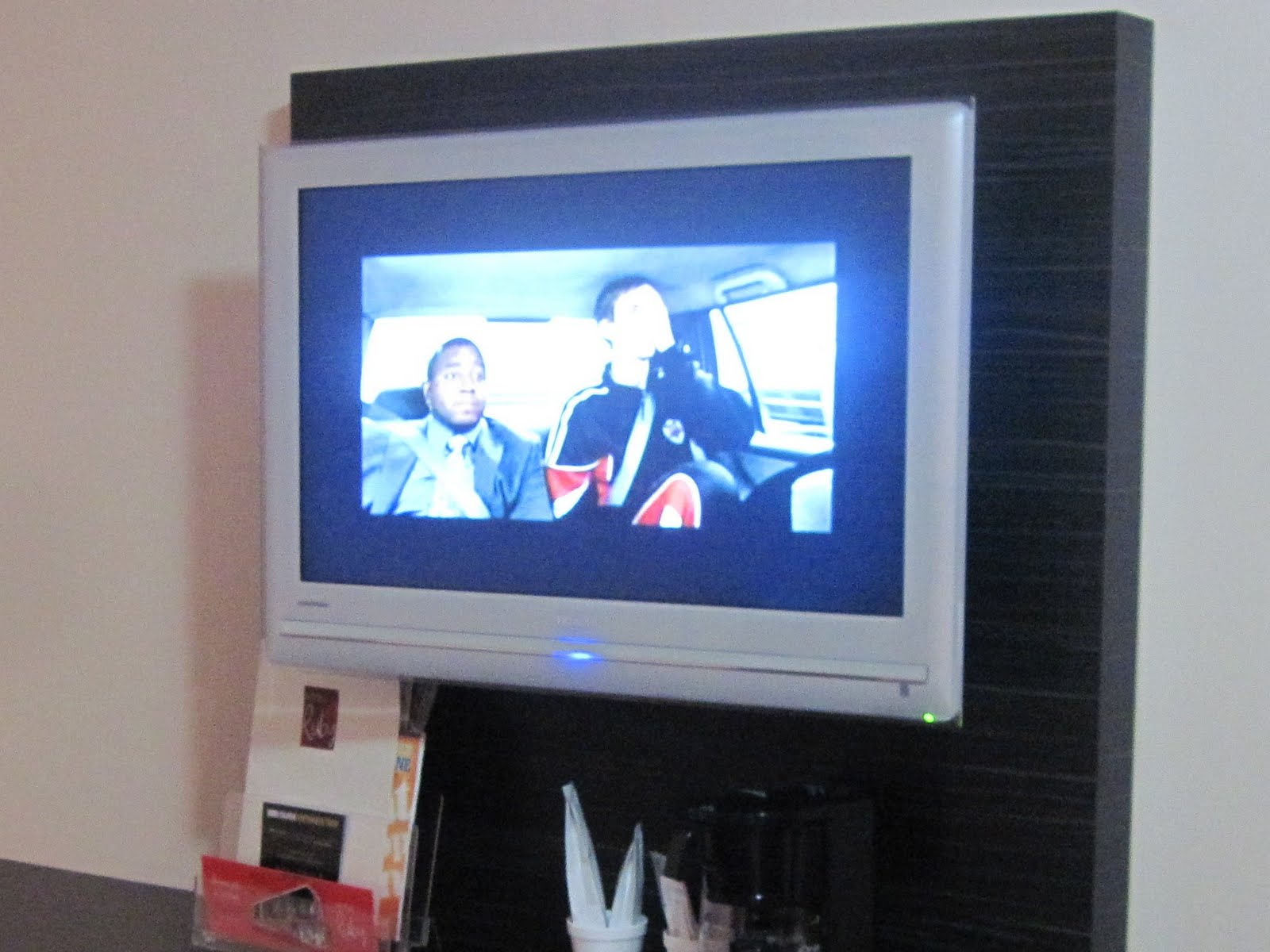 One of the televisions at the Hotel Ruby in Spokane, Washington.
I don't get all that much over the air. The strongest signal is from KVOS, an independent station based out of Bellingham, Washington that carries a variety of modern and more classic programming; I watch mainly because it airs House on Saturday nights - it's a series that would constantly come up in conversation or on TV Tropes, but I wasn't willing to go buy a DVD set based purely on word-of-mouth. But I will watch it as it streams in.
Plenty of people will be familiar with being spoiled for choice. The way I watch TV now, it's about discovery. I don't have an TV Guide - though I have heard they barely even bother with the program grids now, which tells you how long I've been out of the loop - and I don't have a digital information system with an on-screen guide and plot summaries and what have you. I have the antenna, the remote, and the screen - and aside from easy conclusions like "House will be a jerk" or "it's not lupus," I have no idea what's coming up next. It's almost exploratory - just finding out what's there, with only the barest knowledge of what to expect.
Sure, I'll admit that it's got problems - as an entirely passive medium, there are plenty of ways in which it's just thoroughly beaten by the internet - but I still think that TV does have place in this modern future. I don't think television itself will die - more along the lines of television as I, personally, know it.
Thursday, July 22, 2010
PDP #254: Way Out of Their Jurisdiction
The other day I went to downtown Toronto and ended up in Manhattan. The southern exit of King subway station had become 34th Street Station, NYPD cruisers and New York taxis lined the streets, the flags flying from the Hotel Victoria were replaced with American and New York State flags, and at the corner of Yonge and Melinda a bunch of guys in FBI jackets stood back from the crowd.
It's yet another television shoot. This one is for the new TV series Nikita, which according to the filming notification letter "follows Nikita after she has escaped 'Division.' And her new mission is to take down the organization that created her." Also it apparently has nothing at all to do with Khrushchev.
 I, the copyright holder of this work, hereby release it into the public domain. This applies worldwide. In case this is not legally possible, I grant anyone the right to use this work for any purpose, without any conditions, unless such conditions are required by law.
It's yet another television shoot. This one is for the new TV series Nikita, which according to the filming notification letter "follows Nikita after she has escaped 'Division.' And her new mission is to take down the organization that created her." Also it apparently has nothing at all to do with Khrushchev.
 I, the copyright holder of this work, hereby release it into the public domain. This applies worldwide. In case this is not legally possible, I grant anyone the right to use this work for any purpose, without any conditions, unless such conditions are required by law.
Subscribe to:
Posts (Atom)