("My Ad Astra Schedule" would probably have been a more compact title, but a lot of people are probably doing variations of that, too.)
If you're one of the maybe two people who actually pays attention to this weblog anymore, you may have noticed that I'm going to be putting in an appearance at Ad Astra, Toronto's own Richmond Hill-based science fiction convention, early next month. The panel schedules have at last come down from on high, and here's what I'll be up to if you feel like tracking me down for some unfathomable reason.
Saturday
A Trillion Is a Statistic
Time: 10:00 AM - 11:00 AM
Room: Markham B
Panellists: Ian Keeling, Karl Schroeder
It happens so often in science fiction there's a name for it: "earth-shattering kaboom." From Lensmen to Ender's Game and beyond, sf has been solving problems with genocide for decades. Is this just authorial laziness, motivating heroes with a big enough bang, or is reflective of something dark in the genre's soul?
The Wisdom of Ages Past: Relevance of Older Science Fiction
Time: 3:00 PM - 4:00 PM
Room: Oakridge
Panellists: David Lamb, Hayden Trenholm, Nina Munteanu
The golden age of science fiction still has a solid grip on the minds and dreams of even the youngest readers today. What can we still learn from the greats, and what of their ideas or methods are so outmoded that they can only be appreciated as a history lesson of how the industry used to be?
Sunday
Readings: Andrew Barton & Mike Rimar
Time: 10:00 AM - 11:00 AM
Room: Aurora
I willn't tell you what'll be happening at the reading on Sunday. It's SOOPER SEKRIT so you'll just have to come.

Showing posts with label convention. Show all posts
Showing posts with label convention. Show all posts
Thursday, March 19, 2015


Thursday, March 27, 2014
Ad Astra 2014 Schedule
As I look outside, winter is very, very, very gradually lifting away from the part of the world I can see--by which I mean most of the snow is gone and the harbor isn't frozen over anymore, even though it remains staggeringly cold--and that means that Convention Season is about to start for another year! First up on my block is Ad Astra, Toronto's local science fiction and fantasy fan convention, even though it's being held up in the remote wilderness of Richmond Hill: close enough to the Arctic Circle as to make no difference at all.
This'll be the first time I've been a participant there, though. They've put me on two panels, and I will be reading from my new story "Three Years of Ashes and Twenty Years of Dust" as part of the official launch of Strange Bedfellows by Bundoran Press. If you're going to be in the neighborhood, perhaps you'll check them out!
Mining in Space - Saturday, April 5, 2:00 PM, Aurora
Bundoran Press Launch Event - Saturday, April 5, 9:00 PM, Book Launch Room
That Drives Me Crazy! - Sunday, April 6, 1:00 PM, Aurora
This'll be the first time I've been a participant there, though. They've put me on two panels, and I will be reading from my new story "Three Years of Ashes and Twenty Years of Dust" as part of the official launch of Strange Bedfellows by Bundoran Press. If you're going to be in the neighborhood, perhaps you'll check them out!
Mining in Space - Saturday, April 5, 2:00 PM, Aurora
Bundoran Press Launch Event - Saturday, April 5, 9:00 PM, Book Launch Room
That Drives Me Crazy! - Sunday, April 6, 1:00 PM, Aurora
Saturday, January 18, 2014
You Got 科学幻想 In My Science Fiction
No matter what form the future takes, there's one country that will take a major role in guiding it from those things that it does, or does not, do--China. I don't think I'm going out on a limb when I suggest that the 21st century will be a Chinese century, if for no other reason that it accounts for a significant fraction of humanity and shows no signs of letting its influence fade. As it stands, China's looking toward the future--witness the Chang'e 3 landing and Yutu lunar probe, for example, or its plans to have its own space station in operation by the 2020s. Appropriately enough, science fiction is big business there; its Science Fiction World, with estimates of more than one million readers per issue, is the most popular SF magazine on Earth.
Still, something of a gap remains between Chinese and Western SF--at least, from the Western perspective. It's not unusual for Western science fiction to be translated for the Chinese audience, going back to translations of Jules Verne in the early 20th century, but there's far less of it happening in the other direction. Ken Liu is active in translating Chinese science fiction and fantasy for publication in English, I can't think of anyone else who's doing it. The English translation of Cheng Jingbo's "Grave of the Fireflies," which appeared in this month's Clarkesworld, is the first I've come across.
It's the sort of thing that should change. I mean, this is the 21st century after all. Science fiction is a conversation, and when people are excluded everyone else misses out. If I had the opportunity, I'd start a magazine half in English, half in Chinese, translating stories to carry them across the language barrier... maybe someone will start something like that, one day. Maybe someone already has and I just don't know about it. But connections are important.
So I wasn't entirely surprised to find, the other day, about a group that's bidding for the 2016 World Science Fiction Convention--in Beijing.
It's a bit of a quixotic bid, really. The voting for 2016 is going to be held in London this August, and it's been Kansas City running unopposed for years. The KC bid has built up enough steam at this point that I doubt Beijing would be able to finagle an upset. It's my suspicion, and the suspicion of others, that the bid organizers are rather new to the whole thing--for one, none of the standard questionnaires detailing the dates being bidded for, bid officials, and so on seem to be present on their website. A website, for that matter, which I can only read after passing it through Google Translate, as it's entirely in Mandarin. The organizers seem to be some kind of scientific society where people can go for answers to science-related questions, talk about science and technology, and that sort of thing.
I think there's a definite opportunity for a Beijing bid: not in 2016, but down the road. 2018, for example, only has two candidates so far, New Orleans and San José. Targeting a more distant year would give a Beijing bid group more opportunity to level out a foundation and build bridges to bring the Chinese and Western science fiction communities closer together--which, really, should be the entire point of it.
That's not to say I don't have misgivings about how well Beijing would fare in competition--just after I heard about this bid, I saw those photos of the sunrise being broadcast on big TV screens in Beijing because the smog was thick enough to turn the sky grey.* Still, I am reminded that Loncon 1, held in 1957, came only five years after a particularly vicious smog descended over London. The more things change, the more they really don't.
I have to say, though, I do like the logo they've chosen.
* Postscript 01/24/2014 - As I have subsequently seen, that is not what those pictures accurately represented, but the fact remains that the air in China's urban centers is hideously polluted.
Still, something of a gap remains between Chinese and Western SF--at least, from the Western perspective. It's not unusual for Western science fiction to be translated for the Chinese audience, going back to translations of Jules Verne in the early 20th century, but there's far less of it happening in the other direction. Ken Liu is active in translating Chinese science fiction and fantasy for publication in English, I can't think of anyone else who's doing it. The English translation of Cheng Jingbo's "Grave of the Fireflies," which appeared in this month's Clarkesworld, is the first I've come across.
It's the sort of thing that should change. I mean, this is the 21st century after all. Science fiction is a conversation, and when people are excluded everyone else misses out. If I had the opportunity, I'd start a magazine half in English, half in Chinese, translating stories to carry them across the language barrier... maybe someone will start something like that, one day. Maybe someone already has and I just don't know about it. But connections are important.
So I wasn't entirely surprised to find, the other day, about a group that's bidding for the 2016 World Science Fiction Convention--in Beijing.
It's a bit of a quixotic bid, really. The voting for 2016 is going to be held in London this August, and it's been Kansas City running unopposed for years. The KC bid has built up enough steam at this point that I doubt Beijing would be able to finagle an upset. It's my suspicion, and the suspicion of others, that the bid organizers are rather new to the whole thing--for one, none of the standard questionnaires detailing the dates being bidded for, bid officials, and so on seem to be present on their website. A website, for that matter, which I can only read after passing it through Google Translate, as it's entirely in Mandarin. The organizers seem to be some kind of scientific society where people can go for answers to science-related questions, talk about science and technology, and that sort of thing.
I think there's a definite opportunity for a Beijing bid: not in 2016, but down the road. 2018, for example, only has two candidates so far, New Orleans and San José. Targeting a more distant year would give a Beijing bid group more opportunity to level out a foundation and build bridges to bring the Chinese and Western science fiction communities closer together--which, really, should be the entire point of it.
That's not to say I don't have misgivings about how well Beijing would fare in competition--just after I heard about this bid, I saw those photos of the sunrise being broadcast on big TV screens in Beijing because the smog was thick enough to turn the sky grey.* Still, I am reminded that Loncon 1, held in 1957, came only five years after a particularly vicious smog descended over London. The more things change, the more they really don't.
I have to say, though, I do like the logo they've chosen.
* Postscript 01/24/2014 - As I have subsequently seen, that is not what those pictures accurately represented, but the fact remains that the air in China's urban centers is hideously polluted.
Monday, September 30, 2013
To Your Scattered Panels Go: LoneStarCon 3
It's been nearly a month since Worldcon flared to brief and blazing life down in Texas over this past Labour Day weekend, but it feels like it took weeks for the echoes to start settling down. You may have heard about it in blogs or Twitter in connection with renewed concerns over the greying of the membership and the ongoing problems with diversity in the science fiction and fantasy field. if not, well, you might as well start off here!
What's Worldcon? It's the World Science Fiction Convention, held yearly since 1939 except for 1942, 1943, 1944, and 1945 due to some unfortunate unpleasantness, and was historically the big get-together of the science fiction and fantasy community--though history tends to give way to the future, which is the source of so many of its present issues. Unlike other major conventions like Dragon Con or San Diego Comic Con or so on, Worldcon doesn't put down roots; it's a roving convention that hops from city to city every year. In 2012 it was in Chicago, in 2014 it will be in London, and so on. Despite the name, which was coined out of analogy with the 1939 World's Fair in New York, most have been held in the United States. This one was held in San Antonio, Texas, at the Henry B. Gonzales Convention Center and the Marriott Rivercenter and Riverwalk hotels.
What'll you find at Worldcon? A goodly number of people, for one--while it isn't the tens of thousands that you'll find at Dragon Con or the major comic conventions, over the past couple of decades Worldcons have settled into a steady attendance of three to four thousand. It's enough for the convention to be busy, with multiple program items running concurrently from morning to evening, but not so crowded that it's impossible to do anything but stake out a spot in a line and hope for the best. What you won't find at Worldcon is a strong media presence. Sure, there are panels here and there, but the overwhelming focus is on the written world. There isn't much cosplay either. I never went to the masquerade, but through all the rest of the con, I encountered one person cosplaying as Vanellope from Wreck-It Ralph and that was it.
Unless you count the guy with the remote-controlled K-9 and Dalek. But then they're not costumes, are they?

There was one major, inescapable presence at LoneStarCon 3, though--Texas itself. I knew what I was getting into from the first time I checked the San Antonio temperature charts, but there's a difference between knowing something and living it. I will say that the weather conditions in late August were tolerable, but only because every square inch of the convention space was air conditioned. On my longest trip outside of the conditioned air--a morning journey to the Alamo and back--I felt like the air had sucked every joule of energy out of me. The conditions were generally comparable to standing next to the heat exhaust of a transit bus. When I stepped out of the convention center it felt as if the hairs were being singed off my arms. One of the most important lessons I took away from LoneStarCon 3 is that I am not built for life in Texas.
Nevertheless, LoneStarCon3 was a very Texas convention. To put it into perspective, there more than twice as many attendees from the Lone Star State as from the entire world outside of the United States. Granted, this is nothing new; generally speaking, wherever Worldcon lands, a substantial proportion of the membership is going to consist of people who live within a few hours' drive, and in San Antonio's case, "a few hours' drive" is Texas with a slice of northeastern Mexico. It was strongly evident in the program; aside from the launch of the new Rayguns Over Texas anthology, there were nearly twenty program items dealing with Texas in general, and a dozen dealing with Robert E. Howard specifically--that latter focus, incidentally, drew some heat on Twitter later, and seems to have come about because of a near-total lack of Howard-related programming at LoneStarCon 2 back in 1997.
Though this does cut close to one of the issues Worldcon is wrestling with: the nature of the attendees. There are those who follow Worldcon from city to city, but due to the expenses inherent in airline tickets and hotel rooms, many of them tend to be either closely involved in the scene themselves--writers, editors, what have you--or people who've been going to Worldcons for decades, and have the free time and money necessary to do so. The expense issue alone excludes a lot of potential attendees; hell, if I'd have been aware of the existence of Worldcon back in university, when I was first starting out toward science fiction, the 2003 Worldcon in Toronto was the only one I could have even begun to consider attending, and that only because I was living in Toronto then. Going to San Jose or Boston or Glasgow or Yokohama as a broke-ass student? Forget about it, mangs.
Now then, on with the meat of it.
In retrospect, the first panel I dropped into foreshadowed the whole "aging" question. Dangerous Visions: Are They Still Dangerous?, held on Thursday afternoon when attendees were still trickling into San Antonio International Airport, wore its subject in its title--Harlan Ellison's groundbreaking anthology Dangerous Visions, published in 1967 to widespread acclaim, and followed by Again, Dangerous Visions in 1972 and The Last Dangerous Visions in1973 1975 1976 1977 1978 1980 1982 1984 1990 2007 bwahahahahahaha I'm just kidding, that thing is never coming out. If you've never heard of it, Dangerous Visions was an anthology intended to collect the sort of stories that couldn't be published anywhere else--or, at least, couldn't be published anywhere else in 1967. One of the included stories, Norman Spinrad's "Carcinoma Angels," arrived after having been rejected by Playboy--at the time, the highest-paying fiction market in the United States--and is entirely innocuous today. As I understand, it was dangerous because... it acknowledged the existence of cancer?
In all, no surprise that this was focused in history. I suppose some might say that Worldcon's whole problem is that there's too much focus on history. Things were different in my first Friday panel, Schmoozing 101 with Mary Robinette Kowal, which unfolded in front of a full room. You'd think some of the things she went over--being able to find common ground in a conversation, not trapping people in a conversation, being physically pleasant through such innovations as bathing--would go without saying, but the sad truth is that they don't. One bit that stuck with me was her demonstration of the three types of movement, aggressive, passive, and regressive; a simple statement like "What did you say?" can have *vastly* different meanings if the speaker is leaning toward the subject, standing still, or recoiling.
At the What-If Moments in History panel, presided over by panelists Vylar Kaftan, David Liss, Harry Turtledove, and Jo Walton, the audience filled the chairs and spilled out into standing room only. While a lot of the panel went over the same sort of things I've seen in alternate history panels before, I did find one of Jo Walton's statements intriguing: that is, the notion that AH is an "anti-providential" literature, and so inherently subversive because it undermines the notion that there is some kind of historical plan. Thinking about it now, that makes AH seem like the next great genre to be officially condemned in some authoritarian thought-control state. Perhaps I could get a plot out of that.
I was also a bit flummoxed by the audience member who claimed that a major issue with AH is that we don't know how people in the past talked, acted, or looked like. It sure is a good thing writing and photography were finally invented in 2011, eh?
I was also heartened by Harry Turtledove's assertion that using historical figures born after an alternate history's point of divergence--say, a story about Napoleon Bonaparte in a world where the Carthaginians crushed Rome to powder--is "cheating." I've been saying this all along! Honestly, though, it would be stronger if Turtledove was not guilty of that cheating himself.
On Sunday, The Future Two Hundred Years Out likewise played to a full room, this one considerably bigger--it may be because Kim Stanley Robinson, one of 2013's Hugo nominees, was one of the panelists. He didn't mince his words on the panel, saying that "the Singularity is bullshit," with humans continuing to be the primary agents of history, and I can't help but lean toward his thinking. There wasn't much real disagreement from the other panelists on that; Joe Haldeman argued the Singularity to be a slow-motion convergence of technological and social trends that began around 1960 and will continue evolving for decades, for one. Other topics tackled here included the common failing of not taking social changes into account (N.B.: according to Sheila Williams, Asimov's does not see nearly enough examinations of the technological and social implications of technological advance, so get on that, writorbs), what will replace capitalism (nobody could really figure that out, though Robinson described present-day capitalism as "liquefied feudalism"), and that dystopias at their core all tell the same story: we can fuck up.
It was the last panel I attended, though--Have We Lost the Future?--that I think put an endcap on the whole experience. In a way, it served as a bookend complementing the Dangerous Visions panel in its historical focus. About midway through, panelist Willie Siros made a statement that bowled me over, that the space age "came and went" in his lifetime. I suppose this is true if you define "space age" to mean "humans landing on Luna." In every other dimension, though, I think things have been accelerating, and the speed of change isn't letting up. As I write this, it's only been a few hours since I watched, live, the launch of a rocket from a webcam attached to its side as it left the atmosphere, built by a company whose CEO has made it clear that he intends to die on Mars. One of the Voyager probes has left the solar system. We've seen 4 Vesta up close and there discovered an equal to Olympus Mons. We have detected nearly one thousand exoplanets!
The Space Age hasn't gone--it's barely even begun!
Here, though, is another potential expression of Worldcon's age issue. The fresh new writers of today are young and of a world in which the lunar missions were all history. We didn't live through them. We didn't expect that they would just be the start and that there would be, say, boots on Mars by 2000. Although we share the science fiction field, our formative experiences are staggeringly different from those who entered the community in, say, the 50s through to the 70s. Likewise, it could be argued that science fiction is still figuring out its place in the cultural sphere--but that place may not necessarily be comfortable to those who were with it in the old days.
What do I think the future holds? I'm not sure. Sooner or later, the cold equations of the actuarial tables demand that younger fans get involved in making Worldcon happen from year to year; the question is how many of those younger fans will be willing to? It's a different world now than it was thirty years ago. Things can change from Worldcon to Worldcon--in my personal experience, I had a good time in the gaming room at Chicon 7 last year, but when I went to the Night Gaming Room at LoneStarCon 3, I found a room with a few tables covered in sheets and absolutely nothing else.
The question of what Worldcon would be in future years hung heavily over the Site Selection battle. For the first time in years, there was more than one site with an active bid: in fact Orlando, Spokane, and Helsinki all vied to host the 73rd World Science Fiction Convention in 2015. Parties rich in Finnish flavors rocked the Marriott Rivercenter to its foundations two nights in a row, and the Orlando team struggled valiantly for a convention that promised openness and low cost, for the price of holding it at Disney World during the height of hurricane season, but once the votes were counted it went to the one few had expected--Spokane, Washington.
Personally, I'd expected the real fight to be between Helsinki and Orlando. However, since Worldcon Site Selection runs on Australian rules balloting--that is, you mark your choices 1, 2, and 3, the candidate with the least 1 votes gets knocked out and their voters' 2 votes redistributed, and so on--it became clear that there were two camps: the people who wanted a Worldcon in Helsinki, and the people who wanted Worldcon to stay in the United States. Helsinki got more #1 votes than anyone at first, but when Orlando was knocked out of the running, their voters broke for Spokane over Helsinki by nearly a 4 to 1 margin. What made it so heartbreaking was that Helsinki lost by thirty-five votes. THIRTY-FIVE!
It doesn't surprise me, in retrospect--because Spokane always struck me as the "safe" bid. Helsinki offered the chance to bring Worldcon to an area of the world that had never had it before, and with the 2014 Worldcon being held in London, affored the opportunity for a European Worldcon fandom to arise. Orlando offered a revolutionary take on Worldcon, with low price and openness to new things, even if their latest bid artwork gave the impression they were looking to turn Worldcon into a mini-Dragon Con. Spokane... Spokane offered something unchallenging.
I'm sure that Sasquan, the 2015 Worldcon, will still be a cool thing, and I've already paid for my membership. Nevertheless, I can't help but think that it says something about the Worldcon community that, when presented with options for the new and for revitalization, it went for the safe and the familiar.
Previous Convention Reports
What's Worldcon? It's the World Science Fiction Convention, held yearly since 1939 except for 1942, 1943, 1944, and 1945 due to some unfortunate unpleasantness, and was historically the big get-together of the science fiction and fantasy community--though history tends to give way to the future, which is the source of so many of its present issues. Unlike other major conventions like Dragon Con or San Diego Comic Con or so on, Worldcon doesn't put down roots; it's a roving convention that hops from city to city every year. In 2012 it was in Chicago, in 2014 it will be in London, and so on. Despite the name, which was coined out of analogy with the 1939 World's Fair in New York, most have been held in the United States. This one was held in San Antonio, Texas, at the Henry B. Gonzales Convention Center and the Marriott Rivercenter and Riverwalk hotels.
What'll you find at Worldcon? A goodly number of people, for one--while it isn't the tens of thousands that you'll find at Dragon Con or the major comic conventions, over the past couple of decades Worldcons have settled into a steady attendance of three to four thousand. It's enough for the convention to be busy, with multiple program items running concurrently from morning to evening, but not so crowded that it's impossible to do anything but stake out a spot in a line and hope for the best. What you won't find at Worldcon is a strong media presence. Sure, there are panels here and there, but the overwhelming focus is on the written world. There isn't much cosplay either. I never went to the masquerade, but through all the rest of the con, I encountered one person cosplaying as Vanellope from Wreck-It Ralph and that was it.
Unless you count the guy with the remote-controlled K-9 and Dalek. But then they're not costumes, are they?

There was one major, inescapable presence at LoneStarCon 3, though--Texas itself. I knew what I was getting into from the first time I checked the San Antonio temperature charts, but there's a difference between knowing something and living it. I will say that the weather conditions in late August were tolerable, but only because every square inch of the convention space was air conditioned. On my longest trip outside of the conditioned air--a morning journey to the Alamo and back--I felt like the air had sucked every joule of energy out of me. The conditions were generally comparable to standing next to the heat exhaust of a transit bus. When I stepped out of the convention center it felt as if the hairs were being singed off my arms. One of the most important lessons I took away from LoneStarCon 3 is that I am not built for life in Texas.
Nevertheless, LoneStarCon3 was a very Texas convention. To put it into perspective, there more than twice as many attendees from the Lone Star State as from the entire world outside of the United States. Granted, this is nothing new; generally speaking, wherever Worldcon lands, a substantial proportion of the membership is going to consist of people who live within a few hours' drive, and in San Antonio's case, "a few hours' drive" is Texas with a slice of northeastern Mexico. It was strongly evident in the program; aside from the launch of the new Rayguns Over Texas anthology, there were nearly twenty program items dealing with Texas in general, and a dozen dealing with Robert E. Howard specifically--that latter focus, incidentally, drew some heat on Twitter later, and seems to have come about because of a near-total lack of Howard-related programming at LoneStarCon 2 back in 1997.
Though this does cut close to one of the issues Worldcon is wrestling with: the nature of the attendees. There are those who follow Worldcon from city to city, but due to the expenses inherent in airline tickets and hotel rooms, many of them tend to be either closely involved in the scene themselves--writers, editors, what have you--or people who've been going to Worldcons for decades, and have the free time and money necessary to do so. The expense issue alone excludes a lot of potential attendees; hell, if I'd have been aware of the existence of Worldcon back in university, when I was first starting out toward science fiction, the 2003 Worldcon in Toronto was the only one I could have even begun to consider attending, and that only because I was living in Toronto then. Going to San Jose or Boston or Glasgow or Yokohama as a broke-ass student? Forget about it, mangs.
Now then, on with the meat of it.
In retrospect, the first panel I dropped into foreshadowed the whole "aging" question. Dangerous Visions: Are They Still Dangerous?, held on Thursday afternoon when attendees were still trickling into San Antonio International Airport, wore its subject in its title--Harlan Ellison's groundbreaking anthology Dangerous Visions, published in 1967 to widespread acclaim, and followed by Again, Dangerous Visions in 1972 and The Last Dangerous Visions in
In all, no surprise that this was focused in history. I suppose some might say that Worldcon's whole problem is that there's too much focus on history. Things were different in my first Friday panel, Schmoozing 101 with Mary Robinette Kowal, which unfolded in front of a full room. You'd think some of the things she went over--being able to find common ground in a conversation, not trapping people in a conversation, being physically pleasant through such innovations as bathing--would go without saying, but the sad truth is that they don't. One bit that stuck with me was her demonstration of the three types of movement, aggressive, passive, and regressive; a simple statement like "What did you say?" can have *vastly* different meanings if the speaker is leaning toward the subject, standing still, or recoiling.
At the What-If Moments in History panel, presided over by panelists Vylar Kaftan, David Liss, Harry Turtledove, and Jo Walton, the audience filled the chairs and spilled out into standing room only. While a lot of the panel went over the same sort of things I've seen in alternate history panels before, I did find one of Jo Walton's statements intriguing: that is, the notion that AH is an "anti-providential" literature, and so inherently subversive because it undermines the notion that there is some kind of historical plan. Thinking about it now, that makes AH seem like the next great genre to be officially condemned in some authoritarian thought-control state. Perhaps I could get a plot out of that.
I was also a bit flummoxed by the audience member who claimed that a major issue with AH is that we don't know how people in the past talked, acted, or looked like. It sure is a good thing writing and photography were finally invented in 2011, eh?
I was also heartened by Harry Turtledove's assertion that using historical figures born after an alternate history's point of divergence--say, a story about Napoleon Bonaparte in a world where the Carthaginians crushed Rome to powder--is "cheating." I've been saying this all along! Honestly, though, it would be stronger if Turtledove was not guilty of that cheating himself.
On Sunday, The Future Two Hundred Years Out likewise played to a full room, this one considerably bigger--it may be because Kim Stanley Robinson, one of 2013's Hugo nominees, was one of the panelists. He didn't mince his words on the panel, saying that "the Singularity is bullshit," with humans continuing to be the primary agents of history, and I can't help but lean toward his thinking. There wasn't much real disagreement from the other panelists on that; Joe Haldeman argued the Singularity to be a slow-motion convergence of technological and social trends that began around 1960 and will continue evolving for decades, for one. Other topics tackled here included the common failing of not taking social changes into account (N.B.: according to Sheila Williams, Asimov's does not see nearly enough examinations of the technological and social implications of technological advance, so get on that, writorbs), what will replace capitalism (nobody could really figure that out, though Robinson described present-day capitalism as "liquefied feudalism"), and that dystopias at their core all tell the same story: we can fuck up.
It was the last panel I attended, though--Have We Lost the Future?--that I think put an endcap on the whole experience. In a way, it served as a bookend complementing the Dangerous Visions panel in its historical focus. About midway through, panelist Willie Siros made a statement that bowled me over, that the space age "came and went" in his lifetime. I suppose this is true if you define "space age" to mean "humans landing on Luna." In every other dimension, though, I think things have been accelerating, and the speed of change isn't letting up. As I write this, it's only been a few hours since I watched, live, the launch of a rocket from a webcam attached to its side as it left the atmosphere, built by a company whose CEO has made it clear that he intends to die on Mars. One of the Voyager probes has left the solar system. We've seen 4 Vesta up close and there discovered an equal to Olympus Mons. We have detected nearly one thousand exoplanets!
The Space Age hasn't gone--it's barely even begun!
Here, though, is another potential expression of Worldcon's age issue. The fresh new writers of today are young and of a world in which the lunar missions were all history. We didn't live through them. We didn't expect that they would just be the start and that there would be, say, boots on Mars by 2000. Although we share the science fiction field, our formative experiences are staggeringly different from those who entered the community in, say, the 50s through to the 70s. Likewise, it could be argued that science fiction is still figuring out its place in the cultural sphere--but that place may not necessarily be comfortable to those who were with it in the old days.
What do I think the future holds? I'm not sure. Sooner or later, the cold equations of the actuarial tables demand that younger fans get involved in making Worldcon happen from year to year; the question is how many of those younger fans will be willing to? It's a different world now than it was thirty years ago. Things can change from Worldcon to Worldcon--in my personal experience, I had a good time in the gaming room at Chicon 7 last year, but when I went to the Night Gaming Room at LoneStarCon 3, I found a room with a few tables covered in sheets and absolutely nothing else.
The question of what Worldcon would be in future years hung heavily over the Site Selection battle. For the first time in years, there was more than one site with an active bid: in fact Orlando, Spokane, and Helsinki all vied to host the 73rd World Science Fiction Convention in 2015. Parties rich in Finnish flavors rocked the Marriott Rivercenter to its foundations two nights in a row, and the Orlando team struggled valiantly for a convention that promised openness and low cost, for the price of holding it at Disney World during the height of hurricane season, but once the votes were counted it went to the one few had expected--Spokane, Washington.
Personally, I'd expected the real fight to be between Helsinki and Orlando. However, since Worldcon Site Selection runs on Australian rules balloting--that is, you mark your choices 1, 2, and 3, the candidate with the least 1 votes gets knocked out and their voters' 2 votes redistributed, and so on--it became clear that there were two camps: the people who wanted a Worldcon in Helsinki, and the people who wanted Worldcon to stay in the United States. Helsinki got more #1 votes than anyone at first, but when Orlando was knocked out of the running, their voters broke for Spokane over Helsinki by nearly a 4 to 1 margin. What made it so heartbreaking was that Helsinki lost by thirty-five votes. THIRTY-FIVE!
It doesn't surprise me, in retrospect--because Spokane always struck me as the "safe" bid. Helsinki offered the chance to bring Worldcon to an area of the world that had never had it before, and with the 2014 Worldcon being held in London, affored the opportunity for a European Worldcon fandom to arise. Orlando offered a revolutionary take on Worldcon, with low price and openness to new things, even if their latest bid artwork gave the impression they were looking to turn Worldcon into a mini-Dragon Con. Spokane... Spokane offered something unchallenging.
I'm sure that Sasquan, the 2015 Worldcon, will still be a cool thing, and I've already paid for my membership. Nevertheless, I can't help but think that it says something about the Worldcon community that, when presented with options for the new and for revitalization, it went for the safe and the familiar.
Previous Convention Reports
- VCON 36 (Vancouver)
- Fan Expo Canada 2010 (Toronto)
- Ad Astra 2010 (Toronto)
- Anticipation, the 67th World Science Fiction Convention (Montréal)
- Ad Astra 2009 (Toronto)
Tuesday, September 17, 2013
My Can-Con 2013 Schedule
Shock, horror, holy crap--it's a post that isn't a photo! Truth be told, I'm in the midst of rethinking how Acts of Minor Treason works; over the next couple of months I'm endeavoring to reinvent it as a more functional, WordPress-based site. For now, though, I have actual news to deliver!
I'll be attending Can-Con 2013, an Ottawa-based speculative fiction convention, which runs from October 4th to 6th at the Minto Suite Hotel in Ottawa, Ontario and will see the presentation of the Prix Aurora Awards, Canada's highest sf honors. In a first for me, I won't be attending as just some guy as I have managed to finagle myself onto some panels!
Friday, 8 PM to 9 PM - News and Fun from Worldcon - As I understand it, this will be a look at LoneStarCon 3, the 71st World Science Fiction Convention, for those who weren't there and are curious about how a Worldcon goes.
Saturday, 8 PM to 9 PM - You're Qualified for SFWA: Should You Join? - Once you know that SFWA is the Science Fiction and Fantasy Writers of America, an association of which I'm a member, this one seems pretty self-explanatory.
Sunday, 3 PM to 4 PM - Making Predictions: Looking Into the Future as a Science Fiction Writer - I wouldn't say I make predictions, really. But there are things you can do to make your future feel more real and believable.
So if you're in the Ottawa area and interested in this sort of stuff, come over and see! Track me down even, maybe. Full details are available on the con website.
I'll be attending Can-Con 2013, an Ottawa-based speculative fiction convention, which runs from October 4th to 6th at the Minto Suite Hotel in Ottawa, Ontario and will see the presentation of the Prix Aurora Awards, Canada's highest sf honors. In a first for me, I won't be attending as just some guy as I have managed to finagle myself onto some panels!
Friday, 8 PM to 9 PM - News and Fun from Worldcon - As I understand it, this will be a look at LoneStarCon 3, the 71st World Science Fiction Convention, for those who weren't there and are curious about how a Worldcon goes.
Saturday, 8 PM to 9 PM - You're Qualified for SFWA: Should You Join? - Once you know that SFWA is the Science Fiction and Fantasy Writers of America, an association of which I'm a member, this one seems pretty self-explanatory.
Sunday, 3 PM to 4 PM - Making Predictions: Looking Into the Future as a Science Fiction Writer - I wouldn't say I make predictions, really. But there are things you can do to make your future feel more real and believable.
So if you're in the Ottawa area and interested in this sort of stuff, come over and see! Track me down even, maybe. Full details are available on the con website.
Sunday, January 29, 2012
I Was A Preteen Star Trek Hat Kid
You never forget your first - convention, that is. Back in the day, before the ubiquity of the internet linked fan communities from coast to coast and continent to continent, conventions were the prime mixers of fans and the places where fandoms were anchored. I didn't get the chance to attend Rustycon 29 in Seattle last week like I'd intended, thanks to western Washington being choked with snow, but on this grey and dismal New Westminster Sunday I thought I'd write a bit about my first convention, or at least the little of it that I can remember.
Today it's called Polaris, but twenty years ago it was known as Toronto Trek, being Toronto's preeminent Star Trek convention. In retrospect it's no surprise that this was my first intersection with the convention sphere; it was only because of my age and situation that the next time I crossed paths with that world wouldn't be until ten years later at Anime North. It was one of the many Star Trek conventions that had sprung up in the twenty years following the first such convention, back in 1972, when the syndication of the original series had allowed Star Trek fandom to retain its vitality. My mother took me there, and considering that we had shelves of Star Trek tie-in novels that constituted my first real look at the science fiction genre as well as the entire original run of Star Trek on those Columbia House VHS tapes, there's nothing surprising about that either.
 let's see what this galaxy-class starship can do when it's in the middle of a hollywood warehouse
I don't recall very much about the convention itself. This would have been in the summer of 1993 or 1994, making me eleven years old at the most, and with both The Next Generation and Deep Space Nine fresh on the airwaves, it was energetic. I recall that it was busy, and there were a lot of cast and crew from the series in attendance. What I recall most strongly was a "stump-the-audience" event, because I won it.
The way it worked, to my recollection, was this - if you were in the audience, you could stand up and ask a trivia question related to Star Trek, and if nobody could answer it you won a prize. I'm not sure how much advance notice I had of the way it worked, but it was enough to formulate a plan: win by asking the most obscure question I could find. Fortunately, for that, I had the Star Trek: The Next Generation Technical Manual. I'd read it again and again at home so I already had a fair idea of where to go, and I still remember the question I came up with when the event runners called on me.
"Where," I asked, "was the Starfleet Type 15 shuttlepod manufactured?" This was something that had never been stated on screen, ever, because really it's completely irrelevant, and in the days before on-the-fly smartphone access to Memory Alpha it would have had to come down to someone in the audience having memorized the section of the Technical Manual dealing with shuttlecraft and shuttlepods.
When the time ran out, no one had answered correctly - so I won! I had stumped the audience and I got to go up to the front to pick my prize. From what I remember and what was retold, there were two choices up there. The first was a complete soundtrack for the then-new Star Trek: Deep Space Nine on compact disc, and the second was a Deep Space Nine baseball hat.
So which one did I want, they asked?
"Umm... I don't think we have a CD player at home," I said. I certainly didn't, not at that point, but at that age I would have had only the vaguest notion of what a CD player even was - all the computer software I was familiar with at the time came on floppy disks, and when it came to music it was still the era of records and cassette tapes in my experience. "So I'll take the hat."
We did, of course, have a CD player at home. I was just totally unaware of that. I imagine that whoever ended up getting the CDs was thankful that I'd chosen the $10 hat instead. I don't know what happened to that hat - it disappeared sometime during the '90s, and I've never seen its like again.
Nevertheless, it was worth it. If nothing else, I suppose it was a significant learning experience for me - the first time, to my recollection, where I'd ever posed a question that a whole bunch of grownups couldn't answer. That's an incredibly empowering feeling for a kid, a big step on the road to independence and adulthood.
To answer the question: the Starbase 134 integration facility at Rigel VI.
Today it's called Polaris, but twenty years ago it was known as Toronto Trek, being Toronto's preeminent Star Trek convention. In retrospect it's no surprise that this was my first intersection with the convention sphere; it was only because of my age and situation that the next time I crossed paths with that world wouldn't be until ten years later at Anime North. It was one of the many Star Trek conventions that had sprung up in the twenty years following the first such convention, back in 1972, when the syndication of the original series had allowed Star Trek fandom to retain its vitality. My mother took me there, and considering that we had shelves of Star Trek tie-in novels that constituted my first real look at the science fiction genre as well as the entire original run of Star Trek on those Columbia House VHS tapes, there's nothing surprising about that either.
 let's see what this galaxy-class starship can do when it's in the middle of a hollywood warehouse
I don't recall very much about the convention itself. This would have been in the summer of 1993 or 1994, making me eleven years old at the most, and with both The Next Generation and Deep Space Nine fresh on the airwaves, it was energetic. I recall that it was busy, and there were a lot of cast and crew from the series in attendance. What I recall most strongly was a "stump-the-audience" event, because I won it.
The way it worked, to my recollection, was this - if you were in the audience, you could stand up and ask a trivia question related to Star Trek, and if nobody could answer it you won a prize. I'm not sure how much advance notice I had of the way it worked, but it was enough to formulate a plan: win by asking the most obscure question I could find. Fortunately, for that, I had the Star Trek: The Next Generation Technical Manual. I'd read it again and again at home so I already had a fair idea of where to go, and I still remember the question I came up with when the event runners called on me.
"Where," I asked, "was the Starfleet Type 15 shuttlepod manufactured?" This was something that had never been stated on screen, ever, because really it's completely irrelevant, and in the days before on-the-fly smartphone access to Memory Alpha it would have had to come down to someone in the audience having memorized the section of the Technical Manual dealing with shuttlecraft and shuttlepods.
When the time ran out, no one had answered correctly - so I won! I had stumped the audience and I got to go up to the front to pick my prize. From what I remember and what was retold, there were two choices up there. The first was a complete soundtrack for the then-new Star Trek: Deep Space Nine on compact disc, and the second was a Deep Space Nine baseball hat.
So which one did I want, they asked?
"Umm... I don't think we have a CD player at home," I said. I certainly didn't, not at that point, but at that age I would have had only the vaguest notion of what a CD player even was - all the computer software I was familiar with at the time came on floppy disks, and when it came to music it was still the era of records and cassette tapes in my experience. "So I'll take the hat."
We did, of course, have a CD player at home. I was just totally unaware of that. I imagine that whoever ended up getting the CDs was thankful that I'd chosen the $10 hat instead. I don't know what happened to that hat - it disappeared sometime during the '90s, and I've never seen its like again.
Nevertheless, it was worth it. If nothing else, I suppose it was a significant learning experience for me - the first time, to my recollection, where I'd ever posed a question that a whole bunch of grownups couldn't answer. That's an incredibly empowering feeling for a kid, a big step on the road to independence and adulthood.
To answer the question: the Starbase 134 integration facility at Rigel VI.
Thursday, October 13, 2011
Photo: A Flurry of Flashing Steel
There were a lot of things to see at VCON 36, and one in particular that I'd never run into at any other convention - a demonstration of actual swords. Academie Duello, the swordplay academy in downtown Vancouver, gave a few demonstrations during the convention. Swords tend to show up a lot in science fiction and fantasy literature, and it's instructive to see them being used by modern-day swashbucklers who know how to use them; unlike fistfights in TV and movies, swordfights really do sound like that, though they also tend to be "blink and you'll miss it."
 I, the copyright holder of this work, hereby release it under the Creative Commons Attribution-Non Commercial-Share Alike 3.0 Unported license.
This means that you are free to Share (to copy, distribute and transmit the work) and to Remix (to adapt the work) under the following conditions: Attribution (you must attribute the work in the manner specified by the author or licensor, but not in any way that suggests that they endorse you or your use of the work), Noncommercial (you may not use this work for commercial purposes), and Share Alike (if you alter, transform, or build upon this work, you may distribute the resulting work only under the same or similar license to this one).
 I, the copyright holder of this work, hereby release it under the Creative Commons Attribution-Non Commercial-Share Alike 3.0 Unported license.
This means that you are free to Share (to copy, distribute and transmit the work) and to Remix (to adapt the work) under the following conditions: Attribution (you must attribute the work in the manner specified by the author or licensor, but not in any way that suggests that they endorse you or your use of the work), Noncommercial (you may not use this work for commercial purposes), and Share Alike (if you alter, transform, or build upon this work, you may distribute the resulting work only under the same or similar license to this one).
Thursday, October 6, 2011
To Your Scattered Panels Go: VCON 36
It's been a while since I've been able to attend a proper convention. Although my arrival time in Vancouver last year was such that I could theoretically have attended VCON 35, I didn't think it would go over particularly well when I still had to address minor issues such as, you know, finding an apartment. Aside from Fan Expo 2010, which was less a convention and more a chaotic orgy of merchandising and commercialism, the dry spell was a year and a half long. I was able to end that by attending VCON 36, the latest iteration of Vancouver's science fiction and fantasy convention, which was held between September 30th and October 2nd.
This year marked the fortieth anniversary of VCON's establishment in 1971, making it almost exactly as old as Amtrak, and yet there have only been thirty-six of them; this was explained during the Opening Ceremonies on Friday for the benefit of knownothings such as myself as being a result of some VCONs not actually being called by that name, as well as its displacement by Westercon 44 in 1991. It was held at the Sheraton Vancouver Airport Hotel in Richmond, a few minutes' walk from the Canada Line station at Richmond-Brighouse. I understand that in previous years the convention events were split between multiple hotels, but this year the con was entirely self-contained. According to an article I found about it in the Vancouver Sun, this year's attendance was in the neighborhood of seven hundred.
 This hall at the eastern end of the Sheraton was the spine of VCON 36.
Among the attendees were the three guests of honour, divided into the Author, Artist, and Media categories. Originally the Author Guest of Honour was to be Gregory Benford, but apparently something came up with DARPA and he had to reschedule his appearance to next year; in his stead Larry Niven came up from Los Angeles. Jean-Pierre Normand, whose portfolio includes plenty of enchanting covers for Analog and On Spec, was the Artist Guest of Honour, and the Media Guest of Honour was Lisa Lassek, a film editor who has worked on a number of Josh Whedon projects - she was also the only one of the three I didn't encounter at some point during the weekend.
In that respect, my main interest at the con was the panels - they're the sort of thing that really keep drawing me back to conventions, the opportunity to learn new things and stumble into fresh insights that I am far too oblivious to make on my own.
 Sandra Wickham, Lynda Williams, and Larry Niven at VCON 36's "Food in SF" panel.
The panels were salted throughout the weekend, with a few running even before the official Opening Ceremonies at 5 PM on Friday. There were a few throughout that looked interesting but I didn't attend, if only because it takes more than an hour to get from New Westminster to Richmond via transit and I wasn't feeling up to hanging around. Panels such as "The Rest of the World," which examined the tendency for fantasy settings to be strongly based on medieval Europe and much future-set science fiction to be "suspiciously like the United States with spaceships," and looked at the pitfalls and possibilities of setting a work outside the Western cultural sphere. It might be because it was the very first panel I attended on Saturday morning, but I feel like - and the state of my notebook suggests - I got the most out of that one.
At the "Food in SF" panel, it was established that science fictional food was "often terrifying" - but you don't need to go all the way to science fiction for that. The dude in the seat ahead of me was giving out what I later learned were Creamity Wafer Rolls, some strange Vietnamese no-expiry-date "chocolate" snack tubes that were said to taste of fiberglass. I would not be surprised if things like that, in addition to Quorn - which I seriously want to track down the next time I'm in the States for some of that sweet sweet mycoprotein goodness - end up becoming larger than we would think in our food future.
The "Worldbuilding 101" panel, which was held at 10 AM on Sunday and thus required me to leave New Westminster a little after 8, was enlightening - one of the panelists was a UBC astrophysics professor and a member of the COROT and Kepler teams. In addition to overviews of exoplanets like HD 80606 b, which has the most eccentric extrasolar planetary orbit known to exist, discussion touched upon things I hadn't considered. Such as, on a habitable planet with a high oxygen content such as the Cretaceous-era Earth in the new series Terra Nova, would it be too dangerous to use internal combustion engines? When it came to the possibilities of cross-species infections, I'd never thought about the possibility of plant pathogens being exchanged... but the danger would, theoretically, exist, and there's always the chance that an ecosystem could be decimated or wiped out by a latter-day Columbian Exchange.
One thing I found odd, and which I can't recall encountering at any other convention I've attended, was that the program grid listed a significant number of panels that only had one panelist scheduled. To me, part of the interest of panels is for multiple people up at the front to be interacting with each other and the audience; when it's just one person, it seems a lot more like a university lecture.
It was also while waiting for that "Rest of the World" panel that one of the dealer's room exhibitors, Professor Whovianart, came by and gave a few of us a personal introduction to a circa 1919 electric shock therapy device, which produced the prickly sensation you get when a fallen-asleep limb wakes up again, but over my entire upper body.
 Look out! It tingles!
The dealer's room at VCON 36 was rich with options and had a great deal of variety, though the trend skewed far more sharply toward crafting and steampunk than in the Ad Astra dealer's rooms - I'm not sure whether this is because of the time that's passed, or just fan-cultural differences between Vancouver and Toronto. EDGE, publishers of the Tesseract series of Canadian sf/f anthologies, seemed to be the largest publisher in attendance. I found it strange that On Spec wasn't there, considering that it's a sponsor of the event; Neo-Opsis, however, was in from Vancouver Island.
VCON 36 was also the first con I've attended that gives out its own scrip. As I understand it, every registered member found two "VCON 36 CON CA$H" certificates in their swag bag, each worth $1 in the dealer's room, VCON merchandise table, or art show direct purchases. These are apparently also how some con volunteers were compensated for their time. The one I kept is valueless now, of course; it expired at 5 PM on the last day of the con, but I figured it would be worthwhile to keep it in my con file, next to the flyer for the Aberdeen Proving Grounds' 2011 Worldcon bid.
A convention newbie at VCON 36 would have been presented with multiple pathways to the wider world of sf/f conventioneering. The most prominent was the Spokane in 2015 table, which sought to raise awareness for Spokane, Washington's bid for the 73rd World Science Fiction Convention - as it won't be decided until LoneStarCon 3 in 2013, there's still plenty of time to figure that out. There were also flyers out advertising Rustycon 29 and ConClusion, Westercon 65, both of which will be held in Seattle in 2012. Well, SeaTac - but close enough.
 Con-goers act out a scene from the Red Sonja novel The Ring of Ikribu at VCON 36's Turkey Reading.
There was a lot about VCON 36 that I know I missed out on. Taking the SkyTrain back and forth made me feel like a commuter student at university; I was around for the lectures but not any of the after-class stuff that's just as important. Despite that, though, it was still a good con. The problems I need to get over are my own, and I suppose the first steps to solving that would be buying a membership for VCON 37 and learning how to deal.
Previous Convention Reports
This year marked the fortieth anniversary of VCON's establishment in 1971, making it almost exactly as old as Amtrak, and yet there have only been thirty-six of them; this was explained during the Opening Ceremonies on Friday for the benefit of knownothings such as myself as being a result of some VCONs not actually being called by that name, as well as its displacement by Westercon 44 in 1991. It was held at the Sheraton Vancouver Airport Hotel in Richmond, a few minutes' walk from the Canada Line station at Richmond-Brighouse. I understand that in previous years the convention events were split between multiple hotels, but this year the con was entirely self-contained. According to an article I found about it in the Vancouver Sun, this year's attendance was in the neighborhood of seven hundred.
 This hall at the eastern end of the Sheraton was the spine of VCON 36.
Among the attendees were the three guests of honour, divided into the Author, Artist, and Media categories. Originally the Author Guest of Honour was to be Gregory Benford, but apparently something came up with DARPA and he had to reschedule his appearance to next year; in his stead Larry Niven came up from Los Angeles. Jean-Pierre Normand, whose portfolio includes plenty of enchanting covers for Analog and On Spec, was the Artist Guest of Honour, and the Media Guest of Honour was Lisa Lassek, a film editor who has worked on a number of Josh Whedon projects - she was also the only one of the three I didn't encounter at some point during the weekend.
Still, that's the sort of stuff you could figure out by doing a few minutes of online research, though. What was it like - well - it felt comforting. Welcoming. Like I was surrounded by generally like-minded folks, the same way it had been at Ad Astra and Worldcon in Montreal. Like there were things I could hear there that I would have to really dig for on the internet, if they were attested online at all, such as how Larry Niven considers it a part of his job to save civilization by "keep[ing] six billion people scared" - of the threat of impacts, that is, such as the one written about in Lucifer's Hammer - and that he supports the Libertarian Party and believes that "global warming seems to be largely bullshit," comparable to the flatworm memory RNA experiments of the 1950s and 1960s... neither of which are particularly surprising when you take into account books like Oath of Fealty or Fallen Angels.
In that respect, my main interest at the con was the panels - they're the sort of thing that really keep drawing me back to conventions, the opportunity to learn new things and stumble into fresh insights that I am far too oblivious to make on my own.
 Sandra Wickham, Lynda Williams, and Larry Niven at VCON 36's "Food in SF" panel.
The panels were salted throughout the weekend, with a few running even before the official Opening Ceremonies at 5 PM on Friday. There were a few throughout that looked interesting but I didn't attend, if only because it takes more than an hour to get from New Westminster to Richmond via transit and I wasn't feeling up to hanging around. Panels such as "The Rest of the World," which examined the tendency for fantasy settings to be strongly based on medieval Europe and much future-set science fiction to be "suspiciously like the United States with spaceships," and looked at the pitfalls and possibilities of setting a work outside the Western cultural sphere. It might be because it was the very first panel I attended on Saturday morning, but I feel like - and the state of my notebook suggests - I got the most out of that one.
At the "Food in SF" panel, it was established that science fictional food was "often terrifying" - but you don't need to go all the way to science fiction for that. The dude in the seat ahead of me was giving out what I later learned were Creamity Wafer Rolls, some strange Vietnamese no-expiry-date "chocolate" snack tubes that were said to taste of fiberglass. I would not be surprised if things like that, in addition to Quorn - which I seriously want to track down the next time I'm in the States for some of that sweet sweet mycoprotein goodness - end up becoming larger than we would think in our food future.
The "Worldbuilding 101" panel, which was held at 10 AM on Sunday and thus required me to leave New Westminster a little after 8, was enlightening - one of the panelists was a UBC astrophysics professor and a member of the COROT and Kepler teams. In addition to overviews of exoplanets like HD 80606 b, which has the most eccentric extrasolar planetary orbit known to exist, discussion touched upon things I hadn't considered. Such as, on a habitable planet with a high oxygen content such as the Cretaceous-era Earth in the new series Terra Nova, would it be too dangerous to use internal combustion engines? When it came to the possibilities of cross-species infections, I'd never thought about the possibility of plant pathogens being exchanged... but the danger would, theoretically, exist, and there's always the chance that an ecosystem could be decimated or wiped out by a latter-day Columbian Exchange.
One thing I found odd, and which I can't recall encountering at any other convention I've attended, was that the program grid listed a significant number of panels that only had one panelist scheduled. To me, part of the interest of panels is for multiple people up at the front to be interacting with each other and the audience; when it's just one person, it seems a lot more like a university lecture.
It was also while waiting for that "Rest of the World" panel that one of the dealer's room exhibitors, Professor Whovianart, came by and gave a few of us a personal introduction to a circa 1919 electric shock therapy device, which produced the prickly sensation you get when a fallen-asleep limb wakes up again, but over my entire upper body.
 Look out! It tingles!
The dealer's room at VCON 36 was rich with options and had a great deal of variety, though the trend skewed far more sharply toward crafting and steampunk than in the Ad Astra dealer's rooms - I'm not sure whether this is because of the time that's passed, or just fan-cultural differences between Vancouver and Toronto. EDGE, publishers of the Tesseract series of Canadian sf/f anthologies, seemed to be the largest publisher in attendance. I found it strange that On Spec wasn't there, considering that it's a sponsor of the event; Neo-Opsis, however, was in from Vancouver Island.
VCON 36 was also the first con I've attended that gives out its own scrip. As I understand it, every registered member found two "VCON 36 CON CA$H" certificates in their swag bag, each worth $1 in the dealer's room, VCON merchandise table, or art show direct purchases. These are apparently also how some con volunteers were compensated for their time. The one I kept is valueless now, of course; it expired at 5 PM on the last day of the con, but I figured it would be worthwhile to keep it in my con file, next to the flyer for the Aberdeen Proving Grounds' 2011 Worldcon bid.
A convention newbie at VCON 36 would have been presented with multiple pathways to the wider world of sf/f conventioneering. The most prominent was the Spokane in 2015 table, which sought to raise awareness for Spokane, Washington's bid for the 73rd World Science Fiction Convention - as it won't be decided until LoneStarCon 3 in 2013, there's still plenty of time to figure that out. There were also flyers out advertising Rustycon 29 and ConClusion, Westercon 65, both of which will be held in Seattle in 2012. Well, SeaTac - but close enough.
 Con-goers act out a scene from the Red Sonja novel The Ring of Ikribu at VCON 36's Turkey Reading.
There was a lot about VCON 36 that I know I missed out on. Taking the SkyTrain back and forth made me feel like a commuter student at university; I was around for the lectures but not any of the after-class stuff that's just as important. Despite that, though, it was still a good con. The problems I need to get over are my own, and I suppose the first steps to solving that would be buying a membership for VCON 37 and learning how to deal.
Previous Convention Reports
- Fan Expo Canada 2010 (Toronto)
- Ad Astra 2010 (Toronto)
- Anticipation, the 67th World Science Fiction Convention (Montréal)
- Ad Astra 2009 (Toronto)
Monday, September 20, 2010
PDP #284: Super Cool and Manly
There was a pretty good range of costumes at this year's Fan Expo. Some were good, like the Ghostbusters or the Dr. McNinja; some were better left in the pages of the comics they sprung from, like the overly form-fitting Spider-man; and then there were the superlative ones, like the Weighted Companion Cube from Portal. I wish I could have gotten a better picture, but this was practically shooting from the hip while crossing the street. I'm surprised it turned out as good as it did.
 I, the copyright holder of this work, hereby release it into the public domain. This applies worldwide. In case this is not legally possible, I grant anyone the right to use this work for any purpose, without any conditions, unless such conditions are required by law.
 I, the copyright holder of this work, hereby release it into the public domain. This applies worldwide. In case this is not legally possible, I grant anyone the right to use this work for any purpose, without any conditions, unless such conditions are required by law.
Monday, August 30, 2010
To Your Scattered Panels Go: Fan Expo Canada 2010
In all honesty, I've never been much of a comic-book fan. The childhood years that appear to be when the habit settles in for most people were, in my case, spent watching the complete VHS set of the original Star Trek and reading Star Trek tie-in fiction. I suppose it was for reasons like these that I have never before attended a "comic book" convention - but then, Fan Expo is not just a comic book convention. Now in its fifteenth year, it's a massive melange of comics, anime, sci-fi, horror and gaming - an electromagnet of geekery and nerddom that's totally unlike anything I've ever experienced before.
Looking back, that's probably one of the biggest obstacles I had in front of me. I went to Fan Expo with my memories of Anticipation and Ad Astra 2010 to inform my expectations. Sure, I knew that Fan Expo is a far larger and grander endeavour, something far more along the lines of the San Diego Comic-Con. I had vague ideas of scale, but I didn't know what to expect.
I had to stand in line for an hour just to get inside, a line that spanned a city block outside the Metro Toronto Convention Centre and was as easy for the two security guards to control and corral as it would be for you to steer a motorcycle with nothing but your tongue. This was the line for those who had bought their tickets online - and it was the initial ticket-buying process where Fan Expo distinguished itself from the other conventions I'd attended. It's just as simple as that - tickets. At Worldcon and the smaller conventions I've attended or researched, attendance is based on membership; you pay your fees and you're a member of the convention or, in the case of Worldcon, the World Science Fiction Society. At Anticipation and at Ad Astra, the registration staff had a big paper list that they crossed your name off when you showed up. For me, it had a real personal feeling.
Fan Expo, on the other hand, defined impersonal. Things didn't get much better when I entered the convention proper. The way it was set up, there weren't many neutral areas that I could find - for the most part, what I encountered was one massive, sprawling dealers' room, like I'd stumbled into the biggest and most crowded comic book store in the universe.
 A handful of Fan Expo attendes maneuver on the main convention floor.
I've never had the chance before to discover how I fare in a massive, massive crowd. Fan Expo gave me that opportunity, and with the scale of the crowd forcing me to jounce and jostle for position whenever I wanted to make two steps, after fifteen minutes I felt like I was having trouble breathing. The press of bodies moving this way and that in a Brownian chaos, the warmth from so many human bodies leaving the air conditioning system a huge challenge to overcome, and the incredible sensory overload left me floundering. Every booth at Fan Expo, it seems, wants to get your attention, and they're all bedecked with STUFF!! for sale of the kind that you've never seen before and may never see anywhere else - Initech T-shirts, Japanese Zelda soundtrack CDs, and $600 ED-209 models - and you can easily lose yourself trying to keep track of it all. I certainly did.
Not that my opportunities for recovery were much. While the lower floor of the convention center was fairly open so early in the day, the Metro Toronto Convention Centre evidently does not pass up an opportunity for profit when it sees it: thus, the bottled water for sale cost the princely sum of $2.71. Locally sourced from Simcoe County. I paid three bucks for what is practically Barrie tap water.
As the day went on, the lower level became increasingly clogged. Two twinned escalators were the main access between levels, but by the time we were ready to head outside for open air and lunch, there was absolutely no clearance reserved around them. The end result was, of course, standing-room-only escalators depositing a steady flow of people into a space where there's barely any room for them. Had the people on the lower floor not moved, I felt as if I could have been stampeded down there. God forbid what would have happened had there been a fire in the building; with that kind of attendance, there's no such thing as an "orderly" evacuation. What was worse was that once people left, they had to line up again for re-admittance, which I hear took place only once an hour. Whatever the situation, the conrunners didn't do very well in communicating it to the people.
Nor was there really very much in terms of events that interested me - for a con that pulled in fifty-nine thousand people in 2009, it seemed like there wasn't even as much variety of programming as there was at Ad Astra 2010. From my look over the event list, what panels there were seemed universally to be Q&A sessions with celebrities or showrunners. The autograph area occupied a massive swath of the east side of the convention center, and I can only imagine how absolutely breath-catchingly crammed it would have been when there were people actively signing there.
 Shredder and Bebop take a break from menacing New York circa 1987 to make an appearance at Fan Expo. As far as I could see, no mutant ninja turtles were in attendance - teenage or otherwise.
That's not to say that I didn't find anything to like about Fan Expo, though. The cosplayers really made it - one of the great things about conventions like this is the opportunity to identify the costumes, and there are a lot of costumes. From the usual suspects like Spider-man and the Flash, cosplayers ran the gamut from Ghostbusters to a Batman costume made entirely out of duct tape to Leeloo from The Fifth Element and Dr. McNinja. Some of them require a hell of a lot of dedication, considering the number of character outfits that Man Was Not Meant To Wear.
I was, thankfully, spared an encounter with an overly hairy, three-hundred-pound man in an ill-fitting Sailor Moon costume. They're always there, somewhere. Such a man was one of the first people I saw at Anime North in 2003, but in that case he was something like seven feet tall and with a lush beard.
Ultimately, the most important thing I took away from Fan Expo - aside, that is, from Initech and Blue Sun T-shirts - is that I'm really not the kind of person that conventions like these are marketed towards. Fan Expo is, first and foremost, a profit-making venture. You see it in the different grades of tickets, where some events are restricted to those who have a "Deluxe" pass and above. You see it in the corporate sponsorship - this year it was "presented by Rogers," and the dealers' room included an HMV outlet, a Rogers display area, and a demonstration of the Kinect for the Xbox 360. There didn't seem to be any sense of camaraderie or welcoming there except from the groups that came together - just a sense that you were meant to spend money, and a lot of it.
As for me, I left with bills untouched in my wallet. Thus, I suppose, I win.
Previous Convention Reports
Looking back, that's probably one of the biggest obstacles I had in front of me. I went to Fan Expo with my memories of Anticipation and Ad Astra 2010 to inform my expectations. Sure, I knew that Fan Expo is a far larger and grander endeavour, something far more along the lines of the San Diego Comic-Con. I had vague ideas of scale, but I didn't know what to expect.
I had to stand in line for an hour just to get inside, a line that spanned a city block outside the Metro Toronto Convention Centre and was as easy for the two security guards to control and corral as it would be for you to steer a motorcycle with nothing but your tongue. This was the line for those who had bought their tickets online - and it was the initial ticket-buying process where Fan Expo distinguished itself from the other conventions I'd attended. It's just as simple as that - tickets. At Worldcon and the smaller conventions I've attended or researched, attendance is based on membership; you pay your fees and you're a member of the convention or, in the case of Worldcon, the World Science Fiction Society. At Anticipation and at Ad Astra, the registration staff had a big paper list that they crossed your name off when you showed up. For me, it had a real personal feeling.
Fan Expo, on the other hand, defined impersonal. Things didn't get much better when I entered the convention proper. The way it was set up, there weren't many neutral areas that I could find - for the most part, what I encountered was one massive, sprawling dealers' room, like I'd stumbled into the biggest and most crowded comic book store in the universe.
 A handful of Fan Expo attendes maneuver on the main convention floor.
I've never had the chance before to discover how I fare in a massive, massive crowd. Fan Expo gave me that opportunity, and with the scale of the crowd forcing me to jounce and jostle for position whenever I wanted to make two steps, after fifteen minutes I felt like I was having trouble breathing. The press of bodies moving this way and that in a Brownian chaos, the warmth from so many human bodies leaving the air conditioning system a huge challenge to overcome, and the incredible sensory overload left me floundering. Every booth at Fan Expo, it seems, wants to get your attention, and they're all bedecked with STUFF!! for sale of the kind that you've never seen before and may never see anywhere else - Initech T-shirts, Japanese Zelda soundtrack CDs, and $600 ED-209 models - and you can easily lose yourself trying to keep track of it all. I certainly did.
Not that my opportunities for recovery were much. While the lower floor of the convention center was fairly open so early in the day, the Metro Toronto Convention Centre evidently does not pass up an opportunity for profit when it sees it: thus, the bottled water for sale cost the princely sum of $2.71. Locally sourced from Simcoe County. I paid three bucks for what is practically Barrie tap water.
As the day went on, the lower level became increasingly clogged. Two twinned escalators were the main access between levels, but by the time we were ready to head outside for open air and lunch, there was absolutely no clearance reserved around them. The end result was, of course, standing-room-only escalators depositing a steady flow of people into a space where there's barely any room for them. Had the people on the lower floor not moved, I felt as if I could have been stampeded down there. God forbid what would have happened had there been a fire in the building; with that kind of attendance, there's no such thing as an "orderly" evacuation. What was worse was that once people left, they had to line up again for re-admittance, which I hear took place only once an hour. Whatever the situation, the conrunners didn't do very well in communicating it to the people.
Nor was there really very much in terms of events that interested me - for a con that pulled in fifty-nine thousand people in 2009, it seemed like there wasn't even as much variety of programming as there was at Ad Astra 2010. From my look over the event list, what panels there were seemed universally to be Q&A sessions with celebrities or showrunners. The autograph area occupied a massive swath of the east side of the convention center, and I can only imagine how absolutely breath-catchingly crammed it would have been when there were people actively signing there.
 Shredder and Bebop take a break from menacing New York circa 1987 to make an appearance at Fan Expo. As far as I could see, no mutant ninja turtles were in attendance - teenage or otherwise.
That's not to say that I didn't find anything to like about Fan Expo, though. The cosplayers really made it - one of the great things about conventions like this is the opportunity to identify the costumes, and there are a lot of costumes. From the usual suspects like Spider-man and the Flash, cosplayers ran the gamut from Ghostbusters to a Batman costume made entirely out of duct tape to Leeloo from The Fifth Element and Dr. McNinja. Some of them require a hell of a lot of dedication, considering the number of character outfits that Man Was Not Meant To Wear.
I was, thankfully, spared an encounter with an overly hairy, three-hundred-pound man in an ill-fitting Sailor Moon costume. They're always there, somewhere. Such a man was one of the first people I saw at Anime North in 2003, but in that case he was something like seven feet tall and with a lush beard.
Ultimately, the most important thing I took away from Fan Expo - aside, that is, from Initech and Blue Sun T-shirts - is that I'm really not the kind of person that conventions like these are marketed towards. Fan Expo is, first and foremost, a profit-making venture. You see it in the different grades of tickets, where some events are restricted to those who have a "Deluxe" pass and above. You see it in the corporate sponsorship - this year it was "presented by Rogers," and the dealers' room included an HMV outlet, a Rogers display area, and a demonstration of the Kinect for the Xbox 360. There didn't seem to be any sense of camaraderie or welcoming there except from the groups that came together - just a sense that you were meant to spend money, and a lot of it.
As for me, I left with bills untouched in my wallet. Thus, I suppose, I win.
Previous Convention Reports
- Ad Astra 2010 (Toronto)
- Anticipation SF (Montréal)
- Ad Astra 2009 (Toronto)
Wednesday, June 2, 2010
PDP #229: Would You Like A Jelly Baby?
This past weekend saw the running of Anime North 2010, one of the (if not the) largest anime-focued fan conventions in Canada. Though I didn't attend I was in the area on the weekend, and had the opportunity to rub shoulders with some of the attendees - many of whom were cosplayers, though the costuming isn't limited to purely anime characters. While I was waiting for the 58 Malton bus I encountered a Fourth Doctor from Doctor Who. Honestly, I still think the Fourth Doctor is the iconic Doctor. I mean, look at that scarf!
 I, the copyright holder of this work, hereby release it into the public domain. This applies worldwide. In case this is not legally possible, I grant anyone the right to use this work for any purpose, without any conditions, unless such conditions are required by law.
 I, the copyright holder of this work, hereby release it into the public domain. This applies worldwide. In case this is not legally possible, I grant anyone the right to use this work for any purpose, without any conditions, unless such conditions are required by law.
Wednesday, April 14, 2010
To Your Scattered Panels Go: Ad Astra 2010
It could, as one of the Nerdgasm comics observed, just as easily have been called "GoggleCon." If you're wondering why I'm wearing goggles myself now, this year's Ad Astra convention - the twenty-ninth since 1980, since it wasn't held in 1999 - is the reason. After my experience at Anticipation last year, I'd been looking forward to going back to Ad Astra for a proper convention experience, and not just the handful of hours I picked up last year. With what seemed like only a few hundred people in attendance, I didn't have much trouble finding it. It was much the same "convention flavor" as I'd found in Montreal, only not as concentrated.
 The convention was held from April 9 - 11 in the same place it's been since 2006, the Toronto Don Valley Hotel & Suites - though it was known as the Crowne Plaza Toronto Don Valley Hotel as recently as last year, and there still remain some monogrammed napkins that attest to the old name. Situated adjacent to the Don Valley Parkway where the Eglinton East and Flemingdon Park buses meet, it's straightforward to get here by transit, if time-consuming - it took me an hour to return downtown on Saturday night, though some of that was swallowed waiting for my streetcar connection at Broadview station. Between the hotel salons, conference rooms, and the three-part Commonwealth Ballroom, there was plenty of room for everything from the Apocalypse Now panel to the Beefcake/Cheesecake Charity Event and the steampunk fashion salon, the latter of which likely goes a long way toward explaining why so many people had goggles on.
After speedily passing through registration, I had a chance to dig through the customary red swag bag. In addition to the standard convention programme book, it came with - among other things - a trial-size bottle of Irish Spring bodywash ("NOT FOR RESALE") and the first issue of the Stephen Colbert's Tek Jansen Adventures comic book series. Now I have two. Solar plexus!
You may recall from my Anticipation conreport that the last thing I did, before rushing off to catch a train in which the haze was palpable to Berri-UQAM station, was attend a reading given by Robert J. Sawyer. So it was only an appropriate synchronicity that the first event I attended at Ad Astra was another reading by Robert J. Sawyer - in which he read one of the pieces he'd also read in Montral, a prose poem called "The Transformed Man," as well as an extract from his new novel Watch and a scene from his earlier novel FlashForward. It was interrupted for a moment when he went to investigate the loud, thumping bass from the Collaborations panel next door, and I have to say I was a bit disappointed when he came back not covered in bloodstains and without a massive claymore slung over his shoulder. The air conditioning also started whirring and groaning the second he started reading from Watch. Everyone's a critic.
 After taking the opportunity to float around the dealers' room (no fresh bumper stickers, regrettably), the next event I attended flowed seamlessly from the last - Robert J. Sawyer's Guest of Honour Hour, and it was devoted to the new series FlashForward, his involvement with it, and "why it seemed like a good idea at the time." He explained why the TV series ditched the original twenty-year flashforward for one only six months in the future - among other things, to avoid the necessity of artificially aging the cast, and to enable obvious seasonal discontinuities between the present and the future of the show.
"The usual Hollywood thing," he said, "is you get the rights, then you screw the author." Fortunately that hasn't happened in the case of FlashForward, and Sawyer is closely involved with the series. He read a couple of scenes from the script of the episode he wrote, scenes that ended up on the cutting room floor, which is unfortunate - the one of Lloyd Simcoe identifying his wife's body in a stadium full of dead bodies was powerful and "would've been really f'ing cool" if it had been filmed.
 After the hour was up, I traded the future for an intersection of the future and the past at Steamed to Perfection: A Steampunk Salon, where the gracious Lord Spector and lady adicat "parade[d] visiting dignitaries and the latest in steam inspired haute couture... pomp and pageantry guaranteed." There were characters from time travellers and Continental royalty to the nefarious Mr. Holocaust - who has yet to conquer so much as a Tim Horton's - and Lord Summerdown and Lady Grey, "genetic aberrations" fighting for justice. Mostly though, I liked the steampunk fashion. Plenty of goggles.
The Apocalypse Now panel that evening was the first regular panel I attended during the convention, and it was a trip back to the sort of thing I'd done at Anticipation - standing on the production floor of the idea factory. It looked at why apocalyptic themes seem to be so common now, and asked why they resonate the way they do and whether they reflect the tenuous social climate of the modern day. I'm not too sure about that - I agree more with one of the later points raised in the panel, that it's when society is relatively stable that people are willing to get apocalypses in their entertainment. After all, you didn't see too much end-of-the-world stuff during the Second World War, which is arguably the closest we've come to an apocalypse in terms of culture.
Sunday was my panel day, and for Sunday morning panels they were rather well attended. The first was one that's been eating at me ever since, Writing the Future with Matthew Johnson, Hayden Trenholm, and Karl Schroeder. What were the key points of it? For one, that the future is not just the past with better gadgets. When creating a future, it's easy to exaggerate just one thing and leave everything else utterly unchanged - which is bunk. People are collaborative. Things can change in unexpected ways. There's no such thing as absolute stasis, technological or cultural.
What I hadn't fully comprehended before I attended this panel, though, was that while disruptive and transformative technologies exist, the assumption that a technology will prove transformative by simple fact of its existence - or, alternatively, that an existing technology is not transformative because it hasn't disrupted society yet - is inaccurate. These things can lurk in the wings for years, waiting for the right climate to erupt. Take the automobile - while the idea of the modern suburb became technically possible as soon as Model Ts started rolling off the assembly lines, it wasn't until the end of the Second World War that the social and cultural climate existed to make it happen. Without the example of the Great Depression and lacking the Levittowns that sprang up to provide housing for veterans coming back from the battlefields, North American suburbanization may well have taken a different turn.
I'm not going to blame Hitler for that. But someone might eventually. Or, worse - as was pointed out at the Inventing Real People: History & Fiction panel - some people a few centuries down the line, some culture who's isolated from what he did, might try to rehabilitate him as a hero through the process of historical revisionism. Imagine a time traveller stepping into 2510 and finding statues of him, and people so innocently unaware of ancient history that they don't realize why this is a problem. It wouldn't be the first time a leader and conqueror has been put on a pedestal - just look at Alexander the Great.
It was a fine convention, and I had plenty of opportunities to think on that during the bus and streetcar ride back under an open blue sky. Next year, Ad Astra 2011 will be commemorating the convention's thirtieth anniversary - and in November, SFContario will add a new gathering to Toronto's calendar. I can say that, yeah, I'm looking forward to the future.
Previous Convention Reports
 The convention was held from April 9 - 11 in the same place it's been since 2006, the Toronto Don Valley Hotel & Suites - though it was known as the Crowne Plaza Toronto Don Valley Hotel as recently as last year, and there still remain some monogrammed napkins that attest to the old name. Situated adjacent to the Don Valley Parkway where the Eglinton East and Flemingdon Park buses meet, it's straightforward to get here by transit, if time-consuming - it took me an hour to return downtown on Saturday night, though some of that was swallowed waiting for my streetcar connection at Broadview station. Between the hotel salons, conference rooms, and the three-part Commonwealth Ballroom, there was plenty of room for everything from the Apocalypse Now panel to the Beefcake/Cheesecake Charity Event and the steampunk fashion salon, the latter of which likely goes a long way toward explaining why so many people had goggles on.
After speedily passing through registration, I had a chance to dig through the customary red swag bag. In addition to the standard convention programme book, it came with - among other things - a trial-size bottle of Irish Spring bodywash ("NOT FOR RESALE") and the first issue of the Stephen Colbert's Tek Jansen Adventures comic book series. Now I have two. Solar plexus!
You may recall from my Anticipation conreport that the last thing I did, before rushing off to catch a train in which the haze was palpable to Berri-UQAM station, was attend a reading given by Robert J. Sawyer. So it was only an appropriate synchronicity that the first event I attended at Ad Astra was another reading by Robert J. Sawyer - in which he read one of the pieces he'd also read in Montral, a prose poem called "The Transformed Man," as well as an extract from his new novel Watch and a scene from his earlier novel FlashForward. It was interrupted for a moment when he went to investigate the loud, thumping bass from the Collaborations panel next door, and I have to say I was a bit disappointed when he came back not covered in bloodstains and without a massive claymore slung over his shoulder. The air conditioning also started whirring and groaning the second he started reading from Watch. Everyone's a critic.
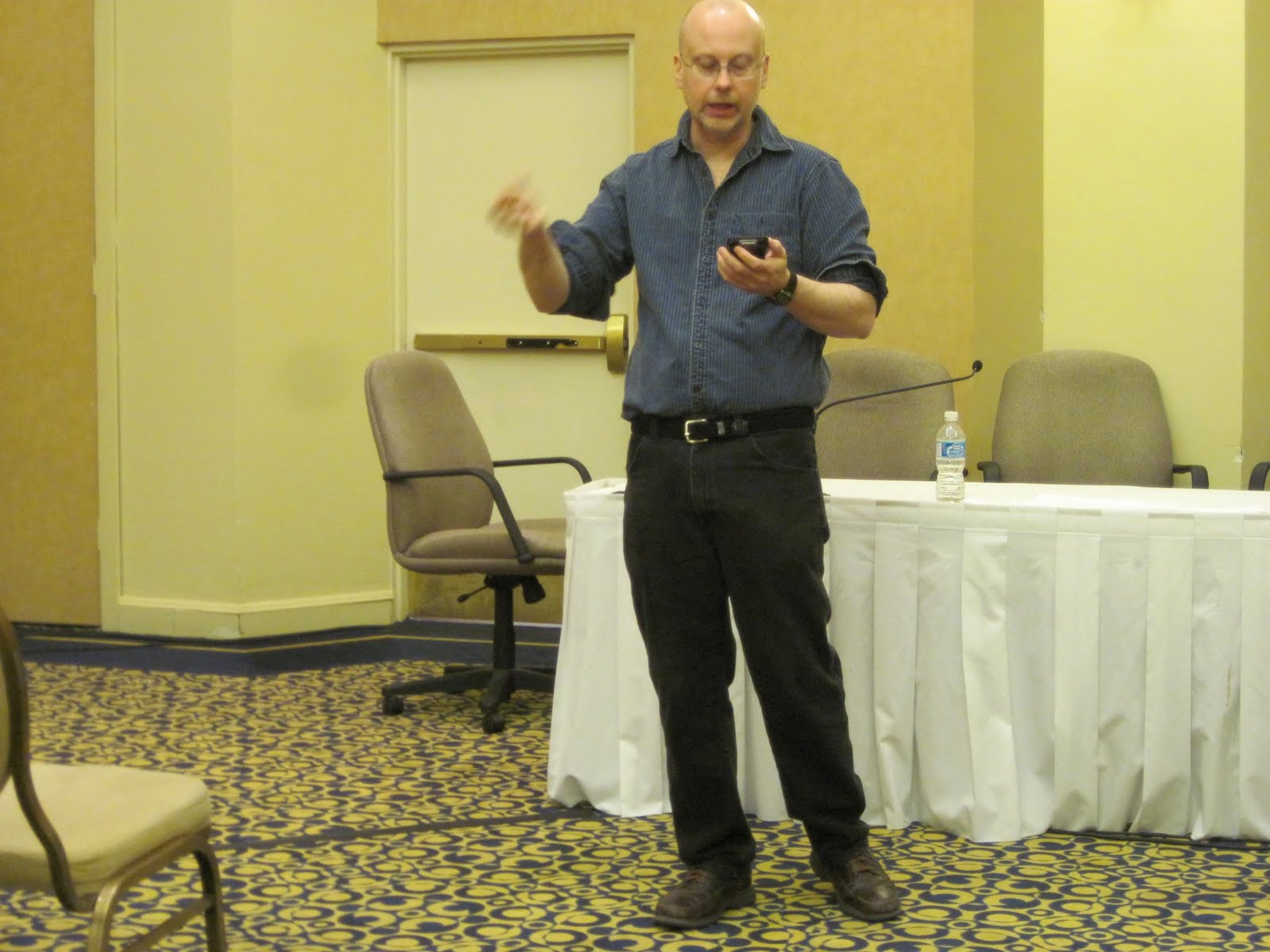 After taking the opportunity to float around the dealers' room (no fresh bumper stickers, regrettably), the next event I attended flowed seamlessly from the last - Robert J. Sawyer's Guest of Honour Hour, and it was devoted to the new series FlashForward, his involvement with it, and "why it seemed like a good idea at the time." He explained why the TV series ditched the original twenty-year flashforward for one only six months in the future - among other things, to avoid the necessity of artificially aging the cast, and to enable obvious seasonal discontinuities between the present and the future of the show.
"The usual Hollywood thing," he said, "is you get the rights, then you screw the author." Fortunately that hasn't happened in the case of FlashForward, and Sawyer is closely involved with the series. He read a couple of scenes from the script of the episode he wrote, scenes that ended up on the cutting room floor, which is unfortunate - the one of Lloyd Simcoe identifying his wife's body in a stadium full of dead bodies was powerful and "would've been really f'ing cool" if it had been filmed.
 After the hour was up, I traded the future for an intersection of the future and the past at Steamed to Perfection: A Steampunk Salon, where the gracious Lord Spector and lady adicat "parade[d] visiting dignitaries and the latest in steam inspired haute couture... pomp and pageantry guaranteed." There were characters from time travellers and Continental royalty to the nefarious Mr. Holocaust - who has yet to conquer so much as a Tim Horton's - and Lord Summerdown and Lady Grey, "genetic aberrations" fighting for justice. Mostly though, I liked the steampunk fashion. Plenty of goggles.
The Apocalypse Now panel that evening was the first regular panel I attended during the convention, and it was a trip back to the sort of thing I'd done at Anticipation - standing on the production floor of the idea factory. It looked at why apocalyptic themes seem to be so common now, and asked why they resonate the way they do and whether they reflect the tenuous social climate of the modern day. I'm not too sure about that - I agree more with one of the later points raised in the panel, that it's when society is relatively stable that people are willing to get apocalypses in their entertainment. After all, you didn't see too much end-of-the-world stuff during the Second World War, which is arguably the closest we've come to an apocalypse in terms of culture.
Sunday was my panel day, and for Sunday morning panels they were rather well attended. The first was one that's been eating at me ever since, Writing the Future with Matthew Johnson, Hayden Trenholm, and Karl Schroeder. What were the key points of it? For one, that the future is not just the past with better gadgets. When creating a future, it's easy to exaggerate just one thing and leave everything else utterly unchanged - which is bunk. People are collaborative. Things can change in unexpected ways. There's no such thing as absolute stasis, technological or cultural.
What I hadn't fully comprehended before I attended this panel, though, was that while disruptive and transformative technologies exist, the assumption that a technology will prove transformative by simple fact of its existence - or, alternatively, that an existing technology is not transformative because it hasn't disrupted society yet - is inaccurate. These things can lurk in the wings for years, waiting for the right climate to erupt. Take the automobile - while the idea of the modern suburb became technically possible as soon as Model Ts started rolling off the assembly lines, it wasn't until the end of the Second World War that the social and cultural climate existed to make it happen. Without the example of the Great Depression and lacking the Levittowns that sprang up to provide housing for veterans coming back from the battlefields, North American suburbanization may well have taken a different turn.
I'm not going to blame Hitler for that. But someone might eventually. Or, worse - as was pointed out at the Inventing Real People: History & Fiction panel - some people a few centuries down the line, some culture who's isolated from what he did, might try to rehabilitate him as a hero through the process of historical revisionism. Imagine a time traveller stepping into 2510 and finding statues of him, and people so innocently unaware of ancient history that they don't realize why this is a problem. It wouldn't be the first time a leader and conqueror has been put on a pedestal - just look at Alexander the Great.
It was a fine convention, and I had plenty of opportunities to think on that during the bus and streetcar ride back under an open blue sky. Next year, Ad Astra 2011 will be commemorating the convention's thirtieth anniversary - and in November, SFContario will add a new gathering to Toronto's calendar. I can say that, yeah, I'm looking forward to the future.
Previous Convention Reports
- Anticipation SF (Montréal)
- Ad Astra 2009 (Toronto)
Sunday, April 11, 2010
PDP #204: A Man of Steam-Powered Science
I've just returned from Ad Astra, Toronto's primary literary convention for science fiction and fantasy, and while it wasn't Worldcon it was stellar in its own right. As you might expect there was no shortage of costumed attendees, and given the course of recent trends, it should not come as a surprise that the steampunk aesthetic was common. Take, for example, this natty gentleman, who with some patience explained to me that he was a man of mad science and steam. I especially liked his mechanical spider pet. Or whatever it is.
 I, the copyright holder of this work, hereby release it into the public domain. This applies worldwide. In case this is not legally possible, I grant anyone the right to use this work for any purpose, without any conditions, unless such conditions are required by law.
 I, the copyright holder of this work, hereby release it into the public domain. This applies worldwide. In case this is not legally possible, I grant anyone the right to use this work for any purpose, without any conditions, unless such conditions are required by law.
Tuesday, August 25, 2009
To Your Scattered Panels Go: Anticipation
For an event oriented toward the world as a whole, it was surprisingly cozy. Anticipation SF - the 67th World Science Fiction Convention - was fairly lightly attended, with only a few thousand people navigating this way and that through the wide and very long halls of the Palais des congrès de Montréal in downtown Montreal, Quebec from August 6th to 10th. It was a place where one could easily find oneself sharing an elevator with Larry Niven or shaking hands with Cory Doctorow, and I should know, because that's what I found - among other things, to be sure.
This was the first time I've attended a Worldcon, and considering that the next two are in Melbourne and Reno, it may be the last for a while yet. It was the closest I've ever been to science fiction fandom as a unified force. Though its attendance was a drop in the bucket next to the Fan Expos and Comic-Cons of the world, that's all right with me. While I was at Worldcon I felt like I was rubbing shoulders with the genre as a whole, from its elite grandmasters down to everyday fen.

Everyone gets something different out of a convention. For some it's the costuming and masquerade, and others find themselves amid the crowded tables of the dealer's room. Personally, I was most interested in the panel discussion. There were panels held every day of the convention, from 9 AM to 10 PM - some even went head-to-head with the Hugo Awards presentation on Sunday night - and even if I had slept five hours a night and spent every waking moment in the Palais, I wouldn't have been able to attend all the ones I was interested in.
It wouldn't have been as fun of a convention either, at that rate. I'd have never been able to tour the Montreal Metro - but that's for another day.
 The panelists for Saturday's Is Climate Change Storyable? panel
Friday
The first panel I attended set the tone for much of what was to follow. Intellectual Property and Creative Commons, held on Friday the 7th at 10 AM, included Cory Doctorow among its panelists and he had a great deal to say, as well as a great many questions from the audience to answer. I'd not considered the idea of a Laffer curve in copyright, but from what the panel said meshes with my own experience, not to mention common sense - beyond a certain point, additional rights reserved to creators or rightsholders do not translate into a greater incentive to create.
Later that evening I attended the presentation for the 2008 Sidewise Awards for Alternate History, and compared to the Hugo Awards presentation ceremony two days later, it was brief and informal and, to me, reminiscent of what science fiction itself might have been like a few decades ago, before it hit the mainstream in a big way. It was nice. Only twenty-five people, approximately, were in attendance, and not even the two winning authors - Mary Rosenblum for "Sacrifice" and Chris Roberson for The Dragon's Nine Sons - were among them. Both were accepted by sf author and editor Lou Anders. The program had budgeted it an hour slot, but it wrapped up after fifteen minutes.
I came to the conclusion, while in that room, that I'd like to win a Sidewise one day. All I need to do is write something that's worthy of one.
Saturday
My first priority on Saturday was to tour the Montreal Metro, and that ate the whole morning. Once that was settled, I returned to the Palais for the Alternate Canadas panel, looking at alternate history in a specifically Canadian vein. This was the first of two panels I attended that included S.M. Stirling - who, when questioned on the Draka series, answered "I wrote that in law school. I was full of anger and hate." Which, if you've read or even heard of the Draka, explains a great deal.
What I took out of this panel is that there are a great deal of potential points of divergence, but only a handful of well-known ones. AHs that include, say, a successful Quebec referendum in 1980 or 1995, or the success of the Avro Arrow, tap into issues that are relatively familiar to the public at large. The way I see it, there is great potential in Canada's more obscure history. Possibilities like a Huguenot exodus to New France - which would have completely upended the manner in which Quebec and Canada developed - no expulsion of the Acadians, the settlement of Prince Edward Island by Norse seafarers in the 11th century, a Canada bilingual in English and Swedish, or the survival of Sir Isaac Brock and Tecumseh all have great potential, but are only rarely used because of the general lack of familiarity with Canadian history.
One thing that's always galled me is a tendency in science fiction to look gleefully into a future where cities are obsolete, and the people scatter like seeds into a new rural lifestyle made possible by new communication or transportation technologies - Sir Arthur C. Clarke had his personal helicopters, and Transhuman Space has the ubiquitous Web. The City of the Future panel took a long, hard look at this issue. The panelists traced possible roots of this idea to the immediate aftermath of the Second World War, when cultural nostalgia for vanished village life led to the increasingly common portrayal of cities as dystopias. I don't have any truck with that kind of belief, and it was refreshing to find that the panelists didn't seem to, either - cities are far more efficient in energy use per capita, and there's nothing more isolating than rural life. I learned that while travelling through Amaranth Township.
Sunday
The first panel I attended on the last full day of Worldcon flowed smoothly from the day before. Which Histories Get Alternates? was even better-attended than Alternate Canadas, and explored the same subject matter on a grander scale. One of the ideas presented was that the frequency of alternate histories that focus on the American Civil War or Second World War, and the lack of ones that explore differences in, say, the Napoleonic Wars or the First World War, stem from a lack of "blazing moral questions" in the latter two conflicts. It's easy to cast the Civil War as a war against slavery, and the Second World War as a war against Evil, and they're both intensely familiar to a story's potential audience. That doesn't mean writers and readers shouldn't try things they're not as familiar with, though.
Later that evening I shuffled to the Is Climate Change Storyable? panel, which is of particular interest to me. It's the sort of thing writers are going to have to acknowledge in their visions of the future, or those visions will soon look as anachronistic as stories set in 1999 which include a prominent Soviet Union and vacuum-tube computers. Geoffrey Landis was there, and his comment on potential mitigating solutions for climate change was instructive: "There are quick solutions, and they're usually stupid and wrong."
What issues are there to be explored with something like climate change? The panel discussion came up with a few - what happens when environmental Quick Fixes go awry, what happens if developing states "leapfrog" the 20th century, political and cultural issues that stem from the decentralization of power generation, or the consequences of the Midwest drying up due to water depletion - Landis advised Great Lakes cities like Chicago and Toronto and Montreal to start building walls now. I think he was only half-kidding.
Saturday night was dominated by the presentation of the Hugo Awards, held in the single largest room in the Palais and filled to the brim by most of Worldcon's attendees. I was there for a short while, but ducked out; I'd been on my feet most of the day, and I'm not really an awards-show kind of dude. It really was science fiction's Academy Awards, though, and the scope and scale was impressive.
 Monday, the final day of Worldcon, was more of a whirlwind for me. As we had to check out of our hotel room by noon at the latest, my roommate and I spent the last couple hours just hanging out in the Palais, like I'd seen so many people do beforehand. The last event I attended was a reading by Robert J. Sawyer, where he read a "prose poem" he did for the Harbourfront Centre and his short story "Mikeys." Once the applause came up, that was it for me, and I was hustling towards Place-d'Armes metro station to get to Berri-UQAM and the Central Bus Station on time.
It'll be difficult to forget, Montreal will. I just can't figure out, though, what the convention guide cover illustration - an anthropomorphic skunk playing hockey - has to do with Montreal.

Previous Convention Reports
This was the first time I've attended a Worldcon, and considering that the next two are in Melbourne and Reno, it may be the last for a while yet. It was the closest I've ever been to science fiction fandom as a unified force. Though its attendance was a drop in the bucket next to the Fan Expos and Comic-Cons of the world, that's all right with me. While I was at Worldcon I felt like I was rubbing shoulders with the genre as a whole, from its elite grandmasters down to everyday fen.

Everyone gets something different out of a convention. For some it's the costuming and masquerade, and others find themselves amid the crowded tables of the dealer's room. Personally, I was most interested in the panel discussion. There were panels held every day of the convention, from 9 AM to 10 PM - some even went head-to-head with the Hugo Awards presentation on Sunday night - and even if I had slept five hours a night and spent every waking moment in the Palais, I wouldn't have been able to attend all the ones I was interested in.
It wouldn't have been as fun of a convention either, at that rate. I'd have never been able to tour the Montreal Metro - but that's for another day.
 The panelists for Saturday's Is Climate Change Storyable? panel
Friday
The first panel I attended set the tone for much of what was to follow. Intellectual Property and Creative Commons, held on Friday the 7th at 10 AM, included Cory Doctorow among its panelists and he had a great deal to say, as well as a great many questions from the audience to answer. I'd not considered the idea of a Laffer curve in copyright, but from what the panel said meshes with my own experience, not to mention common sense - beyond a certain point, additional rights reserved to creators or rightsholders do not translate into a greater incentive to create.
Later that evening I attended the presentation for the 2008 Sidewise Awards for Alternate History, and compared to the Hugo Awards presentation ceremony two days later, it was brief and informal and, to me, reminiscent of what science fiction itself might have been like a few decades ago, before it hit the mainstream in a big way. It was nice. Only twenty-five people, approximately, were in attendance, and not even the two winning authors - Mary Rosenblum for "Sacrifice" and Chris Roberson for The Dragon's Nine Sons - were among them. Both were accepted by sf author and editor Lou Anders. The program had budgeted it an hour slot, but it wrapped up after fifteen minutes.
I came to the conclusion, while in that room, that I'd like to win a Sidewise one day. All I need to do is write something that's worthy of one.
Saturday
My first priority on Saturday was to tour the Montreal Metro, and that ate the whole morning. Once that was settled, I returned to the Palais for the Alternate Canadas panel, looking at alternate history in a specifically Canadian vein. This was the first of two panels I attended that included S.M. Stirling - who, when questioned on the Draka series, answered "I wrote that in law school. I was full of anger and hate." Which, if you've read or even heard of the Draka, explains a great deal.
What I took out of this panel is that there are a great deal of potential points of divergence, but only a handful of well-known ones. AHs that include, say, a successful Quebec referendum in 1980 or 1995, or the success of the Avro Arrow, tap into issues that are relatively familiar to the public at large. The way I see it, there is great potential in Canada's more obscure history. Possibilities like a Huguenot exodus to New France - which would have completely upended the manner in which Quebec and Canada developed - no expulsion of the Acadians, the settlement of Prince Edward Island by Norse seafarers in the 11th century, a Canada bilingual in English and Swedish, or the survival of Sir Isaac Brock and Tecumseh all have great potential, but are only rarely used because of the general lack of familiarity with Canadian history.
One thing that's always galled me is a tendency in science fiction to look gleefully into a future where cities are obsolete, and the people scatter like seeds into a new rural lifestyle made possible by new communication or transportation technologies - Sir Arthur C. Clarke had his personal helicopters, and Transhuman Space has the ubiquitous Web. The City of the Future panel took a long, hard look at this issue. The panelists traced possible roots of this idea to the immediate aftermath of the Second World War, when cultural nostalgia for vanished village life led to the increasingly common portrayal of cities as dystopias. I don't have any truck with that kind of belief, and it was refreshing to find that the panelists didn't seem to, either - cities are far more efficient in energy use per capita, and there's nothing more isolating than rural life. I learned that while travelling through Amaranth Township.
Sunday
The first panel I attended on the last full day of Worldcon flowed smoothly from the day before. Which Histories Get Alternates? was even better-attended than Alternate Canadas, and explored the same subject matter on a grander scale. One of the ideas presented was that the frequency of alternate histories that focus on the American Civil War or Second World War, and the lack of ones that explore differences in, say, the Napoleonic Wars or the First World War, stem from a lack of "blazing moral questions" in the latter two conflicts. It's easy to cast the Civil War as a war against slavery, and the Second World War as a war against Evil, and they're both intensely familiar to a story's potential audience. That doesn't mean writers and readers shouldn't try things they're not as familiar with, though.
Later that evening I shuffled to the Is Climate Change Storyable? panel, which is of particular interest to me. It's the sort of thing writers are going to have to acknowledge in their visions of the future, or those visions will soon look as anachronistic as stories set in 1999 which include a prominent Soviet Union and vacuum-tube computers. Geoffrey Landis was there, and his comment on potential mitigating solutions for climate change was instructive: "There are quick solutions, and they're usually stupid and wrong."
What issues are there to be explored with something like climate change? The panel discussion came up with a few - what happens when environmental Quick Fixes go awry, what happens if developing states "leapfrog" the 20th century, political and cultural issues that stem from the decentralization of power generation, or the consequences of the Midwest drying up due to water depletion - Landis advised Great Lakes cities like Chicago and Toronto and Montreal to start building walls now. I think he was only half-kidding.
Saturday night was dominated by the presentation of the Hugo Awards, held in the single largest room in the Palais and filled to the brim by most of Worldcon's attendees. I was there for a short while, but ducked out; I'd been on my feet most of the day, and I'm not really an awards-show kind of dude. It really was science fiction's Academy Awards, though, and the scope and scale was impressive.
 Monday, the final day of Worldcon, was more of a whirlwind for me. As we had to check out of our hotel room by noon at the latest, my roommate and I spent the last couple hours just hanging out in the Palais, like I'd seen so many people do beforehand. The last event I attended was a reading by Robert J. Sawyer, where he read a "prose poem" he did for the Harbourfront Centre and his short story "Mikeys." Once the applause came up, that was it for me, and I was hustling towards Place-d'Armes metro station to get to Berri-UQAM and the Central Bus Station on time.
It'll be difficult to forget, Montreal will. I just can't figure out, though, what the convention guide cover illustration - an anthropomorphic skunk playing hockey - has to do with Montreal.

Previous Convention Reports
Subscribe to:
Posts (Atom)